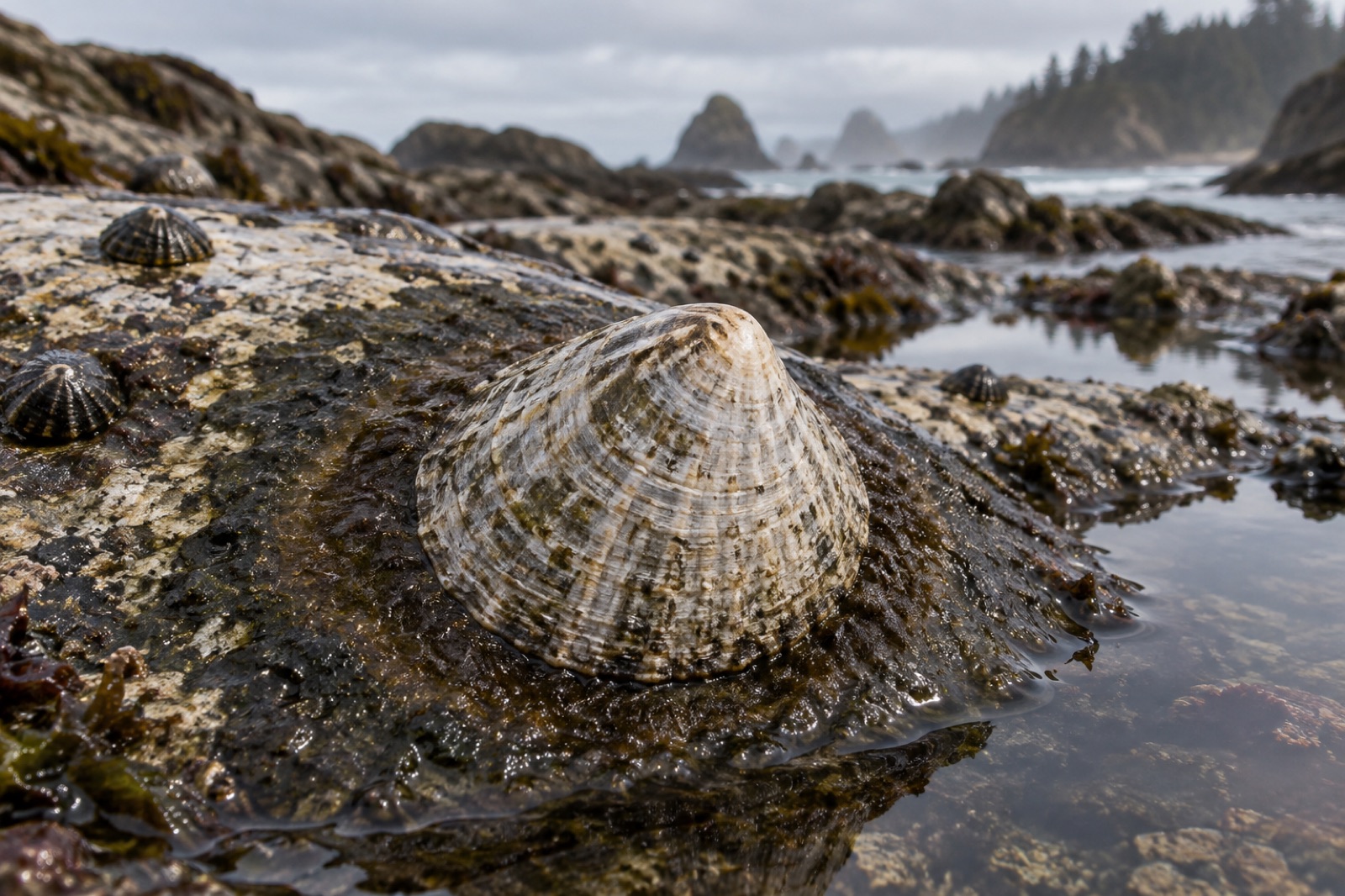
If there is a more beautiful two-centimetre animal in the North Atlantic, it is hiding well. The blue-rayed limpet (Patella pellucida) is a small, thin-shelled limpet that lives its entire adult life on kelp — and across its amber, translucent shell run dotted lines of living electric blue, as if the animal had been wired with fibre optics. In a real sense, it has: those rays are one of the most elegant examples of structural colour in the sea, produced by microscopic layers of the shell that catch, channel and return blue-green light. Small, slow and easy to miss, the blue-rayed limpet is also a genuine force on Europe's kelp forests — in autumn, in dense years, the grazing of this little snail helps decide which kelp survives the storms.
Fast facts
|
|
| Scientific name |
Patella pellucida |
| Group |
True limpet, family Patellidae (gastropod mollusc) |
| Shell length |
Commonly 1–2 cm; large adults reach about 2.5 cm |
| Range |
Northeast Atlantic: Arctic Norway to the Iberian Peninsula, and into the western Mediterranean |
| Habitat |
On the fronds and stipes of subtidal kelps, especially the forest-forming laminarians |
| Diet |
Kelp tissue and surface biofilm, scraped with a radula |
| Lifespan |
Short for a limpet — typically around two to three years |
A shell that makes light
Most shells get their colour from pigment. The blue-rayed limpet gets its from physics. Its thin, oval shell — a flattened cone in translucent amber-brown, crossed by rays of bright blue-green spots or dashes — contains stacked, precisely spaced calcium carbonate layers that selectively reflect blue wavelengths, the same interference principle behind a butterfly wing or an oil-slick rainbow. Researchers examining the shell at microscopic scale found the aligned lineages of blue structures can even guide light along the band like a crude optical fibre — a shell that works as a living waveguide.
Why build that? The honest answer is that nobody knows for certain. The most persuasive hypotheses dispute the obvious reading that blue is camouflage, since the rays glow against the kelp rather than hiding the animal; they may instead act as a signal — to mates, or, more interestingly, to predators as a kind of warning or confusion display — or the structure may simply cool or strengthen the thin shell, with the optical fireworks riding along for free. Either way, underwater on a kelp stipe, the limpet reads as what it is: a small jewel of the understory, easy to overlook until light hits it right and the shell ignites.
Life on the kelp
The defining fact of this species is its address. Blue-rayed limpets live on the kelp itself, not on the rock beneath it, and different stages of life use different parts of the plant:
- Juveniles settle on kelp fronds, especially the broad, fast-growing blades of species like sugar kelp, where they graze surface films and the kelp's outer layer. The frond habitat is a nursery — abundant, well-lit, and disposable: laminarian kelp sheds fronds seasonally, and a limpet that stayed on a blade would be discarded with it.
- Adults move down to the stipe, the kelp's stem, and particularly onto the big, rough-skinned stipes of tangle kelp (Laminaria hyperborea, and its relatives). Here the limpet excavates a shallow home pit, pressing its shell rim into a depression on the stipe surface that it enlarges by grazing and chemical erosion, returning to the same pit between foraging excursions just as rock limpets do on shore.
Marine biologists long distinguished two forms — a smooth-shelled form living on thin-bladed kelps and a heavier, ribbed form on Laminaria hyperborea stipes — before recognising them as growth stages and ecotypes of one flexible species, which adjusts its shell to its substrate.
The economy of a kelp stipe
A stipe is crowded real estate. Blue-rayed limpets share it with bryozoans, tube worms, hydroids, the burrowing sponges that perforate old stems, and the pressure of a dozen grazers — a layered epiphyte community riding every plant. In calm, rich years blue-rayed limpets reach remarkable densities on Laminaria hyperborea — tens and, on favoured beds, hundreds of individuals per stipe — and their collective rasping thins the outer stipe tissue meaningfully.
This produces one of the species' most consequential ecological effects, one well documented on European coasts: heavily limpet-grazed stipes break. When autumn gales arrive, weakened, pit-eroded stipes snap, and dense populations of the limpet are understood to contribute measurably to the seasonal turnover of old tangle kelp. In a sense, the little grazer is part of the forest's pruning machinery, tipping the calculus that decides which old kelp plants the winter takes — a microscale version of the disturbance regime that structures whole forests, the way storms decide how waves shape reefs at grander scale.
Reproduction and a fast, bright life
Blue-rayed limpets breed in the colder months, with gametes released into the water column; the fertilised eggs develop as planktonic veliger larvae that ride coastal currents for a short season before settling on kelp fronds. The species is catholic about its first home — new settlers appear on several laminarian species and even on other surfaces — and then, as they grow, the individuals migrate down to stipes of the big forest kelps, where they adopt the sedentary, pit-keeping life of adults.
The life cycle is compressed compared with long-lived shore limpets. Blue-rayed limpets race: they grow fast, breed within a year or two, and most are gone by three, replaced by the next recruitment. This gives populations a pronounced boom-and-bust character — a grazer year of dense, stipe-bending abundance can be followed by seasons in which the limpet thins to a scattering, tracking the recruitment lottery of its planktonic young and the fortunes of the kelp beds themselves.
Where to find it, and how to look
Anywhere on the northeast Atlantic coasts where Laminaria hyperborea or Saccharina kelps stand — western Britain and Ireland, Norway's outer skerries, Brittany's great laminaria beds — a diver in the shallow subtidal can find blue-rayed limpets by slowing down and turning over the inspection. The method is to follow a tangle kelp stipe from its holdfast upward, looking for the small amber domes with, under torchlight, that giveaway glint of blue. On winter shore walks they wash ashore still attached to storm-torn kelp; look on stipe segments cast up after gales along beaches downcurrent of the kelp beds of Brittany and Scotland's west coast.
The etiquette follows the stipe rule: admire, photograph, leave attached. These limpets live on a living substrate; detaching one from its pit destroys a home the animal built over many months, on a kelp plant that is itself still growing.
Why it matters to kelp science
For kelp ecologists, the blue-rayed limpet matters out of all proportion to its two centimetres. It is a window into the condition of the forest: limpet density, pit depth, and proportion of stipes inhabited are all indicators used in assessing kelp bed health and age structure, in work from Norway to Portugal. Dense limpet infestation correlates with old, stable forest; the absence of limpets on bed after bed suggests beds too disturbed — by storm scour, by trawling in some places, by shifting temperature — to mature their stipes. As European kelp shifts under warming — the same class of pressure that has retressed the kelp's southernmost European coasts — monitoring this small, beautiful snail gives scientists a living gauge of the forest's age and stability.
And there is the plainest reason of all: when you can persuade divers, students and beachcombers to stop and stare at a two-centimetre limpet's blue neon lines, you have taught the first, most important lesson of the kelp forest — that its wonder is concentrated at every scale, and that even its tiniest residents do real work in keeping the forest standing, and eventually, letting it fall.
Key takeaways
- The blue-rayed limpet (Patella pellucida) is a small Atlantic limpet that lives its adult life on kelp stipes, marked by iridescent blue-green rays produced by structural colour in its shell.
- Juveniles settle on kelp fronds; adults migrate to stipes, where they excavate home pits and graze kelp tissue and biofilm.
- At high densities, collective grazing weakens stipes and contributes to storm-season kelp turnover — a small animal with a real structural role in the forest.
- It completes its life in around two to three years, with larvae linking populations of kelp beds across regions.
- Limpet presence and density are working indicators of kelp forest age and stability for European reef monitoring.
FAQ
What makes the blue rays on the shell?
Not pigment but structure: microscopic, precisely stacked layers of calcium carbonate in the shell act as multilayer reflectors, selectively returning blue-green light — the same physical trick as a butterfly's wing. Under a torch at night the rays can seem to light up.
Does the limpet harm the kelp it lives on?
In balance, it is part of the normal economy of the forest. Everyday grazing is minor; in boom years dense populations significantly thin stipes and likely help storms snap aging kelp, which is itself part of the forest's renewal cycle — though a stressed forest losing plants prematurely is a different matter.
Where is the best place to see one?
Shallow subtidal kelp beds on the Atlantic coasts of Norway, Scotland, Ireland and Brittany. After autumn and winter storms, check storm-cast kelp stipes on nearby beaches — the limpets often go ashore still gripping their rides.
Yes — it is a true limpet of the family Patellidae, kin to the armoured intertidal species like the owl limpet of Pacific shores, but adapted to a mobile lifetime on kelp rather than a rock scar, with a thinner shell matched to a life carried by the plant rather than battered by surf.
How long do blue-rayed limpets live?
Fast, for limpets — most individuals live about two to three years, racing through settlement, stipe migration, breeding and a single generation's worth of home-pit building in a compressed, luminous life.