Encyclopedia8 min read
Grass Rockfish: The Kelp Bed's Stealth Hunter
Meet the grass rockfish (Sebastes rastrelliger): a shallow-water ambush predator that barely leaves home — and pays for that loyalty when the pressure comes.
Dr. Mara Ellison ·
The brown rockfish is the shallowest of the Pacific rockfish — a dusky, bay-loving homebody of kelp beds, pier piles and eelgrass edges from Alaska to Baja.
Ask a marine ecologist which rockfish tolerates a boat harbour, brackish surface water and a pier piling, and the answer is the brown rockfish (Sebastes auriculatus). While its dozens of Sebastes cousins hold deep rock and offshore reef, the brown rockfish has specialised in the shallowest, murkiest, most human-adjacent slice of kelp country — and made a homebody's success of it. It is the rockfish you are most likely to meet in water barely deeper than a dive flag, and one of the most faithful fish on the coast.
| Scientific name | Sebastes auriculatus |
| Family | Scorpaenidae (scorpionfishes), the rockfish genus Sebastes |
| Maximum size | To about 56 cm; most encountered are 20–40 cm |
| Colour | Mottled dark brown to copper-olive, often with pinkish blotches; a dark blotch on the gill cover is the classic mark |
| Depth range | Very shallow — intertidal pools and 2–40 m, occasionally to around 120 m |
| Distribution | Northeast Pacific: from Prince William Sound, Alaska, to northern Baja California |
| Diet | Shrimp, crabs, small fish and other crustaceans hunted around structure |
| Lifespan | Long — aged fish past 25 years; slow-growing like its kin |
Rockfish identification is famously humbling; the brown rockfish helps slightly. Look for a mottled, dusky brown fish with a pale belly and irregular coppery or pinkish wash, holding tight to structure in shallow water. The definitive mark is a dark, almost black blotch on the rear of the operculum — the fish's "dark ear." It is visible at diver distance on a settled fish.
Confusion species include the copper rockfish, which runs lighter with a clear lateral-line band, and the grass rockfish, a smaller, more plainly freckled kelp-bed specialist. The brown sits between them in build and backs it up with habitat: piled rock, dock structure and kelp holdfast tangles in water an otter could wade through.
The genus Sebastes spans the shelf from tide's edge to the deep slope, but almost every member leans deeper with age. The brown rockfish leans the other way. It is routinely the shallowest rockfish present on a given coast — found in eelgrass margins, under bull kelp rafts, along breakwater rock and around piers, and famously tolerant of the warm, brackish, silty conditions of enclosed bays. In Puget Sound and San Francisco Bay it is the resident rockfish in water that other species treat as transit.
That tolerance is physiological as much as habitual: brown rockfish handle the wide swings of temperature and salinity that shallow embayments throw at anything resident. It lets them own habitat with little competition from deeper relatives — the trade being that enclosed, shallow, urbanised water is exactly where human pressure concentrates.
Even by rockfish standards, brown rockfish do not move. Acoustic tagging studies of bay populations have found individuals holding home ranges of a few hundred square metres, sometimes for years — fish that could be said to have a favourite piling. Adults settle after a pelagic larval phase and then commute, at most, between a daytime resting structure and a night feeding patch.
The consequences mirror those of its deeper cousins, sharpened:
Like all rockfish, the brown is viviparous: females brood internally fertilised eggs and release live larvae, typically in spring to early summer. The larvae drift and develop in the plankton for one to two months — short by rockfish standards, which suits a shallow-water life — before settling to eelgrass, algae and shallow rock, often within the same embayment system their parents never left. It is the same strategy outlined across the genus in our guide to how reefs are colonised by drifting larvae, here run on the shortest leash.
Adults feed mostly by night and dusk on shrimp, crabs, gammarids and small fishes disturbed from the bottom — an ambush rhythm any night diver over a harbour reef can watch in a torch beam.
The brown rockfish occupies the exact band of water where kelp restoration happens: the shallow subtidal edge where holdfasts take and fronds first reach light. That makes it one of the first fish metrics that responds when structure and canopy return. Our own nearshore transects — run from Drifter survey vessels and by diver teams — log young-of-year brown rockfish as an early signal that a restored patch is functioning as nursery habitat, often within two seasons of canopy closing.
It is also an equity species, in a way fish rarely get credit for: the brown rockfish is the Sebastes of public piers, shore snorkels and school dock programs, the rockfish the most people can actually meet. A fish this loyal to shallow structure is a fish a community can genuinely steward — the same logic that drives our solutions work with coastal communities.
Anywhere shallow, structured and slightly scruffy on the Pacific coast: pier pilings and breakwaters at Monterey Bay, kelp-edged rock in Puget Sound, eelgrass-to-kelp transitions all down the outer coast. Go shallow — 3 to 15 m is prime — move slowly along the structure, and look for the dusky fish sitting still with the dark ear. The rest of the shallow-kelp fish cast is profiled in the fishes group of our Encyclopedia.
Depth and colour are the first cues: browns hold very shallow, run darker, and show the dark opercular blotch; coppers are typically found deeper, look lighter along the lateral line and show a pale band there.
Exceptionally shallow for the family — from intertidal pools and a couple of metres of water down, with most of the population in the 2–40 m band. Their ability to tolerate bay conditions is what opens this zone to them.
No. They are live-bearers: females release brooded larvae into the plankton, usually in spring, and juveniles settle to shallow algae, eelgrass and rock after a few weeks to two months adrift.
Yes. As a site-loyal shallow specialist, it colonises restored rock and canopy quickly and its young-of-year counts give an early, honest read on whether a restored patch functions as nursery habitat.
Piers, breakwaters and rocky shore snorkel sites across the range — Puget Sound's shore reefs and Monterey's harbour edges are classic. Snorkel shallow, slow and close to structure.
Meet the grass rockfish (Sebastes rastrelliger): a shallow-water ambush predator that barely leaves home — and pays for that loyalty when the pressure comes.
Dr. Mara Ellison ·
The copper rockfish (Sebastes caurinus) is a cryptic, long-lived, home-ranged reef fish of Pacific kelp forests. Biology, fishery history and how it recovers.
Dr. Mara Ellison ·
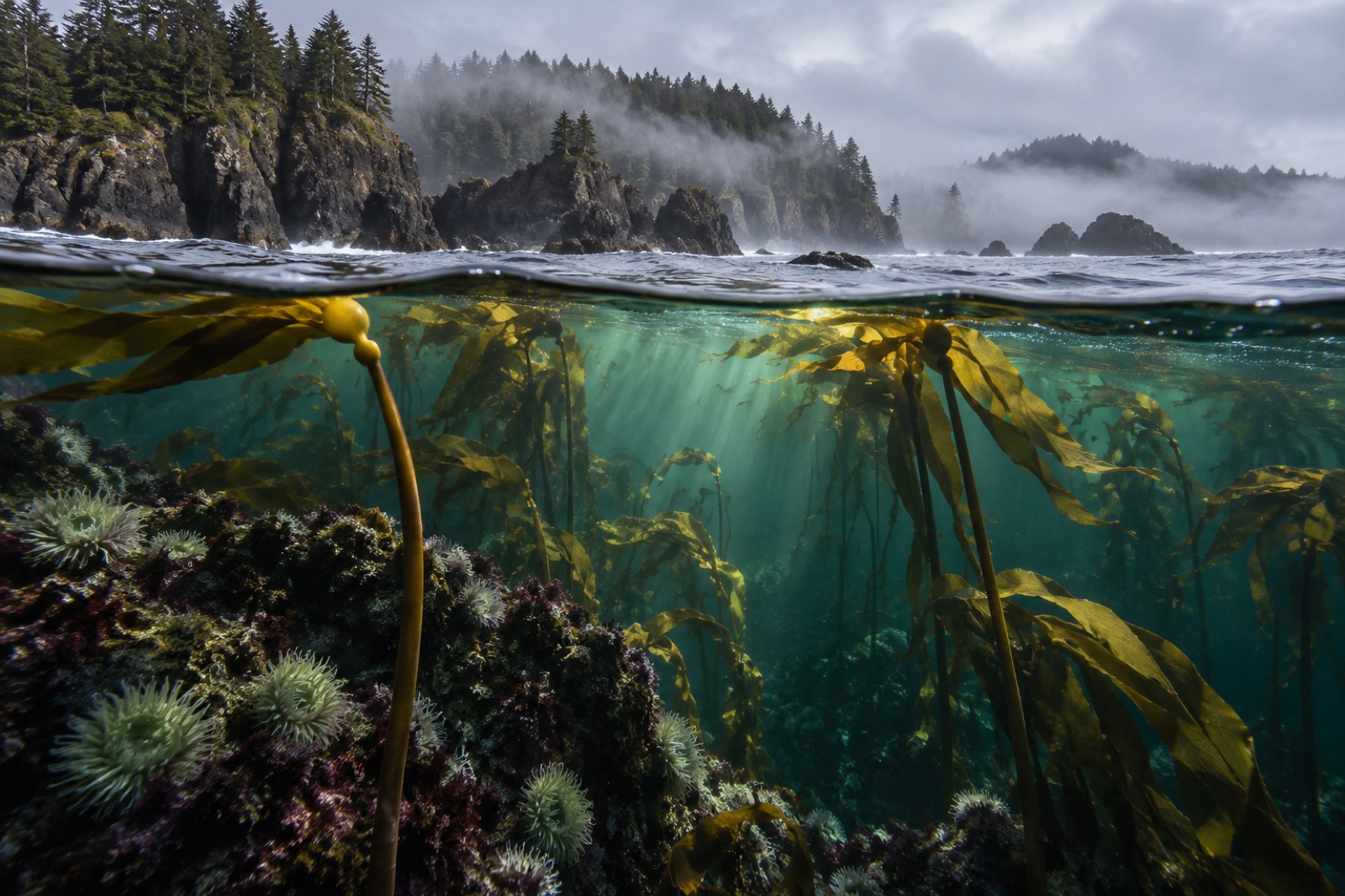
An island-wide guide to Vancouver Island's kelp forests: bull kelp surf coasts, sea otter recovery, and the First Nations stewardship shaping their future.
Tom Okafor ·