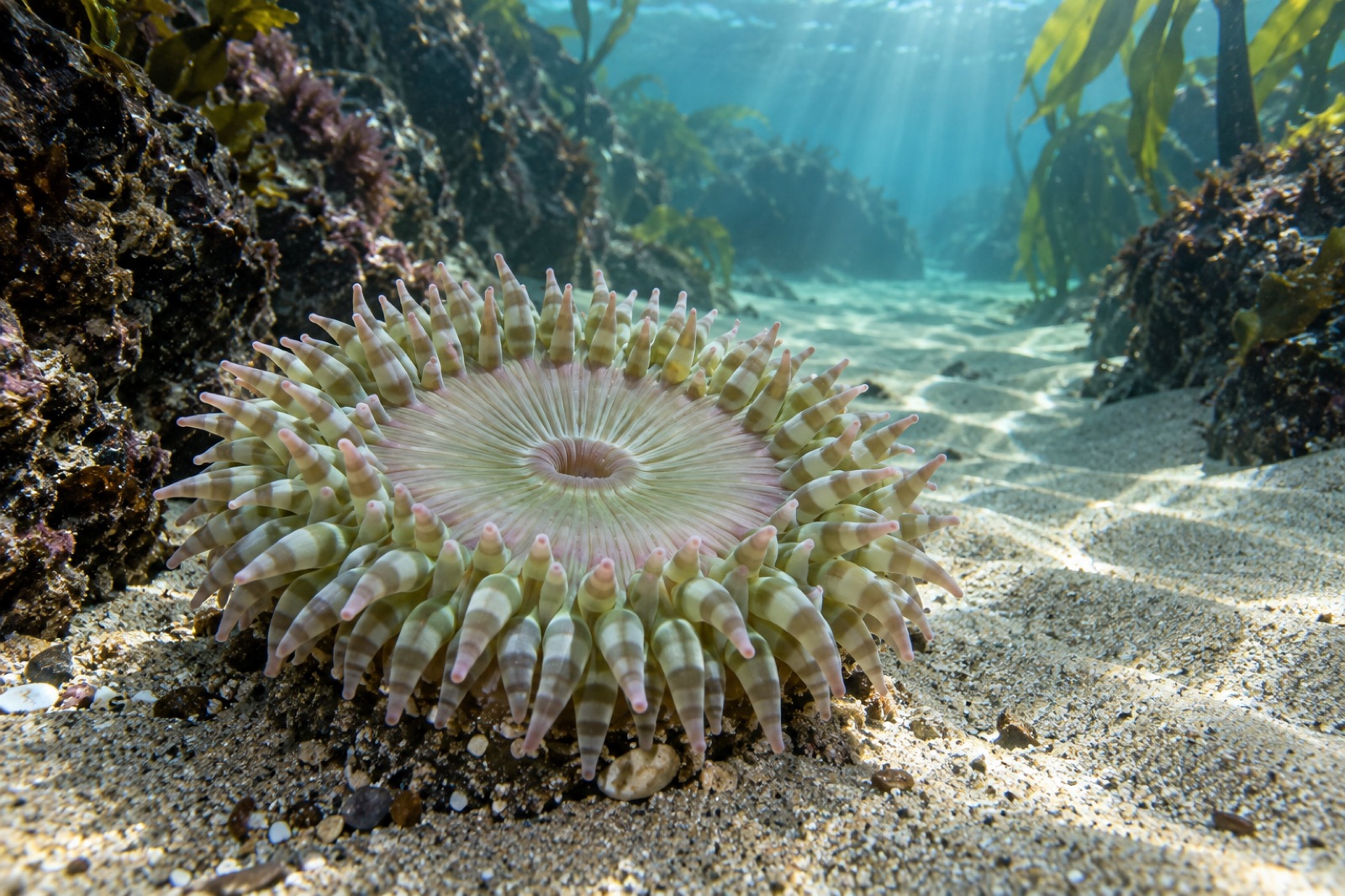
Some anemones advertise themselves. The moonglow anemone does the opposite: it hides most of its body in the ground. On a low tide along the Pacific coast of North America, what looks like a bare patch of wet sand between rocks may open, underwater an hour later, into a broad, banded flower of tentacles — a disc the size of a small saucer that seems to float on the sediment with no animal beneath it at all. There is one, of course. The column of Anthopleura artemisia is sunk into sand, gravel or the sediment pocket under a rock, armoured in stuck-on shell grit, and the animal can vanish downwards entirely, pulling its tentacles in and letting its gravel coat close over it like a trapdoor. It is one of the most overlooked large anemones on the coast precisely because it is so good at not being seen.
Fast facts
|
|
| Scientific name |
Anthopleura artemisia |
| Group |
Sea anemone, class Anthozoa, phylum Cnidaria |
| Size |
Oral disc to about 10 cm across; column taller than wide, mostly buried |
| Lifespan |
Solitary polyps live for years; growth and exact longevity are poorly documented |
| Depth range |
Mid and low intertidal to shallow subtidal, in sediment pockets among rock |
| Range |
Eastern North Pacific, roughly Alaska to southern California |
| Status |
Common but undercounted; easy to miss unless you know where to look |
Anatomy of a buried animal
The moonglow anemone solves a problem its rock-dwelling cousins never face: how to be a soft-bodied cnidarian in a shifting, abrasive, occasionally scouring substrate. Its answer has three parts.
First, the column. Unlike the smooth or warty but exposed column of the aggregating anemone, the moonglow's column carries rows of adhesive bumps called verrucae, and it uses them aggressively. Sand grains, broken shell and tiny pebbles stick to the verrucae until the whole buried column is wearing the sediment it sits in — a coat of gravel that serves as camouflage, abrasion armour and ballast all at once. Dig one out carefully (don't, unless it's for permitted research) and the animal that emerges is twice the length of anything you saw above the surface.
Second, the disc and tentacles. The oral disc is broad and often pale, marked with radiating lighter lines, ringed by several rows of short, conical tentacles. Those tentacles are usually conspicuously banded — alternating rings of pale and darker tissue, sometimes with pinkish or greenish tints — which is one of the best field marks for separating a moonglow from its relatives. Underwater, in moving light, an open disc can read as a soft moon against dark sand; the common name is apt.
Third, the retreat. A moonglow can deflate, invert its disc, and pull the whole tentacled crown down inside the sediment-fast column. At low tide on drained sand, what remains topside may be no more than a gravel-coated lump or a crater-like dimple — easy to step past, or on. Patient observers who settle beside a drained specimen and wait for the returning tide get the full reveal: the gravel cap opens like a lens cap and the banded tentacles unfold into the current.
Where it lives — and how to actually find one
Moonglow anemones occupy the seams of the shore: places where rock and sediment meet. Look for sand-filled channels between rock ridges, gravel pockets in the lee of boulders, the sediment aprons at the base of rock walls, and the sandy floors of mid-to-low intertidal pools. Anywhere sediment accumulates against hard substrate from Alaska to California is potential habitat. Individuals are solitary — unlike the clone-carpets of A. elegantissima — but a good sand channel may hold several, spaced an arm's length apart.
Finding them is an exercise in reading texture. Scan the sand for circles: a slight crater with a closed, gritted centre is a retracted animal; a cluster of banded tentacles emerging from apparently clean sediment is a feeding one. On calm days, shadows help — tentacles cast fine moving shadows on the bright sand beneath them. The fieldcraft is the same slow-looking that rewards tidepool exploration everywhere, but tuned to sand rather than rock.
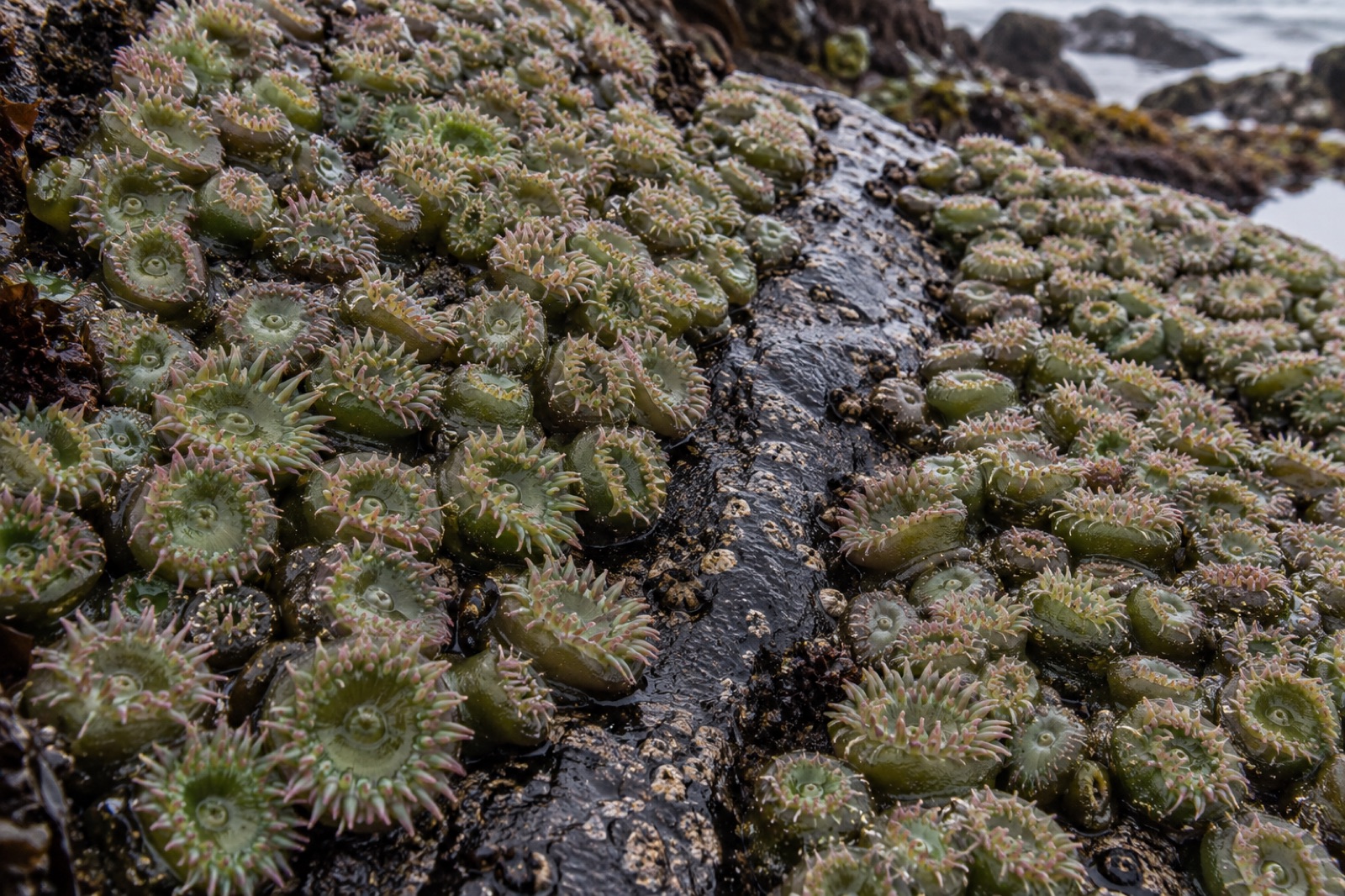
One honest caution: the moonglow shares its range and even its genus with two frequently confused relatives. The giant green anemone (A. xanthogrammica) sits on open rock, has a smooth, bright green column free of debris, and is far larger. The aggregating anemone lives in dense clones with acrorhagi and clone borders. If your animal is alone, buried to the disc in sediment, and wearing a coat of stuck-on gravel, it is almost certainly artemisia.
Diet, symbiosis and a quiet predator problem
Like most large anemones, the moonglow is a sit-and-wait carnivore with a photosynthetic side income. Its stinging tentacles take small crustaceans, planktonic larvae and organic particles delivered by the surge, and its tissues host symbiotic algae that pay a sugar dividend when the animal holds its disc open to the light — one reason it feeds in sunlit, shallow sand seams rather than under dark ledges, and why sun-exposed individuals tend to run greener than shaded ones.
Burial buys safety from most of the shore's usual hazards — desiccation, wave shock, casual grazers — but not from everything. The leather star, a soft-skinned sea star with a taste for anemones, can and does prey on buried Anthopleura, and specialist nudibranchs also attack anemones of this genus. The moonglow's defence is depth and armour rather than the warrior castes of its aggregating cousin: a gravel-coated column sunk in scouring sediment is simply a hard thing to eat.
Reproduction is conventional compared with the clone wars next door. Moonglow anemones spawn gametes into the water column, and their larvae disperse in the plankton — the ocean's standard lottery ticket — before settling into a new sediment pocket and starting the slow work of growing a column worth hiding. Fission happens occasionally, but the great carpets of genetically identical polyps that define elegantissima are not this species' strategy. Each moonglow is, more or less, one animal, one hole, one life.
Why this species matters to shore-watchers
The moonglow anemone is a reminder that intertidal biodiversity is not confined to rock. Sediment habitats among rocks carry their own assemblage — burrowing anemones, sand dollars, tube worms, ghost shrimp — and these creatures are systematically under-recorded because they live where casual tidepooling doesn't look. Community-science platforms regularly log A. artemisia as an "unexpected" find by new observers, which says more about observer habits than about the anemone's abundance.
For kelp-coast ecosystems, the moonglow is a marginal-forest neighbour rather than a resident: it occupies the sandy channels and sediment aprons that braid between kelp-forested reefs. Those borders matter. Sand-edge habitat is where many reef fishes feed at slack tide, where juvenile flatfish settle, and where sand-channel predators like the Pacific electric ray hunt. A healthy moonglow population is a small but genuine sign that a coast's sediment seams are intact — undredged, unarmoured and still shifting the way shorelines are supposed to shift.
Key takeaways
- The moonglow anemone (Anthopleura artemisia) is a solitary, sediment-buried anemone of the Pacific coast from Alaska to southern California.
- Its column is sunk in sand or gravel and armoured with debris stuck to adhesive verrucae; the broad, often pale disc with banded tentacles is the best field mark.
- It retracts completely beneath its gravel coat at low tide, leaving only a crater or gritted lump — which is why it is so often overlooked.
- It combines stinging-tentacle carnivory with photosynthetic symbionts, and its predators include anemone specialists like the leather star.
- Unlike the aggregating anemone, it does not form clone carpets: one hole, one animal.
- Healthy moonglow populations signal intact sand-and-rock seam habitat along kelp coastlines.
FAQ
How do I tell a moonglow anemone from a closed aggregating anemone?
Look at the substrate and the company. Aggregating anemones live on rock in dense clusters of tiny clones; a moonglow sits alone in sediment, and even retracted it is broader and wears a coat of stuck-on gravel. If you can see banded tentacles, it's a moonglow.
Is the moonglow anemone dangerous to touch?
Its sting is designed for small prey and is not considered harmful to people, but the rule that protects the shore's animals and your hands alike is the usual one: look, don't handle. Retracted animals are especially vulnerable to being stepped on or pried out.
Why is it green in some places and brownish in others?
Colour tracks its symbiotic algae and its sun exposure. Animals feeding openly in sunlit sand seams host more photosynthetic symbionts and run greener; shaded or deeply buried individuals look browner. It's the same symbiosis logic as the giant green anemone, dialled down.
Does it ever move?
Yes — slowly. Like other anemones it can creep on its pedal disc and will relocate if scoured out or buried by storm deposition, but its life is overwhelmingly sedentary. The "buried anemone" strategy depends on finding one good hole and keeping it.
Where along the shore should beginners look?
Mid-to-low intertidal sand channels between rock ridges on a calm minus tide. Find an area where clean sand meets reef, slow down, and scan for circles and banded tentacles. Once you've seen your first open disc, you'll start seeing the closed craters everywhere too.