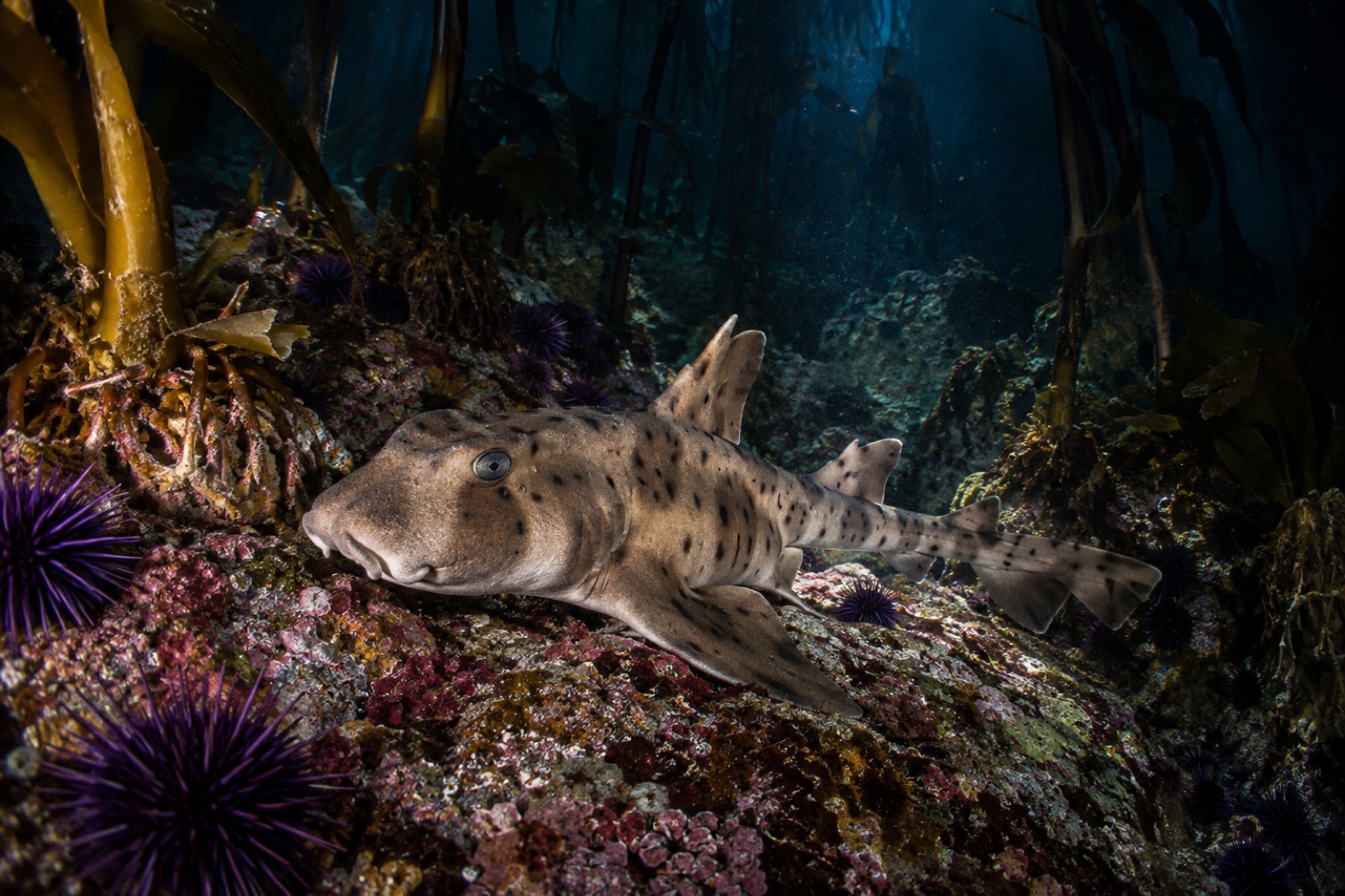
There is a soundless report when the sand flat wakes up on a night dive: a shape the size of a dinner platter for most of the year — and a trash-can lid at full maturity — rises off the bottom between the kelp-covered rocks, and the water around it carries something that is not quite water. Meet the Pacific electric ray (Tetronarce californica, long known as Torpedo californica), the only electric ray of the temperate west coast of North America, a slug-slow, night-hunting specialist that carries a genuine weapon in its wings — up to roughly 50 volts of discharge, enough to punch through a wetsuit and bring a diver's intention to meet it to an immediate close.
Fast facts
|
|
| Scientific name |
Tetronarce californica (formerly Torpedo californica) |
| Group |
Electric ray, family Torpedinidae, class Chondrichthyes |
| Size |
Commonly to ~0.9 m; maximum about 1.4 m and 40+ kg in exceptional females |
| Lifespan |
Long-lived for a ray; ages of two decades and beyond estimated in tagged animals |
| Depth range |
Recorded shallow to very deep (~900 m), but commonest on sandy margins at 10–200 m |
| Range |
Eastern Pacific: British Columbia to Baja California and the Gulf of California |
| Status |
Not threatened; uncommon to locally common; occasionally taken as bycatch |
The living battery
The electric ray's defining machinery lies pair-fused into its broad pectoral disc. On each side of the head, between the smooth skin and the body wall, sits a kidney-shaped electric organ built of hundreds of vertical columns, each column a stack of thousands of thin disc-shaped cells called electrocytes — a natural battery pack, literally stacked cells, modified from branchial muscle and wired for series discharge. A resting ray waiting for prey is a charged instrument.
When it fires, the discharge is a brief pulse of something on the order of 45–50 volts of direct current at extremely short duration — enough to stun prey outright and, on a grabbed or provoked animal, to deliver a numbing, unforgettable wallop to any animal (or diver) in the circuit. Physically large individuals carry proportionately more power; the current is felt most sharply in salt water only within a close radius of the animal, because salt water is conductive and the field spreads.
The skill is as old as the ray lineage: ancient Greeks knew torpedo rays well enough that Roman physicians employed living rays' shocks as a clinical remedy for headache and gout — the word torpedo is Latin for stiffness and numbness. The Greeks gave the fish the name narke — from which we get "narcosis" — and the modern genus Tetronarce carries the same memory.
Built like a dumpling, hunting like a trap
A Pacific electric ray in daylight, which is the only way most divers ever see one, looks like the least threatening animal on the coast: a plump, round, velvety disc, dark slate-grey to chocolate above and clean white beneath, sitting half-buried in the sand or slumped motionless in a rock cleft. The tail is short and stout with two triangular dorsal fins arranged back-to-back near its end; the eyes are small and bogglingly mild; there is no spine, no stinger, and nothing about it that suggests a weapon. This is camouflage by understatement.
By night it changes registers completely. The electric ray is a nocturnal, slow-stalking predator of the sand channels between kelp-covered reefs, hunting small schooling fishes and other prey drawn to the dark margin: anchovies, small herring, smelt, juvenile flatfishes, squid where available. Its kill depends on the charge rather than the chase. Approaching prey from below or alongside, it lunges and wraps the thick disc around the victim — the wings closing like a broad fist — and floods the enclosure with discharge. The prey, stunned mid-water, is then walked down the animal's short snout and swallowed. Shrimp-small animals are eaten whole at a sitting; large individuals have been documented taking fishes of startling relative size this way, including occasional sizeable bottom fishes.
Rays avoid waste. The rest of their armoury is quiet: rows of small, flat teeth for gripping stunned prey, and the usual elasmobranch senses — ampullae of the snout reading muscle-twitch through the dark, smell, touch — running the hunt until electricity finishes it.
Where it lives, and who it lives with
The Pacific electric ray is a resident of the wide continental shelf from southern British Columbia south through the kelp latitudes of California into Baja California and the northern Gulf of California. It keeps to soft bottom: sand, mud and shell flats at the fringe of every kelp reef, moving between channels freely — evening up the sand slope, morning down the deep edges, or vice versa according to season. Divers find big ones ploughed nearly flush into the bottom on Catalina's sand flats, in Monterey's inside channels, and near Point Loma's deep reef edge, often just a silhouette-scale tan ghost against the sand.
In this habitat it shares the night-shift roster with the horn shark, the Pacific angel shark, and the big bat ray — a guild of slow, unhurried workers of the post-sunset bottom, each on its own prey, each indifferent to the rest. Daylight brings out its opposite: the leopard sharks and smoothhounds sweeping the shallows in numbers.
Reproduction: a slow ray doing slow things
Like most rays, the Pacific electric ray is an aplacental viviparous species — commonly but slightly misleadingly called "live-bearing." Eggs complete their development inside the mother, nourished first by yolk and then by a uterine fluid the embryos consume until birth; litters are moderate — up to about 15–20 pups in large females. Newborns arrive in shallow nursery grounds as perfect, miniature-electric-equipped juveniles with their own modest discharge from day one.
Growth is slow, maturity late, and lifespans long: the standard elasmobranch bargain. In a ray with this little natural pressure on adults and this few offspring per year, the pattern points, as it so often does, to a species that is durable in a stable ocean and vulnerable in a shaken one.
What to do when you meet one
This is the practical section, because eventually you will. A few guidelines:
- Leave it room. The electric ray is not aggressive — no confirmed case of a provoked-into-attack habit exists in divers' records — but it is armed. Do not corner it, do not grab it, do not slide your hand between it and the bottom, and do not poke at it for a photograph.
- Read the posture, not the look. A resting ray half-buried in sand or wedged in a rock cleft is not sleeping; it is a charged animal choosing stillness. If it swims up toward you from the bottom in daylight, treat that movement as escalation and angle away.
- Observe the etiquette of the night shift. On night dives in kelp country, electric rays are often the surprise encounter — a big grey shape emerging from your beam's edge. Stay off the bottom, keep the light low and indirect, and let it pass.
- If you are shocked, surface calmly and exit the water; the effect is a sharp, intensely localised shock with numbness rather than lasting injury, but call it a day and let a jellyfish-bumped swim buddy know what happened.
See the fishes section of our encyclopedia for other rays and sharks of these waters, from the big skate to the swell shark.
Key takeaways
- The Pacific electric ray (Tetronarce californica) is the only electric ray of the North American west coast's temperate latitudes, from British Columbia to Baja California.
- Its paired electric organs — stacks of electrocytes built into the pectoral disc — deliver discharges around 45–50 volts in large animals.
- It hunts at night in the sand channels beside kelp reefs, wrapping prey in its disc and stunning it with electricity before swallowing.
- It is a slow-growing, late-maturing, long-lived, live-bearing species — the classic elasmobranch life-history bargain.
- Divers can observe it safely by observing the rule of the night shift: keep your distance and let it work.
FAQ
How strong is the Pacific electric ray's shock?
Large animals are reported to deliver around 45–50 volts of direct current — enough to stun fish prey outright and to numb a human arm that gets between the ray and its circuit. The shock is brief and localised, and in salt water falls off quickly with distance.
Can a Pacific electric ray kill a person?
There are no confirmed records of a Pacific electric ray killing a person, and it has no venomous spine. A shock close-range can be dangerous for someone with an underlying cardiac condition or in deep water where disorientation matters, so treat the species respectfully; the practical dive advice is distance.
Do electric rays glow or spark when they fire?
No — the discharge is entirely electrical and invisible. The only signs are behavioural: the ray's shape contracts slightly at the moment of discharge, and any animal in contact with it shows an immediate startle-or-stun response.
How is the electric ray different from a stingray?
Completely different weapon. Stingrays defend with a venom-bearing barb on the tail; the electric ray's tail is unarmed — its electricity, generated in the wings, is a primary hunting weapon used to stun prey, not merely a defence. The two rays are also not close relatives.
Where is the best place to see a Pacific electric ray?
Sandy channels and flats on the inside of rocky reefs through Southern and Baja California — Point Loma, Catalina, the Channel Islands and Monterey Bay in the north — especially on night dives. Daylight searchers look for the ray's full-body imprint half-buried in sand.