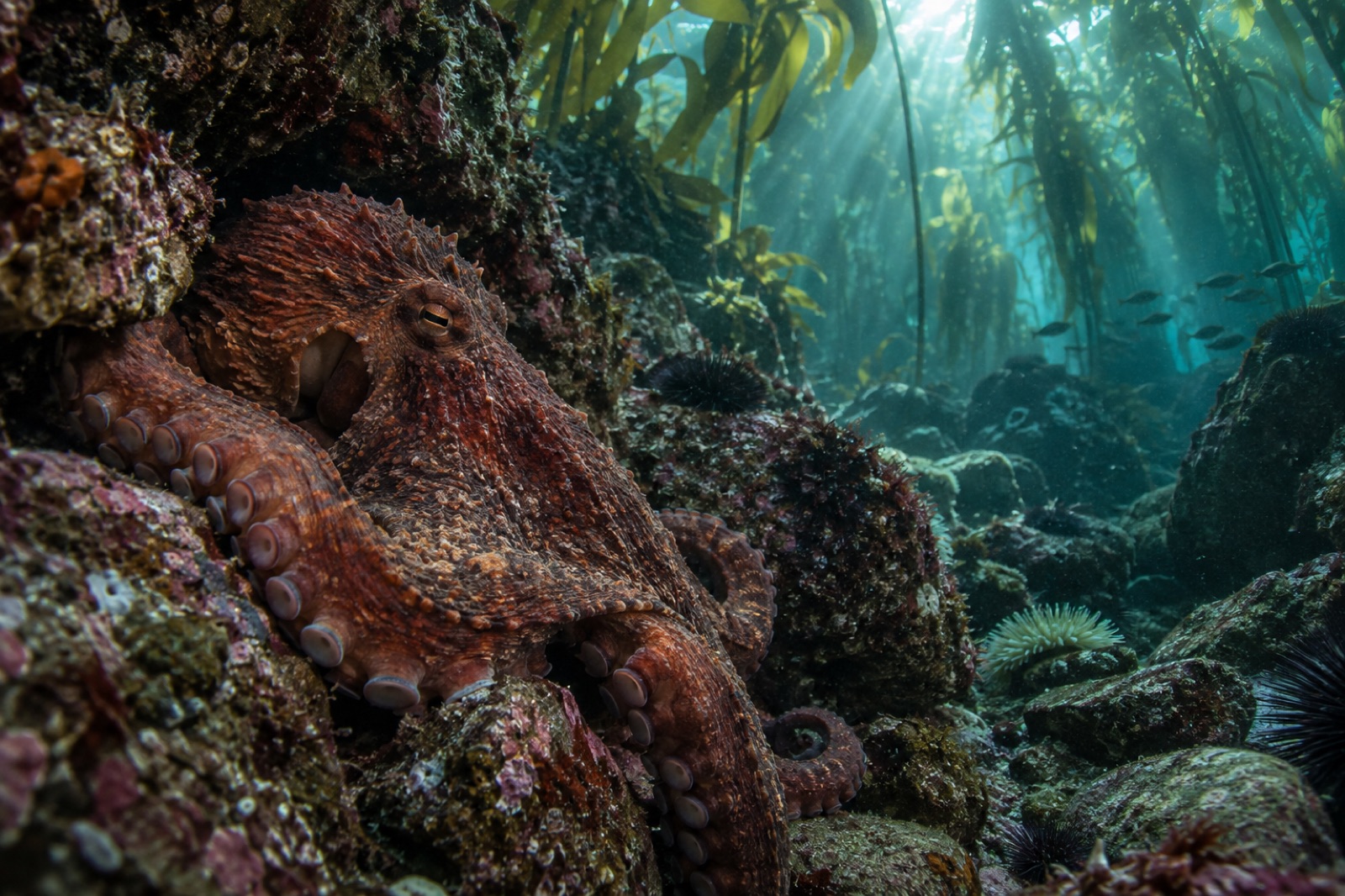
The East Pacific red octopus (Octopus rubescens) is the kelp forest's pocket mastermind: a cephalopod the size of two cupped hands that lives in rocky dens from the Gulf of Alaska to Baja California, solves problems with a brain wrapped around its throat, and vanishes into a rock face by changing colour, texture and outline in a fraction of a second. Divers meet it constantly, often without realising — because the red octopus's first defence is to look like something you would swim straight past.
If you know where to look, though, the red octopus announces itself. The clue is the rubbish.
Meet the little red
In a forest dominated by giants — kelp plants 30 metres tall, octopus cousins heavier than a child — Octopus rubescens is resolutely small. An adult's mantle, the muscular sac behind the eyes, is roughly the length of a thumb, and the whole animal with arms outstretched spans about 40 centimetres. It shares its range with the enormous giant Pacific octopus, and telling the two apart is easy: if the octopus in front of you could fit inside a breadbox, you are looking at a red.
Up close, the species earns its name. The resting colour is a warm brick red or russet brown, and the skin carries permanent small papillae — muscular bumps that give the animal a faintly fuzzy, tweed-like texture. Three little flap-like papillae below each eye, like tiny eyelashes, are one of the most reliable field marks for identifying the species underwater. That texture is not fixed. The skin's papillae can be raised or flattened at will, so the same octopus can go from pebble-smooth to ragged-as-barnacles in moments.
A den with a rubbish heap
Red octopuses live alone, each in a private crevice — a crack between boulders, a gap beneath a ledge, an abandoned pipe or bottle if one is handy. The den is barely larger than the animal, which suits a creature whose only hard part is its beak.
The giveaway is the midden. Like its giant cousin, the red octopus eats in bed and sweeps the scraps out the door: crab claws, snail shells, urchin spines, clam plates. A wreath of shell fragments at the mouth of a crevice is as close as the species comes to a nameplate, and experienced divers scan for middens the way birders scan for nests. The constant through-line of the clean-out behaviour tells you something important: this animal has a fixed address, a mental map of its hunting ground, and a strong preference for home.
Hunting from the front porch
Red octopuses hunt mostly at dusk and at night, flowing arm over arm across the reef with the tips probing every crack. The diet runs heavily to crabs, shrimps and snails, supplemented by small fish. The technique is patience wrapped around a crevice: an arm slides into a gap until the tip touches something edible, then the animal either hauls the prey out or pours its whole body in after it. Subdued prey gets a bite from the parrot-like beak, which delivers venomous saliva that begins to immobilise and pre-digest the meal — standard octopus equipment, though utterly harmless to a diver who leaves the animal alone.
Night is when the species is easiest to watch. On a kelp forest night dive, a red octopus caught in the edge of a torch beam will often freeze in plain sight, texture fully cranked, trusting its camouflage even under direct light.
The fastest costume change in the forest
All octopuses camouflage; small octopuses depend on it, because almost everything bigger than a boot is a potential predator. The red octopus's skin is studded with chromatophores — pigment sacs ringed with muscle, each under direct nervous control — layered over reflective cells that handle blues, greens, whites and iridescence. The result is a canvas the animal can repaint in well under a second: brick red against red algae, bone white over pale sand, a mottled collage on broken shell hash.
The transformation is not just colour. With papillae raised and arms drawn into angular positions, the octopus compresses into a convincing lump of encrusted rock. With skin smoothed and arms trailing, it becomes drifting weed. The arms themselves are tools of deception, capable of mimicking the swaying motion of algae fronds or the stiff reach of a sponge while the animal edges sideways in plain view.
And if theatre fails, there is the standard cephalopod exit: a blast of water from the siphon, a cloud of ink, and a red streak into the nearest hole.
A short, fierce probation
The red octopus lives fast. Its entire lifespan is around two years, and its biology treats adult life as a countdown. Both sexes mate, and then the female retires to a den and festoons its roof with strings of eggs — each a tiny, rice-grain capsule hanging by a stalk, a few hundred in total.
For the next several weeks she does not leave. She fans the eggs with fresh water, grooms away sediment and bacteria, and defends the cluster against everything that comes sniffing. She does not eat. Other parents in the kelp forest, like the brooding fathers of kelp greenling, at least graze nearby; the female red octopus simply spends herself. By the time the eggs hatch into planktonic paralarvae — miniature drifting octopuses that spend weeks riding the currents before settling to the bottom — their mother is dying, and she does not recover. Semelparity, the one-and-done reproductive strategy, runs the whole octopus family, but in such a small species the sacrifice is stark: the entire adult biomass of a red octopus converts into a single cloud of drifting young.
Brains in eight places
Octopus nervous systems are built differently from ours, and the red octopus is a full demonstration of the architecture. Roughly two-thirds of an octopus's neurons are not in its central brain but distributed through its arms, each of which carries enough local computing to explore, taste and manipulate with eerie independence. Watch a red octopus grope a cluster of mussels and you are watching eight semi-autonomous investigators filing reports to a central executive that decides what the reports mean.
In aquariums, rubescens individuals learn routes, distinguish between human keepers, unscrew containers to reach food and develop recognisable temperaments — some shy, some brazen, some greedy. Keepers who work with the species describe them as quicker to engage than their giant cousins, and quicker to scheme. This intelligence is not a party trick; on the reef it is how a soft-bodied snack survives among lingcod, wolf eels, seals and sea lions that all hunt the same crevices. Even its own kind is a hazard — red octopuses are documented cannibals, and the giant Pacific octopus takes them when it can.
Why this small strategist matters
No one conducts a formal census of red octopuses, and the species is not managed, fished or formally listed. But ecologically it sits at a busy intersection of the kelp forest food web. As a predator it prunes the crab and snail populations that otherwise graze young kelp and disturb new reef growth; as prey it converts those crabs and snails into meals for the forest's top hunters. Warm-water years appear to squeeze its range northward from Baja, which makes it one of the many species whose fortunes track the marine heatwaves reshaping these reefs.
It is also, frankly, one of the great gateway animals of temperate diving. A diver who has watched a red octopus reshape itself over crab-midden gravel has learned the essential kelp forest lesson: the most extraordinary things here are small, patient and pretending to be rocks.
Key takeaways
- The East Pacific red octopus (Octopus rubescens) is a small kelp-forest octopus — about 40 cm across — found from the Gulf of Alaska to Baja California, usually brick red with a fuzzy texture and three small flaps below each eye.
- Look for its den by the midden: a scattered apron of crab claws and shells is the species' signature.
- It changes colour and skin texture in a fraction of a second using nerve-controlled pigment cells, and it hunts crabs, shrimp and snails mostly at night.
- It lives only about two years; a female tends one brood of eggs without eating and dies as they hatch into planktonic paralarvae.
- Most of its neurons live in its arms, making it one of the reef's most capable problem-solvers — and one of its most popular prey items.
FAQ
How big does the East Pacific red octopus get?
Not big. The mantle is around 8–10 cm long and the whole animal spans roughly 40 cm with arms extended, typically weighing well under half a kilogram. Anything large enough to fill a scuba diver's embrace is a giant Pacific octopus instead.
Is the red octopus dangerous to divers?
No. Like all octopuses it has a beak and venomous saliva used to subdue prey, but the species is small, shy and non-aggressive. Bites to people are essentially unheard of; the realistic risk is that the octopus inks and flees if handled.
Where am I most likely to see one?
On rocky reefs and among boulder fields in kelp country throughout California and the Pacific Northwest, especially at dusk or on a night dive. Search at eye level along ledges and cracks for piles of broken crab shell — the midden marks the doorstep.
How can you tell a red octopus from a young giant Pacific octopus?
Giant Pacific juveniles are generally stockier, with smoother skin and two white spots that develop on the head region; reds carry the three small papillae below each eye and a consistently bristlier texture. Size at maturity settles it: a full-grown red is barely bigger than a GPO's egg-laying female's eye.
What eats the red octopus?
Lingcod, wolf eels and other large crevice-hunting fish, harbour seals and sea lions, and its bigger octopus relatives — including its own species. Its camouflage, ink and jet escape exist because the list of predators is long.