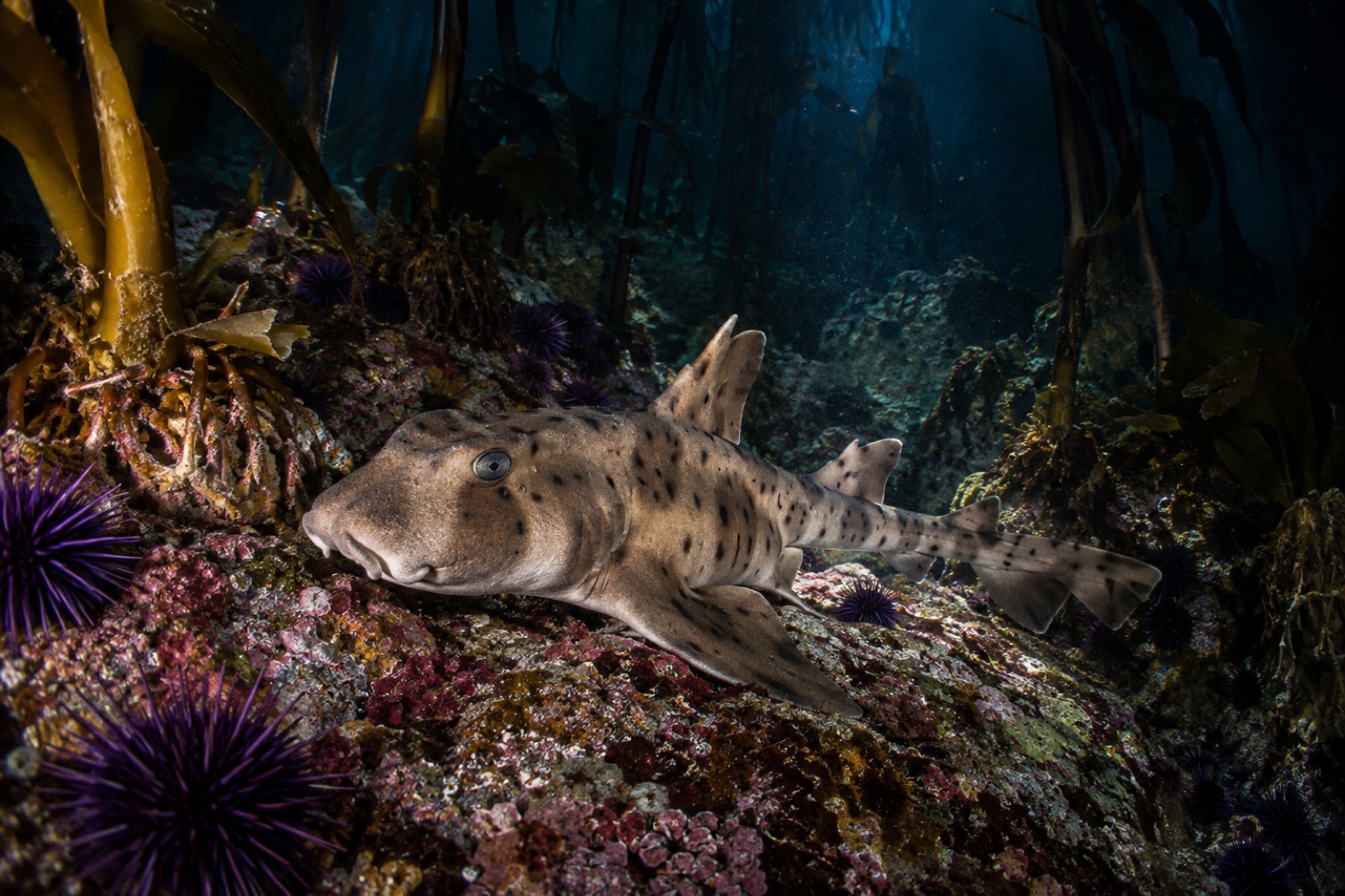
The Pacific angelshark (Squatina californica) looks like a shark that gave up halfway through becoming a ray. Flattened to the shape of a serving platter, winged with broad pectoral fins, camouflaged in mottled sand-brown, it spends its days buried to the eyeballs in sediment at the edges of California's kelp forests — waiting. When a fish drifts into range, the angelshark erupts out of the sand in a strike measured in fractions of seconds, inhaling prey with jaws that project forward like a trap. It is one of the strangest and most efficient hunters on the temperate Pacific coast, and its modern history — a crash in the 1980s, a recovery since — is one of the quiet conservation successes of the California kelp coast.
Quick facts
|
|
| Scientific name |
Squatina californica |
| Common names |
Pacific angelshark, California angel shark; simply "monkfish" in old market usage |
| Range |
Eastern Pacific, from southeastern Alaska to Central America, including the Gulf of California; most abundant off southern and central California |
| Habitat |
Sandy and muddy bottom near kelp beds, reefs and canyon rims, from the shallows to over 150 m |
| Size |
Commonly 1–1.2 m; large females can approach 1.5 m |
| Lifespan |
Likely a few decades; slow-growing, like most bottom sharks |
| Diet |
Bottom and mid-water fishes, squid, crustaceans — croakers, flatfishes and small rockfishes are typical prey |
| Reproduction |
Gives birth to live pups (aplacental viviparity) after a long gestation; modest litters |
Identification: not a ray, however hard it tries
The first question every diver asks is whether they are looking at a shark at all. The giveaway is in the fins. A ray's pectoral fins fuse to the head into a continuous disc; an angelshark's pectorals attach at the body but leave the head free, ending in distinct notches behind the gills. The gill slits lie along the sides of the head, not underneath as in rays. The tail is a shark's tail — narrow-based with proper lower lobes — and twin dorsal fins sit far back on it.
Everything else is ambush machinery. The eyes sit on top of the head, flanked by the spiracles — enlarged breathing pores that let the shark pump water over its gills while buried. The mouth faces forward, fringed with small whisker-like barbels that sense the bottom. The colour is a near-perfect sand-fleck mottle; an angelshark at rest is visible mostly as two eyes and a coin-edged outline, and often not even that.
Among its kelp-coast relatives it is unmistakable in shape: the torpedo-shaped leopard shark cruises openly, and the nocturnal horn shark is a squat, blunt-snouted reef crawler. The angelshark alone is built to disappear.
How it hunts: the sand trap
Ambush predation is an energy budget. Rather than cruise for food like most sharks, the angelshark invests almost nothing in swimming and everything in patience and acceleration. It selects its spot with care — typically the sand adjacent to rocky reef or kelp, often along a channel edge, canyon rim or other fish thoroughfare — settles, and fans sediment over itself until only eyes and spiracles show. There it can sit by day and hunt by dusk and night, sometimes holding the same station for days.
The strike, when it comes, is one of the faster movements on the reef bed: the head snaps upward, the protrusible jaws shoot forward well ahead of the snout, and a small cavern of suction opens around the prey. Croakers flashing over sand at night, juvenile flatfish, market squid drawn down toward the bottom — anything of manageable size entering the kill zone is fair game. Prey fish face a brutal asymmetry: the angelshark is nearly impossible to see until the moment seeing it stops mattering.
For a dive-mapped sense of this habitat, the sandy channels among the kelp at Catalina's Casino Point are classic angelshark ground, and the Channel Islands generally hold some of the best remaining densities.
A caution for divers: leave it buried
Angelsharps are placid to a fault until they are not. Undisturbed, they ignore divers entirely; they do not flee, because flight is not their strategy — camouflage is. But a shark that is touched, grabbed, or herded can deliver a fast, defensive snap with a mouthful of needle teeth it has every capability to back up. The rule on the kelp coast is simple and absolute: observe from beside it, never above it, and never put a hand on it. A watched angelshark does nothing at all, which is itself the privilege — you are witnessing one of the reef's most invisible residents, visible.
Decline and comeback: a California case study
Through the early 1980s, the opening of the California halibut trawl and gillnet fisheries overlapped almost perfectly with angelshark habitat in the Southern California Bight. Flat, bottom-dwelling and slow to reproduce, the angelshark was exquisitely catchable and inherently vulnerable, and landings spiked then collapsed within the decade. It became the case study in how quickly a coastal bottom-shark can be fished down: a fishery can grow around a species and remove most of it before anyone totals the receipts.
The recovery is the second half of the story. Nearshore gillnet restrictions in California waters and the closure of key trawl grounds — part of the broader tightening of state fishery management — removed most of the killing pressure, and the slow arithmetic of shark life history began running the other direction. Divers and survey teams began reporting angels back on old grounds through the 2000s and 2010s, including famously healthy sightings at Catalina. Population rebound of a bottom shark is rare on this coast; the angelshark's is real, instructive, and worth protecting a second time.
Why kelp forests need their buried sharks
It is easy to file the angelshark as an oddity — a weird flat shark that does nothing most of the time. But stationary top predators do ecological work. They remove weak, sick and careless fish from the reef's base, they shape where prey fishes dare to forage, and their nightly strike zone is one more pressure keeping the sandy-edge community honest. A kelp forest with its layers of predators intact — otters at the top, rockfish in the water column, hidden sharks in the floor — is a kelp forest with its regulation intact. The layers are studied in our piece on trophic cascades in kelp forests.
Key takeaways
- The Pacific angelshark is a flattened, sand-burying ambush shark of the eastern Pacific, most abundant off southern and central California.
- Tell it from rays by its free pectoral fins, side-facing gill slits and true shark tail with two rear dorsal fins.
- It hunts by invisibility: buried at kelp and reef edges by day, erupting on fish and squid by night with protrusible jaws.
- Trawl and gillnet overlap collapsed the population in the 1980s; fishery closures allowed a genuine, diver-visible comeback.
- Divers must never touch or corner one: a defensive bite is the shark's only second strategy.
FAQ
Is the Pacific angelshark dangerous?
Not to a diver who leaves it alone. It has no interest in humans as prey, and encounters almost always end with the shark motionless. The real risk is a defensive bite if the animal is grabbed, stepped on or cornered — which is why the rule is look, photograph if you like, and keep your hands and feet clear.
Where can I see one?
Off southern and central California: the sandy flats bordering kelp beds and reefs, notably around the Channel Islands and Catalina, and along canyon rims. Look for the giveaway — two eyes and a faint outline on open sand near the reef edge — ideally between about 5 and 30 metres down.
How does it breathe while buried?
Through the spiracles: large openings behind the eyes that draw water in and across the gills without the shark having to swim or open its mouth. Spiracles are standard equipment for bottom sharks and rays, and they are why an angelshark can sit under the sand indefinitely, fully oxygenated and invisible.
What does it eat?
Whatever bottom and mid-water prey comes within the strike arc: flatfishes and croakers, small rockfishes, plainfin midshipman, squid and larger crustaceans. At dusk its effective menu expands as reef fish start moving between sand and shelter.
Did angelsharks really recover?
By current-diver and survey standards, yes — sightings on historical grounds have rebuilt substantially since the fishing restrictions of the 1990s. Recovery isn't the same as ceiling: a slow-maturing bottom shark remains easy to overfish, and the continued protection of nearshore nursery and ambush habitat is what keeps the comeback compounding.