Encyclopedia8 min read
Eastern Blue Groper (Achoerodus viridis): Species Profile
Meet the eastern blue groper, the friendly, urchin-crunching giant wrasse of New South Wales reefs — every adult blue male began life as a female.
Dr. Theo Nakamura ·
Meet the western blue groper — Western Australia's giant blue wrasse of the kelp reefs, an urchin-eating patriarch that can live more than half a century.
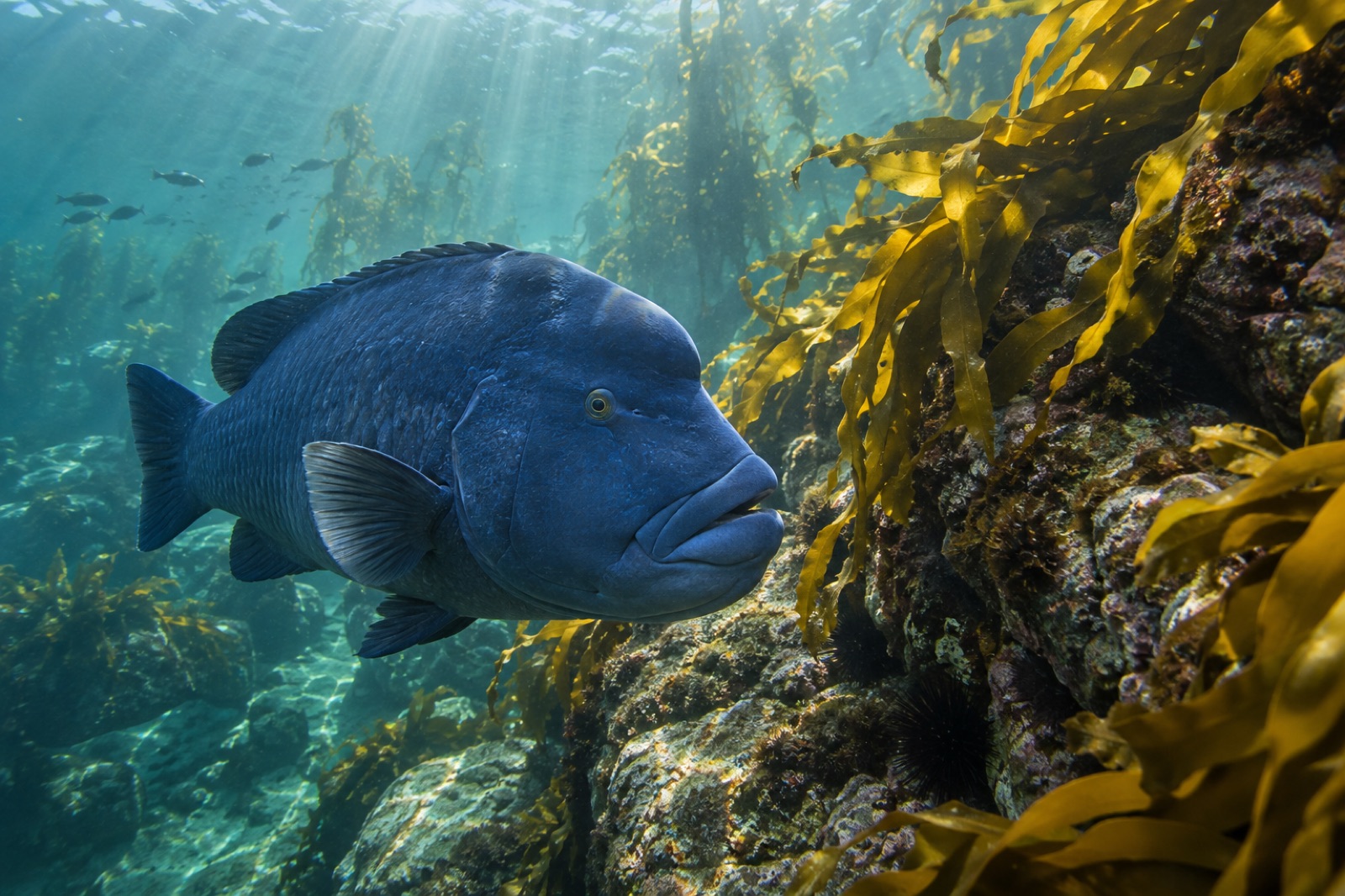
The western blue groper (Achoerodus gouldii) is the largest fish most divers will ever meet face-to-face on a temperate Australian reef. A big male — deep indigo, thick-lipped, unhurried — can stretch past 1.5 metres and outweigh the person watching him. He is a wrasse, a relative of parrotfish and rock cooks, and he has likely been patrolling the same granite ledge since before many of us were born. This profile covers how to recognise the species, where it lives, what it does for kelp forests, and why a fish this slow to grow had to be given special protection.
The species is really two fish in one lifetime. Females and young fish ("red groper" phase) are reddish-brown to olive-green, sometimes mottled, with a lumpy forehead developing as they age. Terminal-phase males are an unmistakable deep, oily blue — the colour of a southern ocean squall — with heavy lips, a steep head profile and a tail edged in pale gold. Large adults of both sexes have a distinctly humped forehead, the wrasse equivalent of grey hair.
Divers occasionally confuse smaller fish with the baldchin groper (Choerodon rubescens), another large WA labrid, or with big western rock lobsters' neighbours like the western foxfish. The combination of sheer bulk, thick lips, and the unbothered, slow-beat swimming style is diagnostic. If the fish turns to look at you rather than fleeing, you are almost certainly looking at a groper.
Its eastern cousin, the eastern blue groper, fills the same ecological role on New South Wales reefs and looks similar, but the two species do not overlap in range — the Nullarbor and the cool corner of the Bight sit between them.
Western blue groper are creatures of hard bottom: granite bommies, limestone ledges, and the boulder fields where golden kelp (Ecklonia radiata) holds the canopy. They favour water from about 2 m down to 40 m, and the largest males tend to hold small, well-defined home ranges — a ledge complex, a swim-through, a favourite overhang — that they work for years.
The heartland of the species is the Leeuwin coast and the Recherche Archipelago, the same kelp country covered in our Leeuwin Capes atlas guide and the Recherche Archipelago profile. Around the wave-washed islands off Esperance, groper cruise the shallows in plain sight, indifferent to surge that pins divers to the rock.
Under those thick lips are fused, peg-like teeth and a powerful pharyngeal mill — a second set of jaws in the throat that grinds shell and test to gravel. The groper's menu reads like a list of kelp forest grazers: sea urchins, large crabs, abalone when it can get them, molluscs of every description.
That diet matters disproportionately. On temperate reefs, sea urchins are the primary agent that converts kelp forest into bare "urchin barrens." In south-western Australia the long-spined sea urchin pressure seen on the east coast is lower, but local urchin populations still boom where structure is lost. Large predators with jaws strong enough to crack big urchins — groper, rock lobsters, big wrasses — are the reef's standing control system. This is the same predator-urchin-kelp triangle we describe in the kina profile from New Zealand, played out with a different cast.
A healthy groper population is, therefore, a reasonable proxy for a reef whose food web still works end-to-end. When Tidewright's field teams survey candidate restoration sites, big wrasses and lobsters on the transect are notes we make with pleasure.
Like most large wrasses, the western blue groper is a protogynous hermaphrodite: individuals mature first as females and, some years later, the largest females in a local social group transition to terminal-phase males. The switch rewires colour, behaviour and role — a red-brown female holding her small range becomes, over a season or so, the blue patriarch policing a bigger one.
Growth is unhurried. Blue groper continue to grow for decades, and age estimates for the largest animals run well past fifty years. That biology has a hard consequence: a mature male speared today represents reef history — decades of accumulated growth, learned territory and reproductive output — that the population will not replace quickly. Numbers of big fish are rebuilt on generational timescales, not on the five-year cycle of a management plan.
Through the middle of the twentieth century, big groper were target number one for pioneering Australian spearfishers: slow, curious and huge, they were the easiest trophy on the coast. Dive-club histories from the 1950s and 60s casually record fish taken that today would stop a whole dive club in its tracks. The result was predictable — groper largely vanished from the easy-to-reach ledges near Perth and Albany within a couple of decades.
Recognition came slowly, but it came. Spearfishing for blue groper is now prohibited in Western Australia, and the species is treated with care by the line fishery. Recovery has been the slow kind: noticeable, but measured in decades, and concentrated in marine parks, offshore islands and harder-to-fish water. Divers visiting the Abrolhos or the Recherche today often meet fish that are admirably large — and it is worth remembering those animals were probably born before colour television.
If you want a groper encounter, go where the pressure has been low for a long time:
The etiquette is simple: don't feed, don't pursue, and don't hover at a fish's favourite cleaning or resting spot. A curious groper will come to you; a harassed one leaves and learns. Our Great Southern Reef atlas guide has broader context for planning a trip to this coast.
No. They are sister species — Achoerodus gouldii in the west, A. viridis in New South Wales — separated by thousands of kilometres of the southern coast. Both are large, blue-male wrasses with similar ecology, and both are protected from spearfishing in their home states.
Fish over a metre are common where protection has held; exceptional males reach around 1.6–1.7 m and roughly 40 kg. Because they grow slowly and never really stop, the very biggest individuals are also the very oldest.
Blue groper are encountered by line fishers in WA, but regulations treat the species carefully and spearfishing for them is prohibited. Rules change; always check the current WA recreational fishing guidelines before targeting or retaining any large wrasse.
Large males are territorial and intensely curious — they patrol a known range and investigate anything unusual inside it, including you. It is not friendliness so much as an inspection. Stay calm, keep your hands to yourself, and enjoy an audience with a reef elder.
Not to divers. The teeth are for crabs and urchins, and the species' reputation across decades of diving is placid curiosity. The real hazard on groper reefs is the swell, not the fish — plan entries and exits accordingly.
Meet the eastern blue groper, the friendly, urchin-crunching giant wrasse of New South Wales reefs — every adult blue male began life as a female.
Dr. Theo Nakamura ·
Golden kelp forms the backbone of Australia's Great Southern Reef. Learn to identify Ecklonia radiata and why this habitat-maker is on the move as oceans warm.
Dr. Mara Ellison ·
Kina is Aotearoa's endemic sea urchin — treasured kaimoana, a kelp grazer, and the engineer behind New Zealand's barren reefs. Here is its biology and its story.
Dr. Mara Ellison ·