Atlas10 min read
King George Sound: Albany's Sheltered Kelp Jewel
King George Sound shelters some of southern WA's richest kelp reefs. A coastal atlas guide to Albany's granite forests, whale history and cold clear diving.
Tom Okafor ·
A coastal atlas guide to Esperance, Western Australia: kelp forests beneath the whitest beaches in the country, granite islands, seadragons and how to see them.
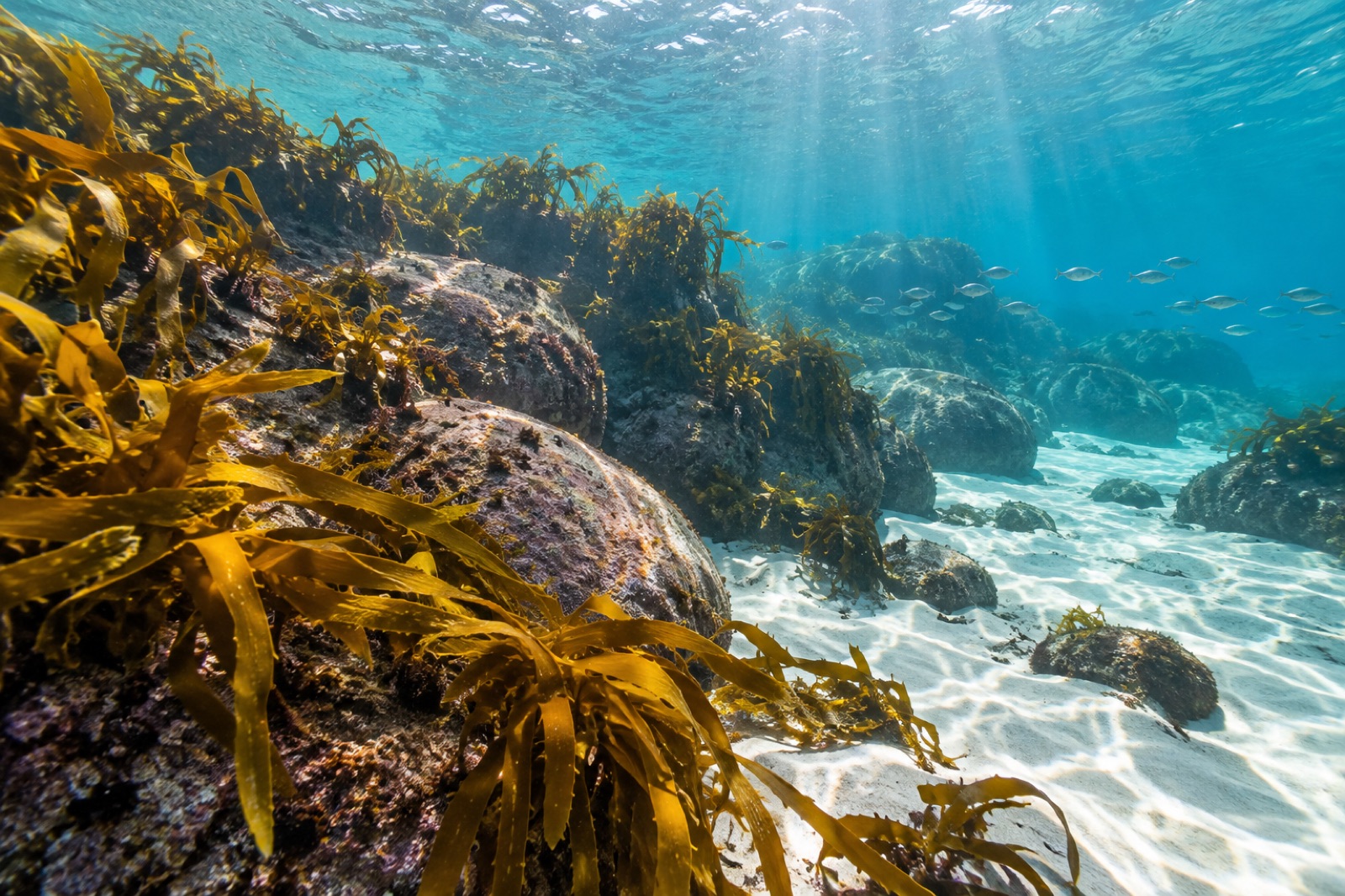
Few coasts anywhere hold a stranger contrast than Esperance. Above the tideline: granite domes the colour of dried rose petals and beaches so fine and pale that the sand squeaks underfoot. Below it: cool green water, kelp fronds waving gold in the surge, and a reef community as rich as any on the Great Southern Reef.
Esperance sits roughly 720 kilometres southeast of Perth on Western Australia's south coast, facing the Southern Ocean across the 105 granite islands of the Recherche Archipelago. This guide covers what grows in that water, where to see it, when to come, and why the marine park here matters more than most visitors realise.
The Western Australian south coast is the western anchor of the Great Southern Reef, the interconnected band of temperate kelp forest that runs from Kalbarri around the bottom of the continent to the New South Wales border. The Leeuwin Current, running warm and weakly south along the edge, keeps these waters milder than latitude alone would suggest — summer surface temperatures around 20–22 °C, winter around 16–18 °C — which is exactly the comfort zone for the dominant canopy former, Ecklonia radiata.
Common kelp as Ecklonia is, it is the unsung architect of the southern Australian coast. Unlike the giant kelp forests of Tasmania, it forms a dense, chest-high canopy over shallow granite reefs, hardening the habitat against surge and throwing the dappled shade in which hundreds of reef fish and invertebrate species shelter. Between the stipes you find golden kelp and crayweed in patches, and under the canopy a pink crust of coralline algae that holds the whole reef together.
The other thing that shapes Esperance's underwater world is the granite itself. Where the coast has soft, sedimentary rock, kelp forest is patchy and sand-scoured. The Recherche's polished granite holds fast both above and below water, which is why the reefs here are stacked with terraces, gutters and swim-throughs — and why the kelp gets a purchase in places the swell would otherwise strip bare.
The Recherche Archipelago — named for one of Bruni d'Entrecasteaux's ships during the 1791–94 French expedition — sprawls about 230 kilometres across the bay, from the Cape Le Grand satellites east of town to islands far offshore like Middle Island, home of the naturally pink Lake Hillier. A state marine park protects the archipelago, with sanctuary zones around key islands; commercial kelp harvesting does not occur here, and spearfishing restrictions apply in sanctuary zones, so check the marine park map before entering the water with any gear.
The islands matter for kelp in a second way beyond substrate: they shelter the nearshore. The archipelago stands like a breakwater between Esperance Bay and the full force of the Southern Ocean swell. Inside the island line, bays like Lucky Bay, Thistle Cove and Hellfire Bay stay calm enough on the right day for snorkelling, while the ocean sides of the outer islands take the full swell and grow the densest, most wave-trained kelp of all.
Wildlife comes with the seaward islands too. New Zealand fur seals haul out on the skerries, and gannets and shearwaters work the baitfish shoals above the reefs. On the mainland beaches, kangaroos doze on the sand at Lucky Bay — the postcard shot — which makes for the surreal experience of planning a shore dive while a macropod watches from the picnic shade.
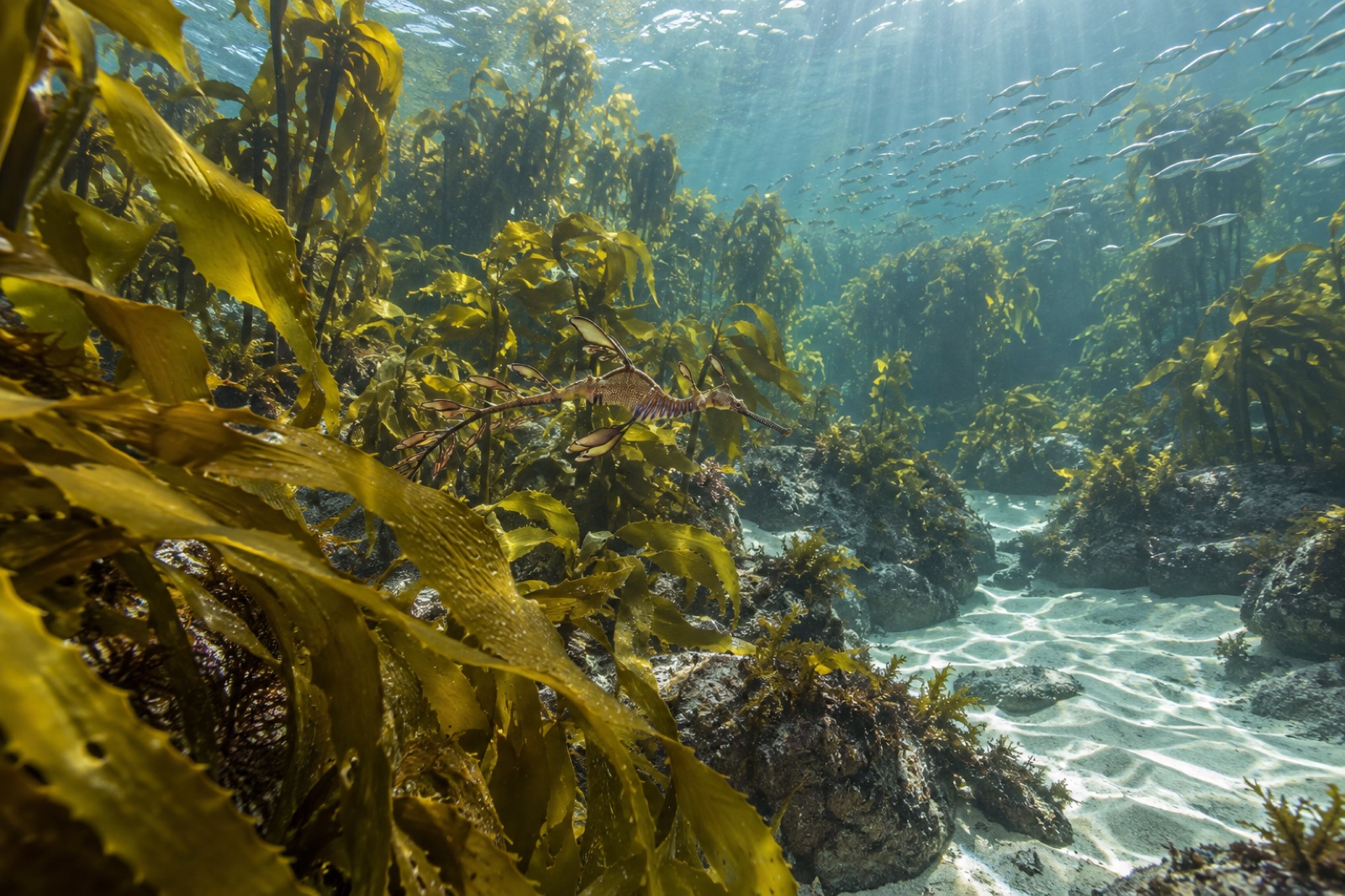
Esperance is the western stronghold of the leafy seadragon's heartland range, and while they are not common, the sheltered weed and kelp edges around Woody Island and the town jetty's neighbour pylons are among the more reliable places to look. Their cousins, the weedy seadragons of the south, visit the weedbeds too. For dedicate seadragon viewing, the classic site down the coast is Second Valley in Gulf St Vincent, but Esperance rewards a slow eye.
The rest of the community is classic Great Southern Reef: western blue groper cruising the kelp line like armoured kelp ghosts; harlequin fish, those improbable orange-and-blue basslets, under every second ledge; western rock lobsters marching the gutters at low tide; sea sweep, zebra fish and western talma flashing over the fronds. In the seasons when the cooler water pushes in with autumn swell, you may see southern right whales just offshore — winter into spring — and orcas have become regular visitors to the Bremer Canyon, a few hours east, one of the most extraordinary temperate whale spectacles on the planet.
Five honest places to start, from easy to committed:
The Esperance town foreshore and Tanker Jetty remnant. The old jetty was demolished, but the foreshore's rock groynes hold small kelp gardens, leafies turn up, and it's the gentlest possible introduction on a calm morning.
Woody Island. Reachable by tour boat from Esperance, Woody is the archipelago's only island with visitor facilities. Snorkel straight off the small beach in Shearwater Bay: kelp edges, wrasse, occasional blue groper and, in summer, crystal-clear water. The walk trail crosses regenerating woodland that gives the island its name.
Lucky Bay and Thistle Cove, Cape Le Grand National Park. On the sheltered northern faces of the granite, the beaches are pure white silica and the inshore reefs carry Ecklonia in water often under three metres deep. Perfect for families and first-time snorkellers; go early before the sea breeze arrives around midday.
Hellfire Bay and Little Hellfire. Punchier and more exposed, with kelp-lined boulder fields in easy snorkelling depths. The water off these north-facing bays is frequently the warmest on the coast, and the fish life on a calm day feels close to a marine reserve.
Outer island boat dives. For certified divers, the seaward faces of islands like Cull, Figure of Eight and the Granite Skerries offer drop-offs, caves and some of the densest underwater forests in the state. Vis can be outstanding — 20 metres is not unusual at depth — but conditions require experience and a local operator. It is hour-plus boat runs with southern ocean swell on the nose; take seasickness seriously.
The coast runs on the sea breeze. In summer (December–February) the afternoon sea breeze — a brisk southwester the locals simply plan around — builds from late morning, so the golden rule everywhere down this coast is "be on the water before ten." Autumn (March–May) is the local favourite: lighter winds, clear water after the summer upwellings, and the stingrays of the foreshore at their most obliging. Winter brings the big swell and the whales but reduces snorkelling days; spring is transitional and often surprisingly good.
Water clarity is driven by swell run and the Leeuwin Current's strength; after a week of easterlies, the bays go gin-clear. Watch the Bureau of Meteorology swell forecasts — significant swell over about 1.5 metres makes the exposed sites unpleasant or unsafe — and time slack tides for any channel snorkelling near the island gaps.
Great Southern Reef kelp forests are under documented pressure from marine heatwaves. Western Australia's own records show the kelp northern range boundary shifting as warm events stack up, and the 2011 heatwave off the mid-west coast pushed tropical species south in ways still being measured. The Esperance and Recherche waters sit near the cooler core of the kelp range, which makes them both a refuge and a baseline — a place where scientists can see what a healthy southern kelp coast still looks like, and where restoration techniques being developed elsewhere on the reef may one day be needed.
Community monitoring runs through local dive clubs and the marine park's programs, and visiting divers can log sightings of seadragons, groper and kelp condition through citizen science platforms. If this coast means anything to you after a visit, the best thank-you is a survey.
Esperance has good accommodation and provisioning; Cape Le Grand National Park, about 50 kilometres east, has camp grounds near the beaches and demands park entry fees. Boat trips to Woody Island and outer island dive charters leave from the Esperance foreshore; book ahead in January. Mobile coverage fades quickly east of town. And drive slowly at dawn and dusk — the kangaroos that pose at Lucky Bay by day are the same animals that step onto the road.
Yes — the contrast fools people. The blinding white Silica beaches of Cape Le Grand give way within a few fin-kicks to granite reefs carrying dense golden Ecklonia. The whitest beach in Australia still has a forest offshore; you just have to put your face in the water to see it.
The town foreshore, Woody Island's Shearwater Bay and the sheltered bays of Cape Le Grand are all beginner-friendly in calm morning conditions, with entry from beach sand onto kelp-edged reef in shallow water. Choose a low-swell day, use a dive flag, and avoid anywhere near channels between islands on a running tide.
They are present but elusive. The most consistent sightings come from slow dives along the weed and kelp edges around the old jetty area, Woody Island and the sheltered reefs of the archipelago. Move at half your normal pace, scan the base of the kelp and the drift weed, and let certified divers' photo logs guide you.
Typically 20–22 °C in late summer, dropping to around 16–18 °C through winter — warm enough for a 3/2 mm wetsuit snorkelling in summer and a 5 mm for winter diving. That mildness is precisely why this coast is kelp country: warm enough to swim comfortably, cool enough for the forest.
Between roughly June and October, southern right whales shelter in the bays of the archipelago and along the mainland — often visible from the same granite headlands you'll lure at between snorkels. A calm winter morning can genuinely deliver both.
King George Sound shelters some of southern WA's richest kelp reefs. A coastal atlas guide to Albany's granite forests, whale history and cold clear diving.
Tom Okafor ·
Australia has a second great reef — 8,000 km of temperate kelp forest across five states, more endemic than the Great Barrier Reef, and in serious trouble.
Dr. Mara Ellison ·
Granite reefs, golden kelp, leafy seadragons and sea lions: a field guide to Kangaroo Island's wild underwater south, from Penneshaw to Western River Cove.
Tom Okafor ·