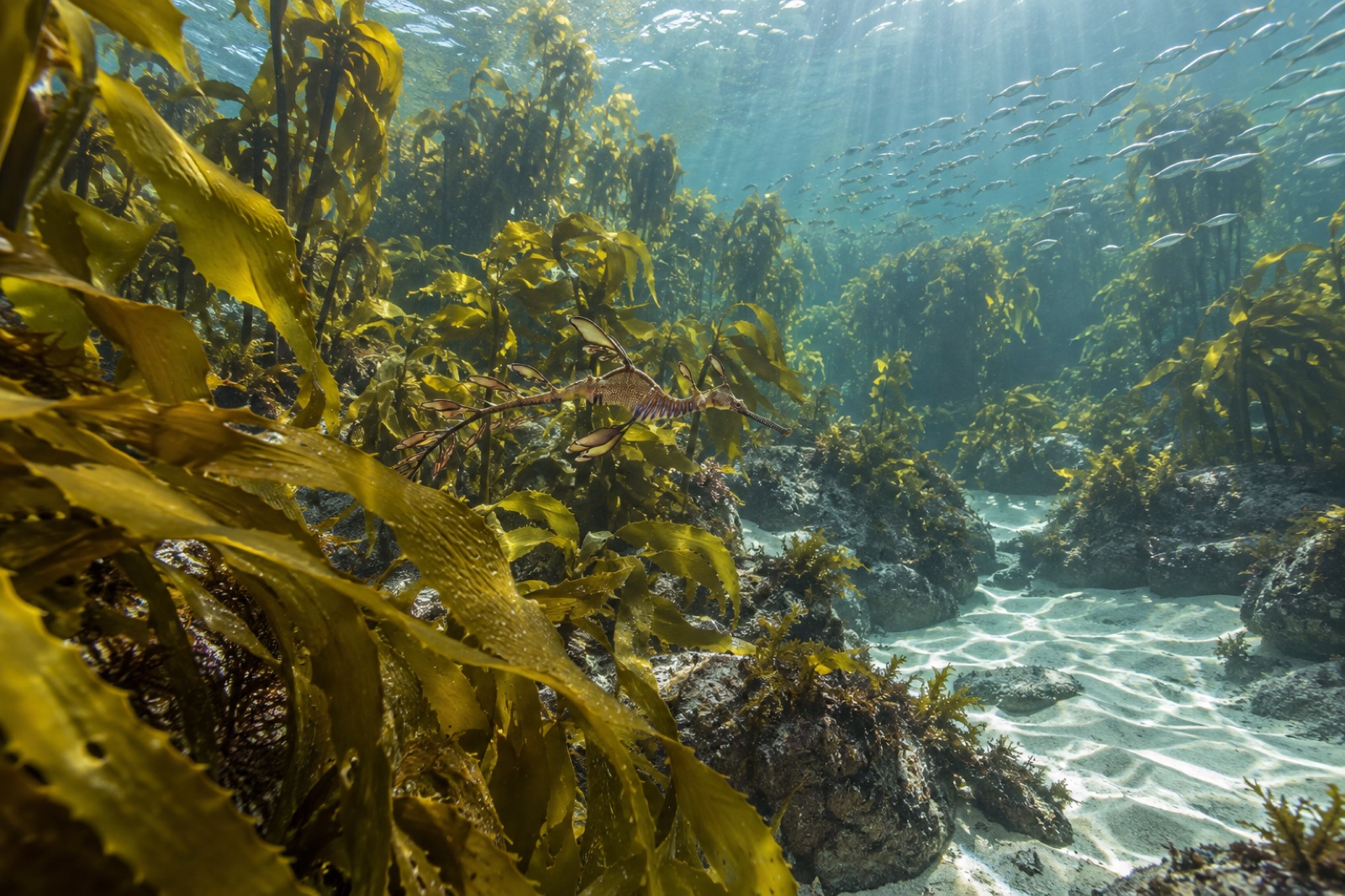
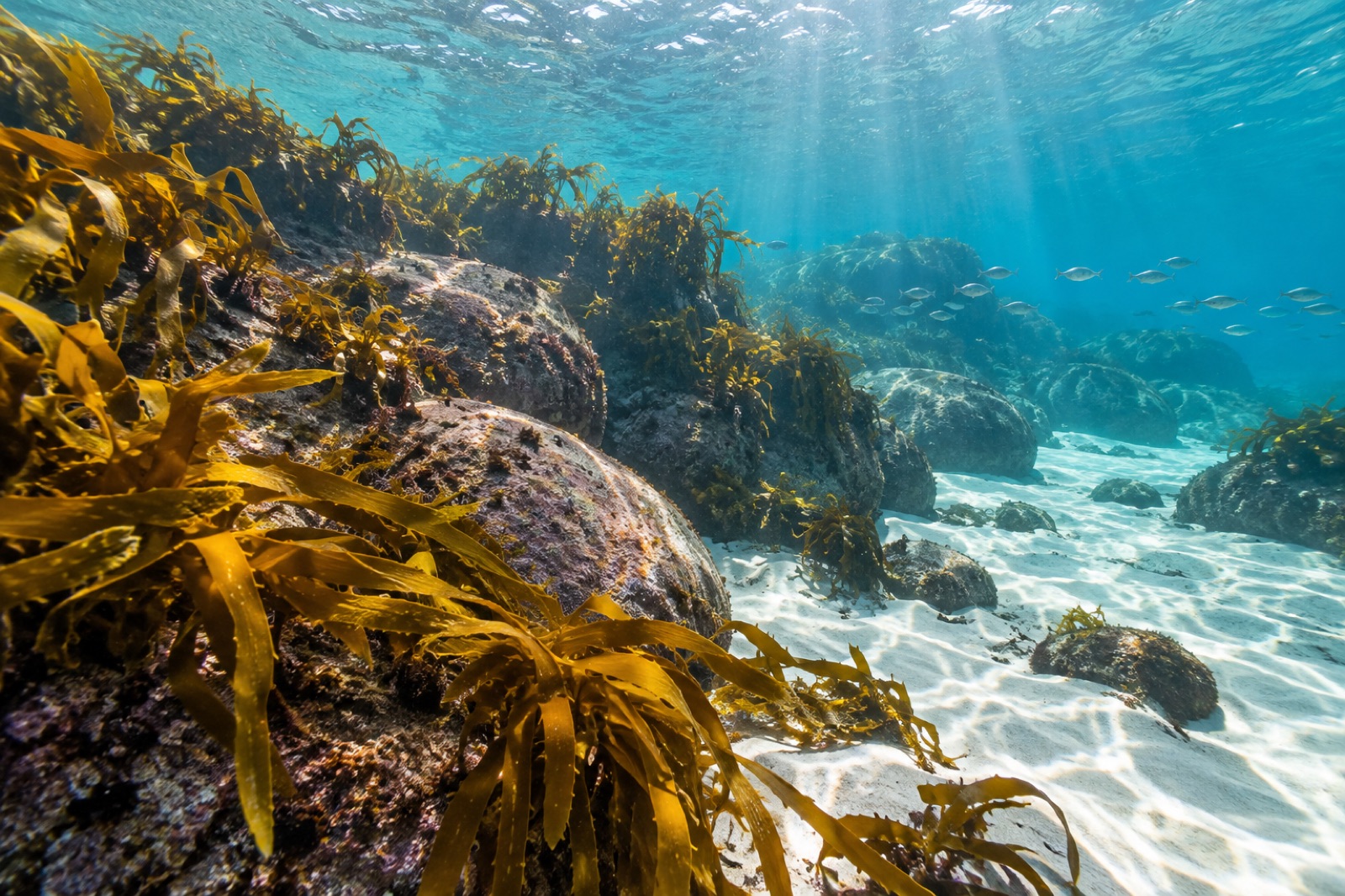
King George Sound is a paradox that works in the ocean's favour. On Western Australia's wild south coast — a shoreline hammered for ten thousand kilometres by the Southern Ocean — it is one of the calmest large bodies of water you will find. Granite headlands and two long islands fold the swell away, leaving a natural harbour so generous that sealers, whalers, navies and grain ships have all claimed it in turn. Beneath that sheltered surface, golden kelp grows thick over granite and limestone, and the marine life of the Great Southern Reef concentrates in water clear enough to make a Monterey diver homesick.
This guide covers what the Sound is, why its reefs look the way they do, where to get in the water, and what its whaling-era history means for the whales that are coming back.
Where King George Sound sits — and why it is so calm
The Sound opens south from the town of Albany into the Southern Ocean, hemmed in by the Vancouver Peninsula to the west, Flinders Peninsula to the east, and two offshore islands — Breaksea and Michaelmas — that break up incoming swell lines before they reach the inner bays. The result is a protected basin roughly 110 square kilometres, with depths mostly under 35 metres and a narrow, deep entrance between Bald Head and Stony Hill.
That shelter matters ecologically. Along most of the south coast, kelp thrives only where it can grip hard substrate and survive enormous wave energy. Inside the Sound, golden kelp (Ecklonia radiata) can grow in relative stillness, building layered canopies that host more fish and invertebrate diversity per square metre than the exposed reefs outside. Calm water also means less suspended sediment, so light penetrates deeper and kelp can photosynthesise at depths that would be too dark on the open coast.
Albany's oceanography is shaped by the same forces as the rest of the region described in our Southern Australia atlas section: the warm, narrow Leeuwin Current pressing east along the coast in autumn and winter, and cold Southern Ocean water welling in beneath it. The meeting of the two keeps the Sound nutrient-rich without ever getting truly warm.
The reef mosaic: granite, limestone and seagrass
The Sound's underwater scenery divides into three broad habitats.
Granite reefs
The outer headlands — Bald Head, the Gap, the rocks beneath Stony Hill — are ancient granite that continues underwater as boulders, walls and gullies. These are the classic kelp gardens: golden kelp canopies over turf of red and brown algae, sponges and sea tulips on shaded faces, and dense schools of old wife and western talma working the edges. The western blue groper patrols here, the big territorial wrasse that divers on southern Australian reefs come to treat as an old neighbour.
Parts of the inner Sound, particularly along the Vancouver Peninsula and around Mistaken and Frenchman Bay (ironic name — it is south of the town, but the resemblance fools nobody who has dived it), sit on softer limestone. The platforms are riddled with ledges and small caves, sheltering rock lobster, Western Australian dhufish, Harlequin fish and, for the patient observer, both weedy and leafy seadragons on the reef edges where kelp mates with algal turf.
Seagrass meadows
The shallow sandy bays hold meadows of Posidonia and Amphibolis seagrass — nurseries for King George whiting, calamari squid and juvenile leatherjackets. The meadows and the kelp reefs work as a system: kelp exports detritus that feeds the meadows' food webs, and fish raised in the grass move out to the reef as adults.
A harbour built on whales
Albany holds the melancholy distinction of hosting Australia's last whaling station. From the sheltered anchorage at Frenchman Bay, the Cheynes Beach Whaling Company hunted humpback and sperm whales until 1978, when the station closed and the hunt — which once made Albany a company town — ended for good. The site is now the Whale World museum, and the shift in the town's relationship with whales has been total.
Each autumn and winter, southern right whales return to the coast. Learn more about this extraordinary species — the whale that plays in kelp — which was hunted to the edge of disappearance because it floated when killed and came willingly into sheltered bays at exactly the human-friendly season. Today, mothers bring calves into the Sound and adjoining bays between roughly June and October, resting in the same water their ancestors were taken from. Humpbacks pass on their northern migration. Watching a right whale mother and calf hold station in three metres of water a short swim from a beach where factory ships once loaded is one of the more quietly hopeful experiences in Australian marine conservation.
The return of whales is slow — recovery is measured in decades, and nobody pretends the populations are restored — but the trend in these waters is upward, and Albany's identity now runs from the harpoon to the hydrophone.
Diving and snorkelling the Sound
Conditions are best from late summer into autumn (roughly February to May), when winds ease, visibility commonly reaches 10–20 metres and the water holds at 17–20 °C. Winter drops it to 15–16 °C and brings the whales.
For snorkellers and newer divers, the sheltered granite bays on the southern face of Frenchman Bay offer kelp, reef fish and seagrass in a few metres of water. Divers with a boat or local charter can work the outer reef structure for bigger scenery.
Then there is HMAS Perth — a 133-metre guided missile destroyer deliberately scuttled in the Sound in 2001 to become a dive wreck and artificial reef. She sits upright in around 35 metres, the superstructure within reach of recreational limits, and two decades of growth have dressed her in algae, sponges, tunicates and clouds of baitfish. It is one of Australia's great accessible wreck dives and a tidy demonstration of how quickly bare structure becomes habitat.
Two cautions: the Sound is a working harbour, so check vessel traffic and dive-flag rules, and the outer sites near Bald Head still catch swell — these are exposed-ocean dives when the weather runs. For context on how this coast compares with the rest of the state, see our guides to the Leeuwin Capes to the west and the Recherche Archipelago to the east.
Ashore: granite country and long memory
The same granite that builds the reefs builds the headland walks. The Bald Head trail follows the Flinders Peninsula to its sea-exposed tip with views into the Sound and out to the islands; the Gap and Natural Bridge show what the Southern Ocean does to unfused rock. Mount Clarence holds Albany's Anzac memorial — the Sound was the last anchorage for the first troop convoys to leave Australia in 1914 — and the broader region takes in Two Peoples Bay, where the noisy scrub-bird was rediscovered after being presumed extinct, and Little Beach, reliably listed among the country's most beautiful.
For anyone who eats on this coast: the same kelp-fringed cold water produces southern rock lobster, scallops, squid and the whiting that built Albany's fishing fleet. Our kitchen cluster has guides if you want to cook the seaweed side of the story too.
Outlook: a working harbour learning restraint
King George Sound remains a deep-water port — grain and woodchip ships pass over the kelp — and Albany's marine park boundaries are still being argued, as they are everywhere on the south coast. The fundamentals, though, tilt the right way: the water stays cool and clean, the whale traffic increases, the wreck becomes more of a reef each season, and the town's prosperity now depends on the ocean being alive rather than processed. On the Great Southern Reef, that counts as a model worth watching.
Key takeaways
- King George Sound's islands and granite peninsulas shelter 110 km² of calm, clear water on a coast dominated by Southern Ocean swell.
- Golden kelp canopies, limestone ledges and Posidonia seagrass meadows form a connected habitat mosaic with high species diversity.
- Albany hosted Australia's last whaling station (closed 1978) and now hosts recovering southern right whales that calve in the same bays.
- HMAS Perth, scuttled as an artificial reef in 2001, is one of Australia's premier accessible wreck dives inside the Sound.
- Best underwater conditions run February–May; whales visit June–October.
FAQ
Can you dive King George Sound without a boat?
Yes. Several sheltered bays on the peninsula side offer shore-accessible granite reef in shallow water, ideal for snorkelling and entry-level diving. The premier sites — the outer headlands and HMAS Perth — require a boat or local charter.
What kelp grows in King George Sound?
Golden kelp (Ecklonia radiata) is the main canopy species, forming thick forests on granite and limestone reef. Understory and turf communities are diverse, and the shallow sandy bays carry extensive seagrass rather than kelp.
When can you see whales in Albany?
Southern right whales arrive from about June and often stay with calves into October, sometimes in very shallow water close to shore. Humpbacks pass through on their migration north in autumn-winter and back south in spring.
Is the water warm enough to swim without a wetsuit?
Barely, and only briefly. Summer surface temperatures peak around 20–21 °C. Most swimmers are comfortable in a shorty; divers use 5–7 mm suits year-round, thicker in winter.
How is King George Sound different from the open south coast?
Swim a few kilometres through the entrance and you pass from sheltered, clear harbour water to some of the most energy-loaded coastline in Australia. The Sound's calmness is what lets kelp and seagrass build unusually dense, layered habitats.