Drive two and a half hours north of Sydney and the coast opens into a drowned harbour — Port Stephens, an estuary roughly twice the surface of Sydney Harbour, ringed by 26 kilometres of sand and the jagged volcanic headlands of the Worimi people, on whose sea country this coast still depends. What makes Port Stephens a destination for ocean people is less its size than its position: it sits near the northern hinge of the Great Southern Reef, the point where the temperate kelp-forest system running from Kalbarri around to southern Queensland starts giving way to the warmth of the East Australian Current.
Underwater, that reads as one of Australia's great blue-collar shore-diving coasts: kelp fringes, sponge gardens, soft corals, tropical vagrant fish beside temperate reef species, and a grey nurse shark population famous enough to have its own dive protocols. This is the guide — ecology, sites, seasons, and how to behave around the coast's most important residents.
Where the East Australian Current meets the shore
The defining character of Port Stephens' subtidal world is mixing. The EAC pushes warm blue water down the shelf seasonally, especially through late summer and autumn; the Karuah River delivers freshwater and sediment to the harbour's head; and the tide swings through a narrow mouth channel between Yacaaba Head and Mount Tomaree that scrambles everything into gradients.
Out on the seaward headlands and offshore islets — Broughton Island in particular — the water is oceanic or near-oceanic for much of the year. Inside the harbour, bays like Shoal Bay and Little Beach run estuarine and sheltered. Between those extremes lies almost the whole spectrum of temperate Australian subtidal habitat, accessible on a single tank day and often from the beach.
The underwater cast
Kelp at its northern edge
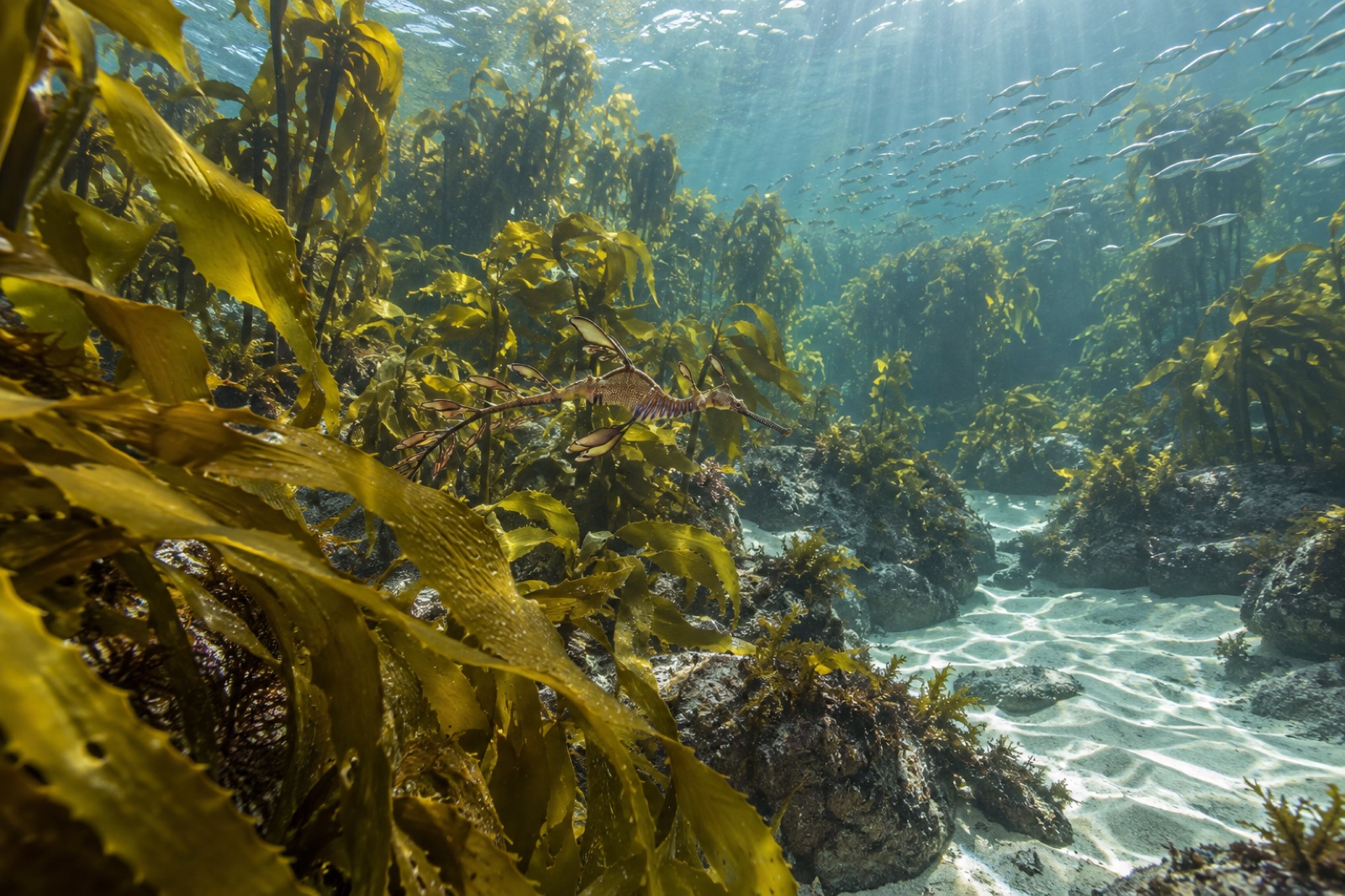
Golden kelp (Ecklonia radiata) — the canopy workhorse documented across our species guide to golden kelp — is present but thin here, holding fringes on exposed rocky reef rather than forming the dense forests you'd see around Sydney's coast or down at Jervis Bay. Port Stephens sits near the northern limit of meaningful kelp canopy in New South Wales. What fills the space instead is a subtropical blend: sponge gardens of remarkable density, soft corals, gorgonians, and boulder reef that tropical fish and temperate wrasses share.
That thinness isn't a flaw — it's information. Monitoring here measures how far north meaningful Ecklonia canopy can persist, and how fast that line is moving.
Grey nurse sharks: the coast's ambassadors
Port Stephens is among the most reliable places in Australia to see grey nurse sharks (Carcharias taurus). Broughton Island's gutted reefs and underwater gutters are a known aggregation area, and the east-coast population — critically endangered under national environmental law — is protected with enforced look-but-don't-disturb protocols.
The reality on the water: you'll encounter them in gutters and caves in 15–25 metres, hanging mid-water and indifferent to divers at respectful distance. The dive operators who run these sites work hard to keep encounters non-invasive; diving here is one of the best arguments that ecotourism and shark conservation can be the same enterprise.
The rest of the ensemble
- Eastern blue groper — read the species guide; this coast is where you reliably find the big, old blue males on kelp-edged reef.
- Port Jackson sharks — aggregating in winter, docile, common in the shallows; see the species profile before you go.
- Australasian fur seals — hauled out at the Cabbage Tree Island colony at Broughton; viewable from boats, occasionally from shore.
- Dolphins — a resident bottlenose population uses the harbour entrances daily; boats work the pod respectfully from Nelson Bay year-round.
- Nudibranchs and sponge life — Fly Point in particular has a macro reputation going back decades.
The shore-dive infrastructure
Port Stephens is engineered for shore diving in a way few NSW coastlines are:
- Fly Point — inside the aquatic reserve, sheltered, shallow, thriving sponge gardens and macro life; the training ground.
- Halifax Park — the neighbouring easy entry, kettle-flat at slack tide.
- Little Beach — the west-facing reef favoured by locals, best early.
- Broughton Island — the offshore reef for the nurses; boat access only through licensed operators.
- Shoal Bay and Nelson Bay headlands — snorkelling perimeter with kelp fringe, dramatically better on calm winter days.
For shore-dive planning fundamentals — tide reading, entry assessment, when to walk away — our guide to reading the beach applies almost line for line here.
Kelp at the boundary: what warming is doing
The Port Stephens coast is one of the places where the reef is being watched for the tropics' arrival. Scientists document increasing counts of tropical and subtropical fish species in the region's kelp-edge habitats each decade — the phenomenon called tropicalisation — and herbivorous tropical species can start to graze habitats built for temperate grazers at different rates.
The honest state of knowledge: Ecklonia canopy here is variable and has never been dense; strong La Niña and cool EAC years bring canopy recovery, marine heatwave years strip the fringes. What the science does show clearly is that the region is a boundary in motion, and the rest of the Great Southern Reef community watches it closely. Tidewright's atlas of the Sydney coast and the crayweed comeback story down the coast record the warmer side of the same diagram.
Seasons, ethics and the rules that matter
- Grey nurse rules: no touching, no flash, no blocking escape routes, follow mooring and zoning rules around aggregation sites. The penalties and the ethics align.
- Marine park zoning: the Port Stephens–Great Lakes Marine Park zones the waterways; sanctuary zones are public and policed. Check the current map before diving or fishing.
- Best diving: May to October for visibility and nurse aggregation; summer for warmth and tropical drift species.
- Best snorkelling: winter mornings on Little Beach, slack water at Shoal Bay.
- Whale season: humpbacks pass through May–July north, September–November south; Mount Tomaree summit is one of the finest land-based whale stations in NSW.
Key takeaways
- Port Stephens sits at the north end of the Great Southern Reef's kelp system, where temperate canopy meets subtropical transition — unusual and scientifically valuable habitat.
- Golden kelp (Ecklonia radiata) here is thin, fringe-holding and watched as a boundary marker of tropicalisation.
- Grey nurse sharks at Broughton Island are among Australia's most reliable large-shark encounters, under strict protection.
- Fly Point, Halifax Park and Little Beach form arguably the best shore-diving training ground in the state.
- Winter is the season: visibility, nurse sharks, whales, and calm kelp-fringe snorkels.
FAQ
How far is Port Stephens from Sydney?
About 2.5 hours north by road. Nelson Bay, the main town, is the logistics centre — marina, dive operators, food, accommodation.
Can beginners snorkel or dive the grey nurse sharks?
Broughton Island's nurse sites are usually boat-dove at 18–25 metres with a guided operator; an Open Water certification and recent diving experience are standard prerequisites. Fly Point inside the marine reserve is the beginner-safe shore alternative, with kelp fringe and sponge gardens in 3–8 metres.
What happened to Port Stephens' kelp?
Kelp here has always been thinner at this latitude — Port Stephens is near the historical northern edge of dense golden kelp canopy in NSW. Fringe beds still hold on exposed reefs, but marine heatwave years strip them, and researchers track tropicalisation as fish and grazers from the warm north increasingly dominate.
When is grey nurse shark season at Broughton Island?
Grey nurse sharks are present year-round, but aggregation numbers and water visibility tend to peak May through October. Summer brings warmer water and tropical vagrant wildlife instead.
Is Port Stephens part of the Great Southern Reef?
Definitively yes — at its northern edge. The reef system runs from Kalbarri in Western Australia around the bottom of the continent and up to the southern Queensland border; Port Stephens sits near the temperate system where it begins to hand warmth back to the north.