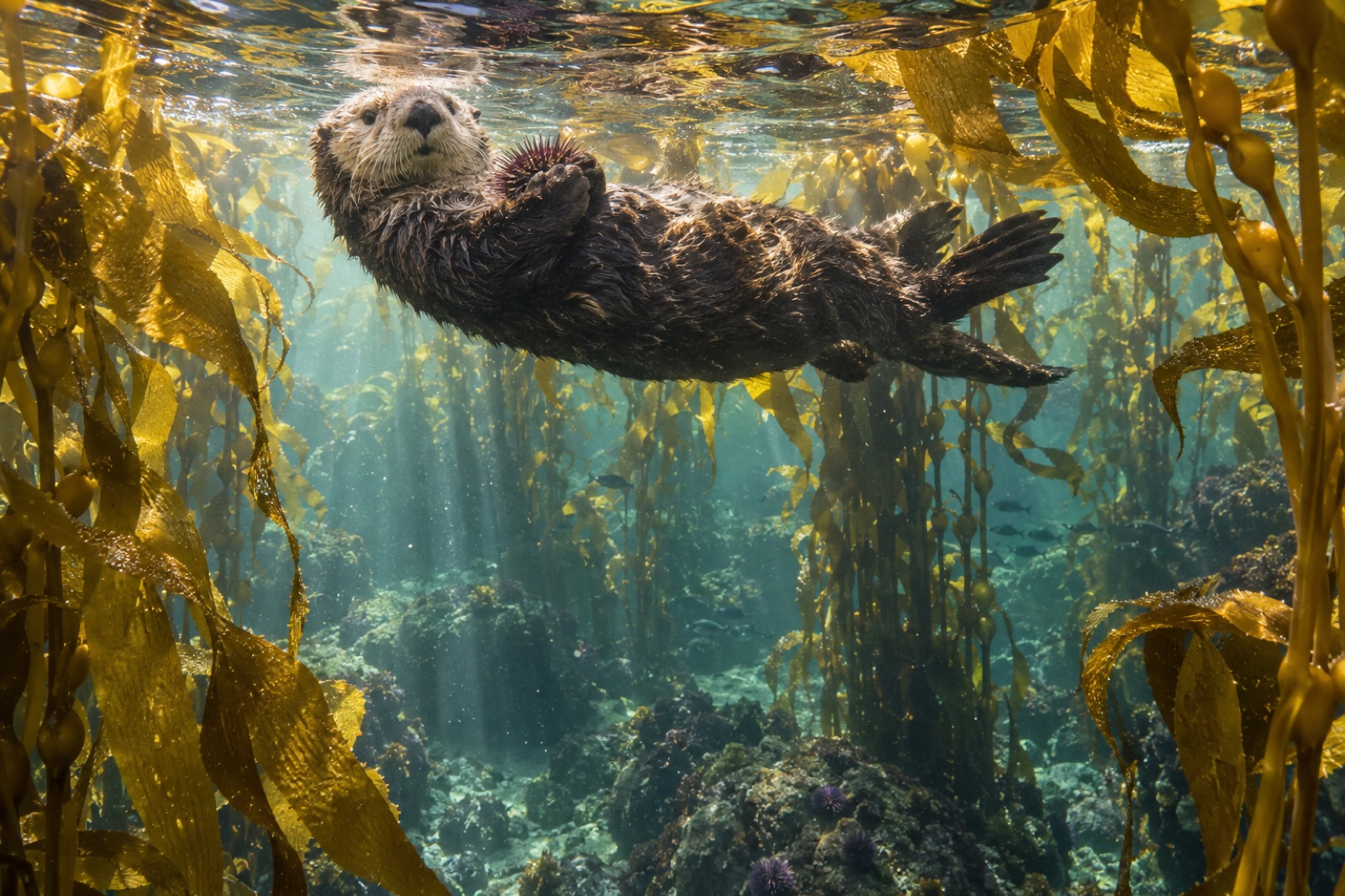
The Steller sea lion (Eumetopias jubatus) is the giant of the eared seals: a northern, shaggy, Labrador-gold animal whose adult males can weigh more than a small car, whose roaring carries across a haul-out beach like a freight yard, and whose range stitches together nearly every great kelp coastline of the North Pacific — Hokkaido and the Kurils, the Aleutian arc, the Gulf of Alaska, British Columbia, and south to California. Where you find Steller sea lions, you are almost always within sight of kelp country.
This profile covers identification, range, the remarkable biology of a top-tier pinniped, the conservation story that made it famous, and how it relates to the kelp forests below its rocks.
Quick facts
|
|
| Scientific name |
Eumetopias jubatus |
| Family |
Otariidae — the eared seals (sea lions and fur seals) |
| Male size |
Up to ~3.3 m long; large males around 1,000–1,100 kg |
| Female size |
~2.3–2.9 m; roughly 250–350 kg |
| Colour |
Pale buff to tawny gold, darker when wet; males develop a thick, maned neck |
| Range |
Cold North Pacific rim: Japan and the Kurils through the Aleutians and Alaska to central California |
| Diet |
Schooling fish (pollock, mackerel, herring), salmon, rockfish, squid, octopus |
| Predators |
Killer whales; large sleeper sharks take some |
Identification
You identify a Steller sea lion first by scale and colour. Against the chocolate-brown shine of a California sea lion — whose males carry a pronounced forehead crest — the Steller is both bigger and fairer: a grizzled, tawny animal, "blonde" when dry, with adult males appearing almost prehistoric. Big bulls develop a massively muscled neck and shoulders wrapped in longer fur (the species name jubatus means maned), a blunt snout and a lion-like roar they use constantly.
Like all eared seals, Stellers have visible ear flaps, rotate their hind flippers forward to walk on land, and propel themselves with their foreflippers underwater — a powerful, flying-stroke locomotion that makes them vastly more agile at sea than on the beach. On a coastal ledge packed with animals, the Stellers are the ones that look like they were modelled in ochre clay.
Range and habitat: a North Pacific rim species
The Steller's world is the cool rim of the Pacific. From northern Japan and the Kuril Islands it arcs through the Aleutians — the wild chain profiled in our Aleutian Islands guide — across the Gulf of Alaska, down the coasts of British Columbia and the Pacific states, with regular animals reaching central California.
Habitat is defined by two needs, one for rest and one for food. Rest happens on haul-outs — offshore rocks, jetties, log rafts and low ledges where the sea can be regained in one slide — and, in season, on rookeries, traditional breeding beaches, often the same wind-and-swell-battered island shelves used for centuries. Food comes from the productive water over and beside shelves and reefs: schools of forage fish, salmon pulses passing to rivers, squid rising at night, and the rich reef communities that kelp forests host. Stellers forage widely, sometimes far offshore, but they work coasts and islands with particular intensity — the seam where an upwelling-fed kelp coast meets deep water is exactly their kind of water, the ecology described in our explainer on upwelling.
Social life and life cycle
Steller society runs on a strict annual schedule. In late spring, adult bulls arrive first on the rookeries and defend territories with roaring, posturing and, when necessary, violent combat. Females come ashore, give birth to a single dark-chocolate pup conceived the previous year, nurse it, and mate again within weeks — then, notably, begin commuting to sea to feed between nursing bouts, because Steller mothers must feed themselves while producing milk for a pup that will stay dependent for many months, sometimes over a year.
Pups are strong swimmers quickly but spend months attending their mothers before weaning. Juveniles drift through non-breeding age classes on haul-outs up to hundreds of animals strong. The species is long-lived: females may reach around 30 years, breeding well into their teens and twenties.
A striking trait for anyone watching a haul-out: Steller sea lions are highly vocal, maintaining a low, continuous roar-and-bark chorus that has a different timbre from the sharper barking of California sea lions, and large animals launch into the water as a body — a wave of animals going in together, an instinctive safety response to killer whale risk.
Conservation: a famous decline, and two different stories
The Steller sea lion's conservation history is one of the most analysed in marine mammals, and it is a lesson in why causes matter more than numbers. Through the later twentieth century, the Alaska populations crashed — losses measured as roughly three-quarters of the western stock over two decades. The western population, ranging from around central Alaska west through the Aleutians to Asia, declined steeply enough to be listed as endangered under the US Endangered Species Act, while the eastern population (southeast Alaska south to California) followed a different trajectory.
The cause of the western decline has been one of the great debated questions of fisheries ecology: nutritional stress — a shift in the availability or quality of fatty forage fish — is central to the scientific discussion, intertwined with changes in the region's ecosystems, predator pressure and human activity. The eastern stock, meanwhile, increased steadily for decades and recovered fully enough to be removed from the threatened list in 2013 — one of the clearer conservation successes in the species' modern record, and a reminder that trajectories can differ sharply across a single species' range.
The present picture is of a species watched closely: big, long-lived, slow-breeding, dependent on forage-fish-rich seas exactly where warming is reshaping the food web — the regime shifts our El Niño and kelp explainer describes for the same coastlines.
The Steller and the kelp: a shared coast
No single species "lives in" a kelp forest in a niche sense — top predators range across it — but the Steller's economy is inseparable from the kelp coast's productivity. Reef fish nurseries, salmon runs, squid and the concentrated forage that kelp coasts produce are the Steller's larder, and the haul-out geography — wave-washed offshore rocks — is the geography of kelp forest coastlines from the Kelp forests of the Aleutians and Haida Gwaii south through the kelp capes of British Columbia.
Healthy kelp systems support the forage fish and reef communities these predators concentrate on; a productive, kelp-fringed coast supports more of the shelf's productivity generally, which is why restoration and conservation of kelp habitat — work Tidewright does across the region in partnership with coastal governments and Indigenous sea-country rangers — is part of the long story of keeping this species well fed.
For anyone watching them, the experience is unforgettable: a graffito-spattered rock in cold Pacific water, a few hundred glowing, roaring animals, and the kelp beds swinging in the surge just below. Responsible watching — from water, quietly, at distance, as our guide to watching sea otters without bothering them also recommends for sensitive marine mammals — is how the sight stays available for the next observer and the next generation of hauled-out sea lions.
Key takeaways
- The Steller sea lion is the world's largest eared seal; big bulls reach around a tonne and carry a maned, muscular neck and a lion's roar.
- It ranges the entire cold North Pacific rim from Japan to California, hauling out on wave-washed rocks tightly associated with kelp coastlines.
- Mothers raise single pups on traditional rookeries while commuting to sea to feed — an energetically demanding lifestyle.
- The western Alaska population collapsed in the late twentieth century and was listed as endangered, while the eastern population recovered and was delisted in 2013.
- Its fortunes are entangled with forage-fish regimes, warming ocean food webs and the productivity of kelp-coast ecosystems it haunts.
- Killer whales are its principal predator; responsible, quiet wildlife watching keeps its haul-outs safe and accessible.
FAQ
How big is a Steller sea lion compared to a California sea lion?
Considerably larger. A big Steller bull can be around 3.3 metres long and weigh on the order of a tonne, with a pale, maned neck — while California sea lion males are smaller, darker chocolate-brown, and carry a bony crest on the forehead. Colour is often the easiest field mark: Stellers are tawny-gold.
Why did the Alaska population decline?
The western Alaska population's crash remains a studied, debated question. Nutritional stress from a shift in forage-fish abundance or quality is central to the science, alongside wider ecosystem changes and predator pressure. The key lesson is that declines in a long-lived, slow-breeding predator often signal that the food web beneath has moved.
Are Steller sea lions dangerous to people?
They are large wild animals and should be given respectful space, especially at haul-outs and rookeries; they are not aggressive toward vessels or swimmers under normal conditions, but approaching closely — on land or water — is unsafe for both parties and can disturb critical rest.
What do Steller sea lions have to do with kelp forests?
Their core range maps almost perfectly onto the kelp coasts of the North Pacific, and they forage intensively on the forage fish, salmon and reef communities those productive cold-water coasts generate; haul-outs are typically the wave-washed rocks beside kelp beds.
Where can I see a Steller sea lion haul-out?
Reliably along the Alaska coast, British Columbia's outer islands, and seasonally farther south on the Pacific coast of Washington, Oregon and California — typically on offshore rocks and navigation markers, visible with binoculars from shore or by quiet boat approach at distance.