Encyclopedia8 min read
Striped Surfperch (Embiotoca lateralis): Species Profile
Meet the striped surfperch (Embiotoca lateralis), the copper-striped, blue-flecked surfperch of rocky shores and kelp beds from Alaska to Baja California.
Tom Okafor ·
Meet the striped seaperch, a live-bearing surfperch of Pacific kelp beds — and a close look at how viviparity works in a fish that births on the reef.
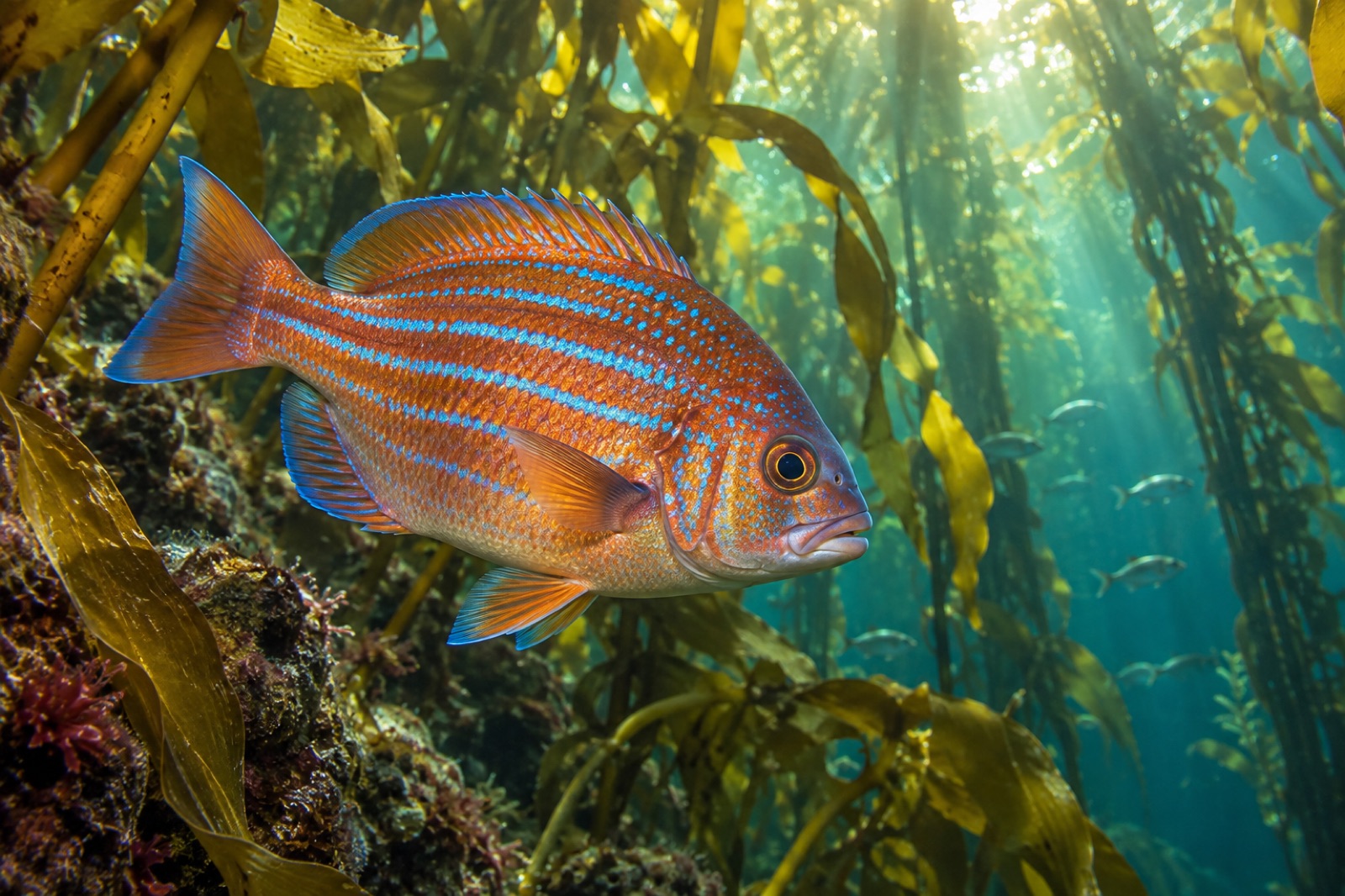
Somewhere in the weed off a Pacific pier, on a warm day in early summer, a female striped seaperch gives birth. Not spawn — birth. Out of her vent come living young, centimetres long, fins spread, already striped faintly like their mother, hanging a stunned moment before schooling off into the understory. It happens every season, within snorkelling range of millions of people, and almost nobody notices. The striped seaperch (Embiotoca lateralis) — the fish many field guides list as the striped surfperch — is the Pacific coast's most approachable example of one of the rarest reproductive strategies in fish: true viviparity, gestation and all. Our companion field profile covers how to identify the fish on sight; this one is about the deeper story — what picking a living off the rocks has to do with giving birth to living young.
| Scientific name | Embiotoca lateralis |
| Family | Embiotocidae — the surfperches |
| Range | Southeastern Alaska (the Wrangell area) to northern Baja California |
| Habitat | Rocky shallows, kelp beds, eelgrass edges, piers and breakwaters |
| Size | To about 38 cm; commonly 15–25 cm |
| Diet | Amphipods, small crabs, shrimps and worms picked from rock and algae |
| Reproduction | Viviparous — internal fertilisation, months of gestation, live birth |
Watch a striped seaperch work and you are watching a specialist at a very particular trade. The fish hangs head-down over turf or rock, body canted, and picks — one gammarid amphipod, one isopod, one crumb of crab at a time — with a small mouth built like tweezers. It does not chase, gulp or filter. It harvests the reef's surface the way a gardener deadheads a flower bed: methodically, alone or in loose company, at the pace the prey field sets.
Division of labour here is fine-grained. Among the surfperches of the same coastline, the shiner surfperch works the open water column in flashing silver schools; the pile perch browses midwater, much of it after dark; the rainbow seaperch and black perch hold the kelp understory; and the striped seaperch owns the rock itself. That partitioning is one reason kelp beds carry so many perch species side by side — each runs a different stall in the same market, a microcosm of the kelp forest food web that divers can watch an arm's length away.
Roughly 500 of the world's 30,000-odd fish species give live birth, and the surfperch family is one of the places evolution has taken the strategy furthest. The striped seaperch's version is worth walking through, because almost every stage has an unexpected twist.
Males carry a modified anal fin — the forward rays stiffened and grouped into an intromittent organ — through which sperm transfers directly to the female during a brief pairing in the autumn and winter months. Fertilisation is internal, and need not be immediate: females can hold viable sperm and fertilise on a delayed schedule, decoupling the season of mating from the season of development.
The embryos that result are not left to an egg yolk and luck. Surfperch practise matrotrophy — the mother provisions the developing young beyond the yolk, bathing them in a nutrient-rich ovarian fluid that the embryos absorb through vascularised surfaces of their own bodies, including hugely expanded hindgut and fin tissues that function as extra-placental absorptive organs. In effect each embryo grows its own temporary feeding apparatus, drinks from its mother for months, and drops it at birth.
It is, functionally, a placenta arrived at from fish anatomy rather than mammal anatomy — convergent evolution in the strictest sense, and one reason surfperch embryology has drawn physiologists since the 19th century.
Parturition comes with the warming water of late spring and summer. A large female releases a brood of dozens of live young — each already a few centimetres of striped, free-swimming fish — into the shelter of shallow weed. There is no planktonic larval stage, no egg predation gauntlet, no months drifting at the mercy of the current. The young simply begin picking at amphipods near where they were born, which is why juvenile striped seaperch turn up, year after year, in the same sheltered eelgrass and kelp-edge nurseries, from Puget Sound's inside waters to the California breakwaters.
Every reproductive strategy is a trade weighed in offspring. An egg-laying perch relative may broadcast thousands of eggs and lose nearly all of them; the viviparous surfperch invests in a few dozen and protects them through the most vulnerable window of life, inside a body designed for the coast it will enter. The price is fecundity — a lifetime's output measured in the low hundreds, not the millions — and the payoff is young that arrive large, striped and ready to feed. In stable, structured habitat like a kelp bed, where a few well-armed recruits can do better than a lottery of larvae, live-bearing keeps winning the argument.
The species runs the full northeast Pacific inshore band: from southeastern Alaska down British Columbia, Washington and Oregon to northern Baja California, always where rock, weed or piling gives the picker its workshop — the same copper-flanked habitué of the Monterey Breakwater and the kelp fringes of Vancouver Island. Growth is unhurried, maturity takes a few seasons, and the oldest fish live toward a decade — modest among rockfish, but long for a two-hand-sized reef fish, and consistent with the slow, few-at-a-time reproductive strategy.
That pace shapes the species' demography: populations turn over slowly, and a pier or reef can carry essentially the same recognisable cohort for years. For fish watchers, this is a gift — individuals learnable over repeated dives, a skill central to fish identification for beginners. For managers, it is a caution: live-bearers cannot rebuild like broadcast spawners.
Striped seaperch have been a staple of the Pacific's pier and shore fishery for generations — willing biters, good on the plate, central to whole childhoods of public-pier fishing that cost nothing but time. The fishery stays modest and largely recreational, and the species remains common through most of its range, but the biology above argues for gentleness: a landed gravid female in late spring is not one fish but dozens, and kelp-fringe reefs inside marine protected areas show what an unharvested age structure looks like — bigger fish, thicker on the rock, bold around divers.
The striped seaperch is unlisted, widespread and secure across most of its range. Its realistic pressures are habitat-scale: degraded kelp beds and eelgrass nursery edges, warmed shallow water during marine heatwaves, and the loss of the loose, weedy, structurally messy shallows where both the picking and the birthing happen. Protect the reef edge and the species largely protects itself — a useful reminder that even a common fish is only ever as safe as the structure it stands on.
Yes — one fish, two common names. Embiotoca lateralis is "striped surfperch" in many field guides and "striped seaperch" in much fisheries usage. On this site, the identification profile covers field marks; this article covers its remarkable biology.
Internally, like a mammal in outline. The male transfers sperm with his modified anal fin; embryos develop for months inside the female's ovary, nourished by a nutrient-rich fluid they absorb through their own vascularised tissues, and are born free-swimming.
Because it is expensive. Carrying and feeding embryos limits brood size to dozens instead of the thousands a broadcast spawner releases. Live-bearing pays best in stable, structured habitats — kelp beds, rocky shallows — where a few large young survive better than a cloud of larvae.
In late spring and summer, yes: gravid females become markedly deep and rounded in the belly, and often hold tight to shallow weed cover. Divers and pier anglers both do the species a favour by returning them.
They are a traditional, well-regarded pier fish — small but sweet-fleshed. Given the live-bearing biology, the customary guidance applies doubly: take sparingly, release big summer females, and value the fish on the reef at least as much as the one on the plate.
Meet the striped surfperch (Embiotoca lateralis), the copper-striped, blue-flecked surfperch of rocky shores and kelp beds from Alaska to Baja California.
Tom Okafor ·
The shiner surfperch (Cymatogaster aggregata) is the small, schooling seaperch of Pacific kelp beds and piers — a live-bearing forage fish worth knowing.
Dr. Theo Nakamura ·
The rainbow seaperch is the most colourful fish in California kelp — a live-bearing surfperch in red, blue and gold that gives birth to fully formed young.
Dr. Theo Nakamura ·