Encyclopedia8 min read
Giant Kelp (Macrocystis pyrifera): Species Profile
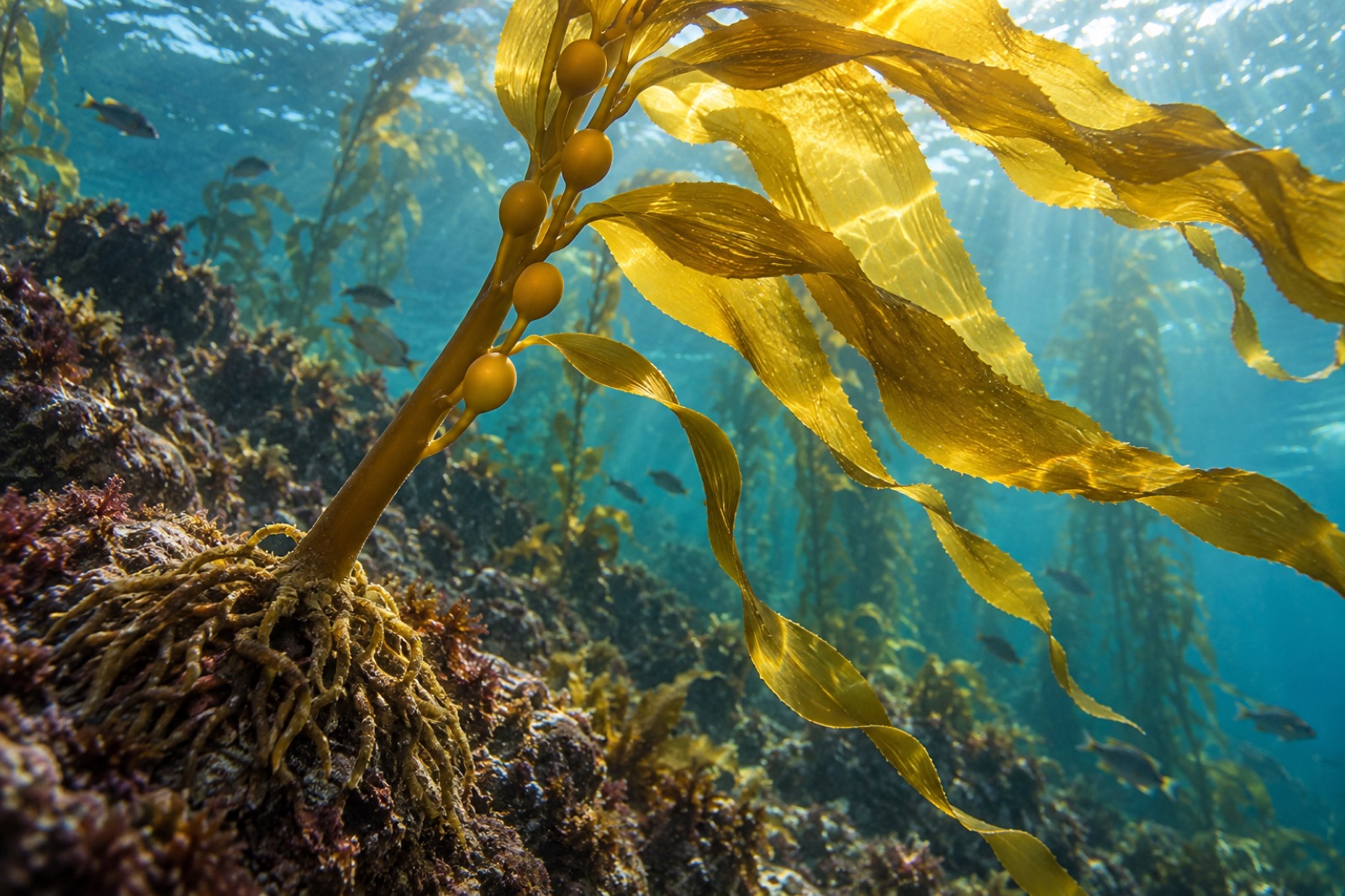
Giant kelp is the fastest-growing organism on Earth and the architect of undersea forests. Learn its biology, life cycle, range and why it matters.
Dr. Theo Nakamura ·
Pterygophora californica grows a woody stipe that stands for decades, sheltering understory life while faster kelps rise and fall around it. Species profile.
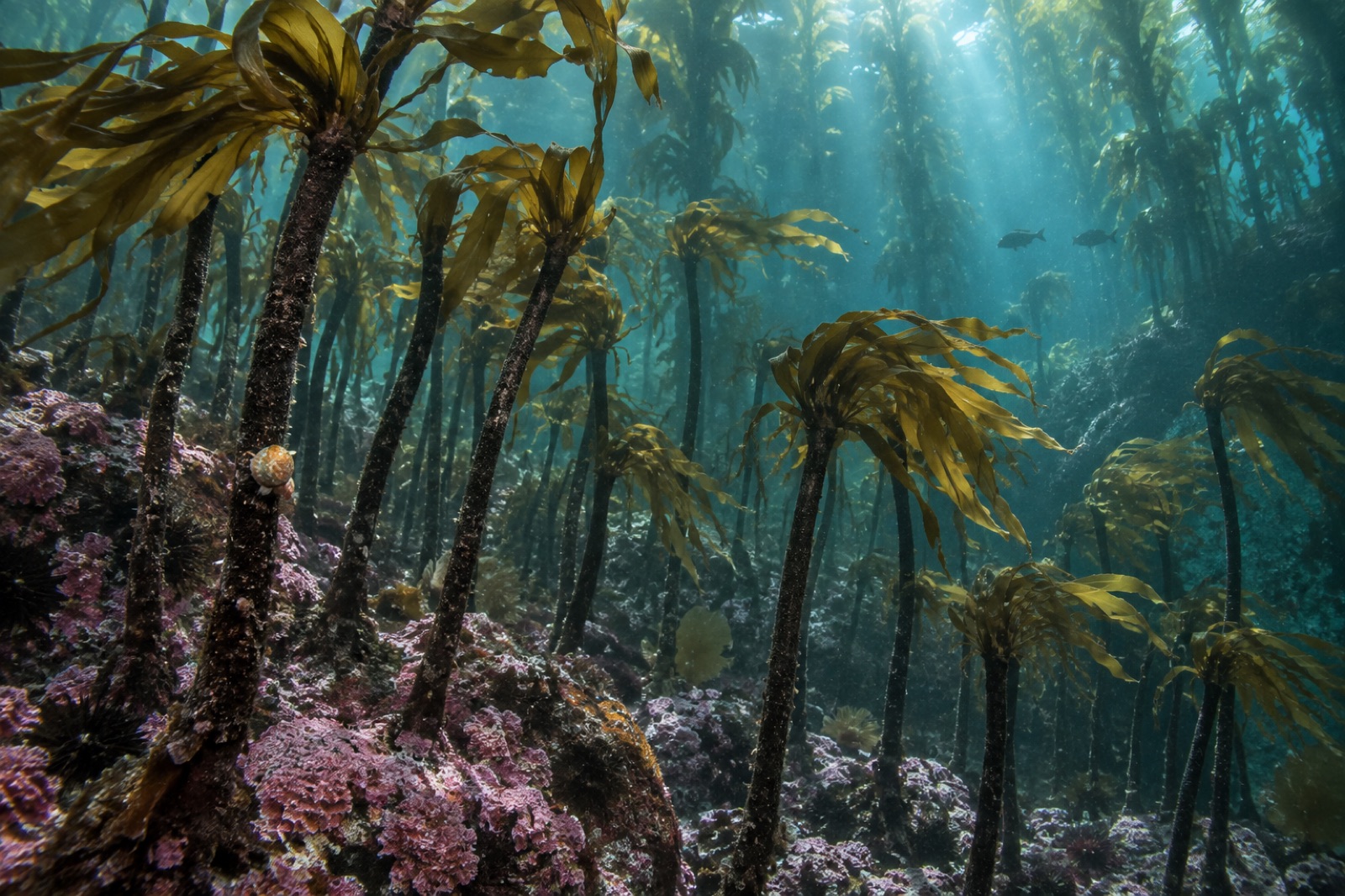
In a mature Pacific kelp forest, most eyes go to the canopy — the streamers of giant kelp climbing toward the light. But at the base of that forest stands a second, older architecture: long-lived understory kelps growing on slow time. The champion of these is the stalked kelp, Pterygophora californica — the only species in its genus, a plant with a stiff, woody stipe that reads like a sapling's trunk and can stand on the reef for twenty years or more. Where its fast-growing cousins arrive, blaze and vanish within years, stalked kelp simply persists, providing an understory of ribs and blades through which fish weave, snails graze and sediment settles. It is one of the kelp forest's most underappreciated frames.
| Scientific name | Pterygophora californica |
| Group | Brown alga, order Laminariales; the only species in its genus |
| Stipe height | Commonly 1–1.5 m; up to about 3 m on old plants |
| Lifespan | Typically over 20 years; growth rings in the stipe show age |
| Depth range | Subtidal, roughly 2–30 m |
| Range | Vancouver Island, British Columbia, south to Baja California |
| Role | Long-lived understory canopy; structural habitat in mature forests |
Stalked kelp grows from a haptera-holdfast like other Laminariales, but its defining organ is the stipe: a slender, stiff strap of tissue that thickens into something like the trunk of a young fruit tree. Cut an old one across and you can see layered growth rings — not seasonal rings, but structural bands laid down through the plant's life, allowing researchers to estimate age by sectioning dead stipes. At the top of this trunk sits a crown of blades that captures the sun below the canopy. Spores are produced on specialised lateral blades — sporophylls — borne at the base of the crown or along the stipe itself, giving the plant a distinctly tufted, many-layered look.
The name itself encodes this architecture: Pterygophora means "feather-bearer" or "wing-bearer" (from Greek pteryx, wing, and pherein, to carry), a nod to the lateral sporophylls that fan from the trunk. The spelling feather boa belongs elsewhere — to the much longer, more pliable feather boa kelp — but the resemblance of a stalked kelp at surface, trailing blades, gives the names a superficial kinship.
Like all kelps, stalked kelp follows the classic two-generation life cycle described in our kelp life cycle explainer: a large sporophyte plant releasing spores that settle on rock, growing into microscopic gametophytes, which fuse to form the next sporophyte. Where it differs is pace:
This longevity has consequences. Giant kelp is a sprinter; stalked kelp is a marathon runner. Where water motion and light allow both forms, the result is a layered forest in which the giant kelp does the dramatic canopy work and the stalked kelp provides lower-level structure for invertebrates, fish juveniles and life-cycle stages that need year-round support.
Stalked kelp is not a species nobody eats — it is a species many organisms use differently:
The species is a Pacific coastal native from Vancouver Island southward to Baja California, common from central California north. It favours clear, energetic rocky reef at depths of roughly 2–30 metres, growing most vigorously where light reaches the bottom through clear water. In southern California it can dominate kelp forests on its own, forming distinct stands beneath or even in place of giant kelp canopy; in British Columbia it is usually one understory layer below the bulls and giants. If you want to see it, look below the canopy and between the giant blades — the woody stipes often appear as pale vertical cords swaying against the darker rock.
Because stalked kelp is slow-growing, long-lived and relatively grazer-resistant, it plays a specific role in restoration thinking. As an early coloniser after clearing, it can help establish kelp cover before giant kelp re-establishes; as a long-term structure, it gives a recovering reef an understory presence that stabilises surfaces and provides habitat over timescales longer than the boom-and-bust of faster kelps. That said, cultivating it at scale is difficult — it is perennial, slow and best propagated from spores rather than hatchery lines — so in Tidewright's (fictional) nursery pipeline, described on the Holdfast platform page, stalked kelp is a monitoring and habitat goal rather than a primary seedstock. Our ecologists count its stands as one of several indicators that a reef has reached a structurally mature stage, as covered in Succession at Sea.
Documented individuals reach over 20 years, and some estimates put maximum ages closer to 25. That makes it one of the longest-lived of the visible kelps — a stark contrast with annual or short-lived species that may rise and fall within one or two seasons.
No. Giant kelp (Macrocystis pyrifera) has a ribbon-like main blade with gas bladders and rapidly reaches the surface; stalked kelp has a woody stipe and an understory crown of blades. Both are common on Pacific reefs but occupy different parts of the forest — giant kelp above, stalked kelp below.
It can be raised from spores, and restoration labs have cultured young plants, but its slow growth and perennial nature make it much harder to scale than the fast-growing annuals used in kelp cultivation. For restoration purposes the species is more often encouraged via habitat and timing than directly seeded.
The stipe contains stiffening structural tissue that gives it a tough, wood-like consistency. This has two consequences: it resists urchin grazing better than blades, and it preserves the growth rings that researchers use to age long-lived plants.
Pterygophora comes from Greek words meaning "wing-bearer", a reference to the lateral spore-bearing blades that fan from the stipe. The species name californica locates it in the Californian context where early collectors first described it.
Giant kelp is the fastest-growing organism on Earth and the architect of undersea forests. Learn its biology, life cycle, range and why it matters.
Dr. Theo Nakamura ·
Elk kelp grows deep, in clear water, with a single antlered float the size of a grapefruit. The deep edge kelp of the Channel Islands and Baja — biology and status.
Dr. Theo Nakamura ·
Coralline algae are calcified red algae that paint reefs pink, cement them together and decide where young shellfish settle. Forms, ecology and climate risks.
Dr. Theo Nakamura ·