Atlas9 min read
Falkland Islands: The Engine of Southern Ocean Kelp
Inside the Falkland Islands' giant kelp beds — among the most extensive on Earth — and the penguins, seals and steamer ducks that run on them.
Dr. Lena Fischer ·
A windswept volcanic island in the sub-Antarctic South Atlantic, ringed by giant kelp and breeding seabirds — and part of one of the most remote marine reserves on Earth.
Some of the world's most important ocean habitat sits in places almost nobody will ever go. Gough Island is one of those places. A small volcano poking through the windswept South Atlantic, roughly 2,600 kilometres from the nearest continental land and part of the Tristan da Cunha group, Gough is difficult to reach, impossible to visit casually, and — for exactly those reasons — ecologically extraordinary. Its cliffs host some of the densest seabird concentrations in the world. Its surrounding waters are cold, kelp-fringed, and part of a marine protected zone of global importance. If you care about what intact cold-water ocean life looks like, Gough is a standard against which much else should be measured.
The Tristan da Cunha group sits in the mid-South Atlantic, on the submarine ridge system that runs between Africa and South America. Gough is the southernmost of the inhabited-region islands — though it has no permanent human settlement beyond the small South African meteorological station that has operated there for decades. The island lies inside the rainy, windy sub-Antarctic belt: the roaring forties and furious fifties, where the wind rarely stops and the sea rarely calms.
The ocean here is sub-Antarctic in character: cold, nutrient-rich, whipped into constant motion, and biologically productive on almost every level of the water column. The kelp forests that ring the island's rocky nearshore are not a curiosity here — they are simply what cold, clear, well-mixed sub-Antarctic water does when it meets rock.
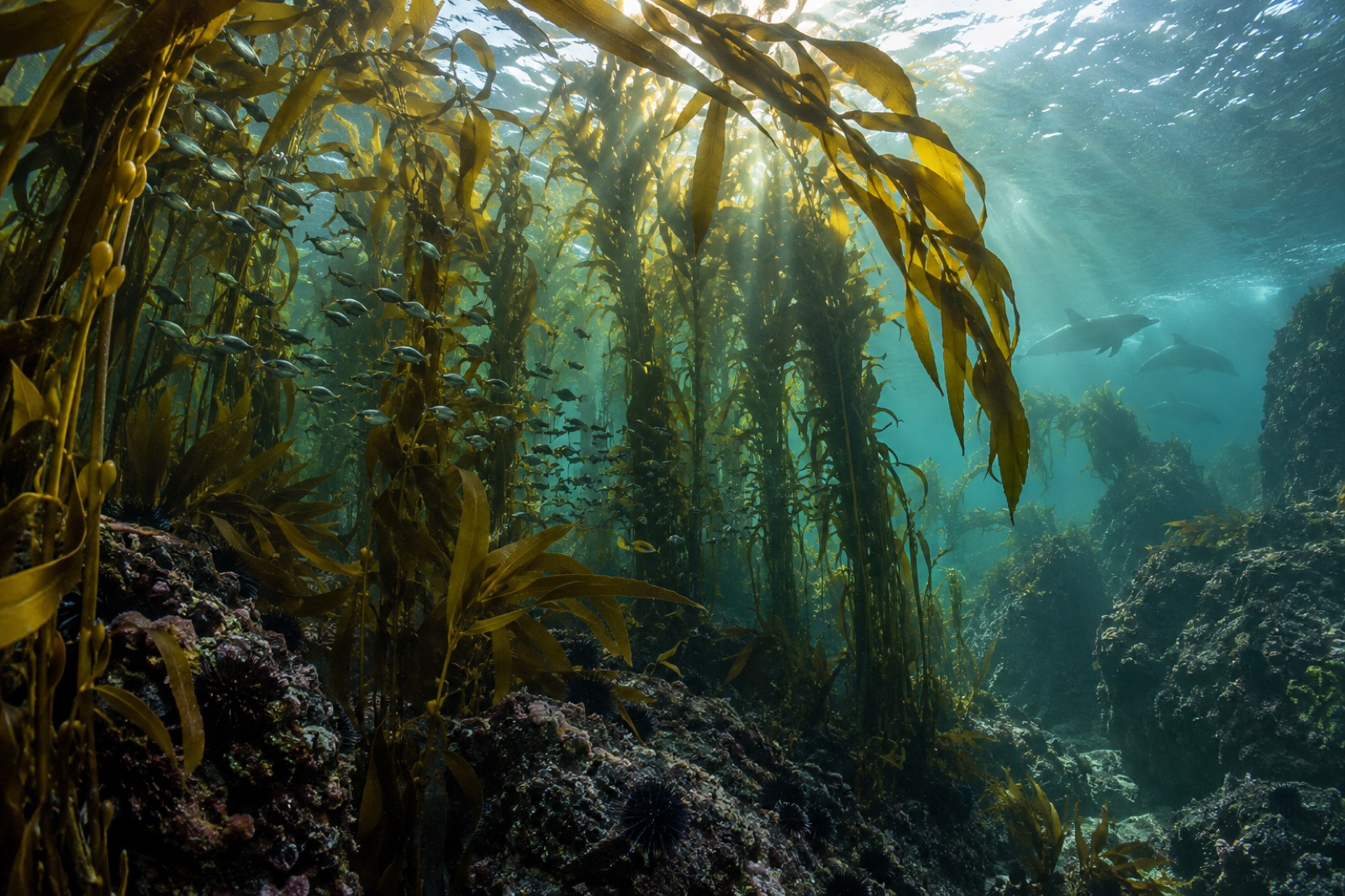
The kelp species is giant kelp (Macrocystis pyrifera) — the same species that forms the great forests of the northeast Pacific, and one of the southern hemisphere's definitive canopy kelps. At Gough, giant kelp fringes the island's narrow hard shore in the wave-pounded shallows, wrapped around the volcanic substrate in a band that comes and goes with the tide.
The forest's position tells its ecological story. The wave exposure here is extreme — few coasts in the world take as much open-ocean swell — and the kelp's grip on the rock is correspondingly tight. Giant kelp in this position plays the same role it plays in every such southern forest: dampening wave energy, providing nursery structure for fish and invertebrates, and exporting organic material into the surrounding food web. The mechanics of holdfast architecture are the subject of our holdfast biology explainer, and the way kelp calms the surface around it in kelp wave damping reads differently once you've imagined giant kelp under South Atlantic swell.
However compelling the kelp, Gough's global significance is airborne. The island is — simply stated — one of the most important seabird breeding sites on Earth. Atlantic petrels, great shearwaters, broad-billed prions, diving petrels, albatrosses: millions of seabirds breed here each year, and several species breed nowhere else in comparable numbers. The island and its close neighbour, Inaccessible Island, together form a UNESCO World Heritage Site, recognised for exactly this reason.
The birds' relationships with the ocean are direct: they feed at sea, often over the productive waters the kelp rings. And the birds bring nutrients back onto the island in the form of guano and dropped prey, fertilising the thin soil and feeding the unique plant-and-invertebrate assemblage on land. It is a single coupled system — the kelp fringe, the sub-Antarctic productivity, the seabird colonies, the island's terrestrial ecology — and any pressure on one part propagates through the rest.
Two conservation stories shape that system right now. First, house mice introduced accidentally decades ago now prey on the chicks of ground-nesting albatrosses and petrels, with catastrophic consequences for the globally threatened Tristan albatross in particular; a large international conservation effort has been working to address this. Second, the surrounding waters are protected under the Tristan da Cunha marine protection regime, one of the largest no-take marine protected areas in the Atlantic. Our explainer on marine protected areas describes what such designation actually means on the water.
Almost certainly not in the ordinary sense, and that is by design. Gough has no tourist operations; access is limited to the small scientific station, occasional conservation teams, and the rare resupply vessel that services the station from South Africa. The island's very inaccessibility is a large part of what protects it. For most of us, Gough is a place to learn about, visit through the meteorological station's reports and the extensive scientific literature, and support from afar — through the conservation organisations working on the mouse-eradication programme and marine protection in the wider South Atlantic.
That isn't a limitation of the place; it is a description of what's most valuable about it. Some places are worth protecting precisely because we don't get to go there.
Placed on the map alongside the other sub-Antarctic and remote-ocean kelp coasts in this atlas — the Falkland Islands, the southern reaches of the Strait of Magellan — Gough sits at the far southern end of the Atlantic's cold-kelp world. Together these coasts form a network of intact or nearly-intact kelp forest across the southern ocean, and they anchor our understanding of what a kelp forest looks like when it has not yet been heavily worked, warmed or stripped. In that role, Gough functions as a kind of reference ecosystem: a benchmark of comparison for the restoration of forests elsewhere, and a reminder of what the baseline once was.
Gough Island is part of the British Overseas Territory of Saint Helena, Ascension and Tristan da Cunha. The nearest permanent human settlement is on the island of Tristan da Cunha itself, several hundred kilometres to the north, and the Gough station is operated by South Africa under long-standing agreement.
Together with its neighbour Inaccessible Island, Gough holds some of the most significant seabird breeding colonies in the world, including species that breed nowhere else in comparable numbers. The site was inscribed as a UNESCO World Heritage Site on the strength of this global seabird significance and the islands' near-pristine state.
Giant kelp (Macrocystis pyrifera), the great southern hemisphere canopy kelp, forms the island's kelp forests. It occupies the wave-exposed rocky nearshore and plays the same ecological role here as in the Pacific: canopy structure, wave dampening, nursery habitat, and a continuous export of productivity into the surrounding food web.
No ordinary tourist access exists. The island is serviced only by the resupply vessel that visits the South African weather station, and there are no tourism operations. Access is effectively restricted to the station personnel, conservation staff and the occasional research expedition. The conservation organisations working there welcome support, but not visitors.
A long-running international conservation effort — involving UK and South African partners — has worked to eradicate the house mouse population from Gough to protect the breeding seabirds. This is one of the most ambitious island-restoration operations attempted in the sub-Antarctic, and the outcomes continue to be monitored carefully.
Inside the Falkland Islands' giant kelp beds — among the most extensive on Earth — and the penguins, seals and steamer ducks that run on them.
Dr. Lena Fischer ·
Inside the subantarctic kelp forests of the Strait of Magellan and Tierra del Fuego: cold clear water, drifting kelp highways, and science at the southern frontier.
Dr. Elias Brandt ·
MPAs, marine reserves, no-take zones explained — how protection levels differ, what the evidence shows, and what MPAs can and can't do for kelp forests.
Dr. Mara Ellison ·