Atlas9 min read
The Shetland Islands: Kelp, Otters and the North Atlantic Front
Shetland grows some of Britain's finest kelp forests: clear northern water, Eurasian otters and an intact sea culture on the North Atlantic front.
Dr. Mara Ellison ·
Sixty degrees north, where the North Sea and Atlantic squeeze through Shetland's sounds, tide races drive some of Britain's richest kelp — and put conditions on everything.
Stand on the shore at Bluemull Sound at full flood and you are watching an argument between two seas. The Atlantic pushes one way around Shetland's northern rim, the North Sea pushes back from the east, and between Unst and Yell the squeezed-together water simply accelerates. Where the two seas agree to differ, the current can run at speeds that make experienced tide-watchers go quiet. Every six hours it stops, turns, and does it again the other way. And under all that churn, in water as clear as anywhere in Britain, grow some of the finest kelp forests in the country.
Our broader guide to the Shetland Islands covers the archipelago, its otters and its culture. This article is about the tides themselves — how Shetland's position at the Atlantic–North Sea meeting point controls the kelp, the diving and the diving schedule of every visitor who wants to see either.
Shetland sits at almost exactly 60° north, roughly 170 kilometres from the Scottish mainland and over 300 from Norway — closer to Bergen in spirit than Edinburgh, as islanders will tell you. Geographically it is a hinge: the Atlantic to the west, the North Sea to the east, and no continental shelf edge nearby to damp either.
Tides here are not simply local. The Atlantic tide wave and the differently phased North Sea tide wave arrive at Shetland at different times and with different amplitudes. Around the main island (Mainland) they meet and mix; through the four great sounds — Yell Sound, Bluemull Sound, Bressay Sound and the narrows around Mousa — the phase difference between the two seas expresses itself as raw horizontal movement. Springs can push currents of several knots through the sounds; Bluemull Sound is known to reach six knots and beyond on big tides, with standing waves and overfalls where the channels pinch and shelve.
For kelp, that moving water is a gift. Current is oxygen delivery and nutrient supply rolled into one; tide-swept kelp sits in a permanent conveyer belt of fresh seawater, grows fast, and stays nearly free of the smothering silt that settles on stiller coasts. Shetland's tide races grow oarweed, sugar kelp and dabberlocks in ribbons along the sound walls, and beneath the canopy the reef communities of plumose anemones, soft corals and sponges are as rich as anything on Britain's northern rim.
Three species do most of the structural work in Shetland's shallow water:
Oarweed (Laminaria digitata) dominates the low shore and shallow subtidal of exposed sides — the classic split-frond kelp that bends rather than breaks in a rising sea.
Sugar kelp (Saccharina latissima) takes over in slightly more sheltered water and deeper down, its long corrugated fronds stretching away with the stream. In the sounds it forms the canopy of what scuba divers would call a kelp forest — waist-to-chest-high beds over rock out to ten metres or more.
Dabberlocks (Alaria esculenta) occupies the fiercest outer ledges, a streamlined, midribbed kelp built precisely for the surf zone of a 60-degree-north winter.
Where the water is very sheltered — heads and inner reaches of voes like Sullom Voe, Weisdale Voe and the landlocked basin of the Loch of Strom — kelp thins and the classic cold-water kelp forest yields to beds of horse mussels, sea loch anemones and fragmentary kelp on whatever hard bottom remains. The mapping between tide and kelp is so clear that experienced Shetland divers read it off the chart: overfalls marked on the sound, expect a kelp-lined wall with anemones; no current marked, expect mud and scallops instead.
Shetland's diving is defined by the simple fact that slack water runs everything. The general Shetland and Orkney overview touches on sites; here is how the tides shape the experience on the water.
Bluemull Sound is the archipelago's signature drift dive. Run on slack-to-slack timing through local dive operators, the drift carries you past kelp-topped boulders, scallop fields and walls painted with dead man's fingers soft corals. Sightings of orcas — the so-called 27s pod and others that patrol the sound for seals — make even the safety stops interesting. The six-knot reach of the full flood is for slack-water specialists only: time it wrong and you have no dive at all and possibly no boat position.
Lerwick and Bressay Sound offers protected-water wrecks (including Second World War casualties), walls and kelp gardens within sight of the town, rescuable from most wind directions. It is the sensible choice when the outer coast is stormbound, which at 60° north is often.
Outer Skerries and Out Skerries — Shetland's far-eastern satellite group — deliver the Atlantic edge: clear blue water, schools of saithe whirling over the kelp walls, and seals that genuinely want to play. Boat access only.
Mousa Sound and the Iron Age broch coast give gentler slack-timed dives over kelp and maerl fragments, with storm petrels returning overhead on summer nights.
Then there is the light. Midsummer brings the simmer dim — the night that never quite lands — and diving at 11 pm in sideways dusk light through sugar kelp is an experience with almost no equivalent at British latitudes. Winter inverts it: three hours of usable light and water down near 6 °C, drowned in plankton-free clarity. Both ends of the year have their partisans.
The tidal engine has shaped Shetland above water too. Voes — Shetland's sea lochs — gave the Norse their harbour lines; every town from Lerwick to Hillswick sits where the tide offered shelter. The islands' famous otters — Britain's densest and most visible population — hunt along kelp-skirted rocky shores where the tide concentrate their prey; and the orcas that summer visitors come specifically to see are here precisely because the currents funnel harbour seals and, in spring, harbour porpoise through the sounds.
The tidal energy is also Shetland's renewable frontier. Tidal stream turbines have been tested in Bluemull Sound — deploying generating capacity into the very flow that makes this coast a dive destination. The local discussion about how to share the sounds between energy, aquaculture, fishing and the diving community is one of the more sophisticated versions of that conversation happening anywhere in Britain, and it matters: tide races are both a kelp ecosystem and a power source, rarely more than once.
If you take one skill to Shetland, let it be tidal literacy. Reading tide tables is good general preparation; add the mechanics of how tides work and then overlay sheer geography: slack in Bressay Sound is not slack in Bluemull Sound, which is not slack at the Out Skerries. Local advice beats local charts — every boat skipper in the islands carries knowledge that no tide app reproduces.
Other practicalities that matter at 60° north:
Shetland sits near the northern limit of Britain's kelp forest range and squarely in the current conversation about how northern hemisphere kelp responds to warming seas. There is no suggestion the forests here are collapsing the way Tasmania's giant kelp did — Shetland's kelp is considered broadly healthy — but the islands are part of the wider monitoring picture for exactly that reason. Northerly, cool, current-fed and intact, Shetland's kelp beds are among the reference ecosystems for what a working northern kelp coast still looks like, and every dive logged and every sighting recorded here feeds into the understanding of where the range edges hold and where they retreat.
On spring tides the sounds can run at several knots — Bluemull Sound reputedly beyond six — with standing waves and overfalls where the channels constrict. That is strong enough that most diving and even sea kayaking is slack-water planned. Talk to a local skipper or the dive operators, not just an app.
Yes, with moderation. The Lerwick and Bressay Sound area offers sheltered sites and wreck diving within easy range of town, and local operators will happily arrange beginner-friendly days between the tide races. Bluemull Sound drifts and the Out Skerries walls are for experienced, current-comfortable divers. See our broader Shetland overview for orientation.
May to September gives you workable weather windows, the long light and water up to about 12–13 °C. September often combines the year's warmest water with clearing visibility as the plankton thins. Winter offers dramatic clarity for the hardy and properly equipped.
Because the tide concentrates their prey along the kelp-fringed rocky shoreline all day, every day. Shetland's otters are habitually day-active — unusual in Britain — and along current-swept shores between kelp-covered reef bits and the shallows they are as reliable to see as anywhere in the country. Give them space and watch quietly; our otter profile covers the northern Pacific species, but the fieldcraft of watching is transferable.
Yes — Shetland is arguably Britain's most reliable place to see orcas, particularly through spring and summer when pods hunt seals around the sounds. Bluemull Sound and the west Mainland coastline are recurring hotspots. Sightings are never guaranteed, but the odds here beat almost anywhere else around the British Isles.
Shetland grows some of Britain's finest kelp forests: clear northern water, Eurasian otters and an intact sea culture on the North Atlantic front.
Dr. Mara Ellison ·
Orkney and Shetland hold Britain's most exposed kelp forests: tide-scoured channels, otter-rich shores and the sunken fleet of Scapa Flow. A coastal atlas guide.
Jack Callum ·
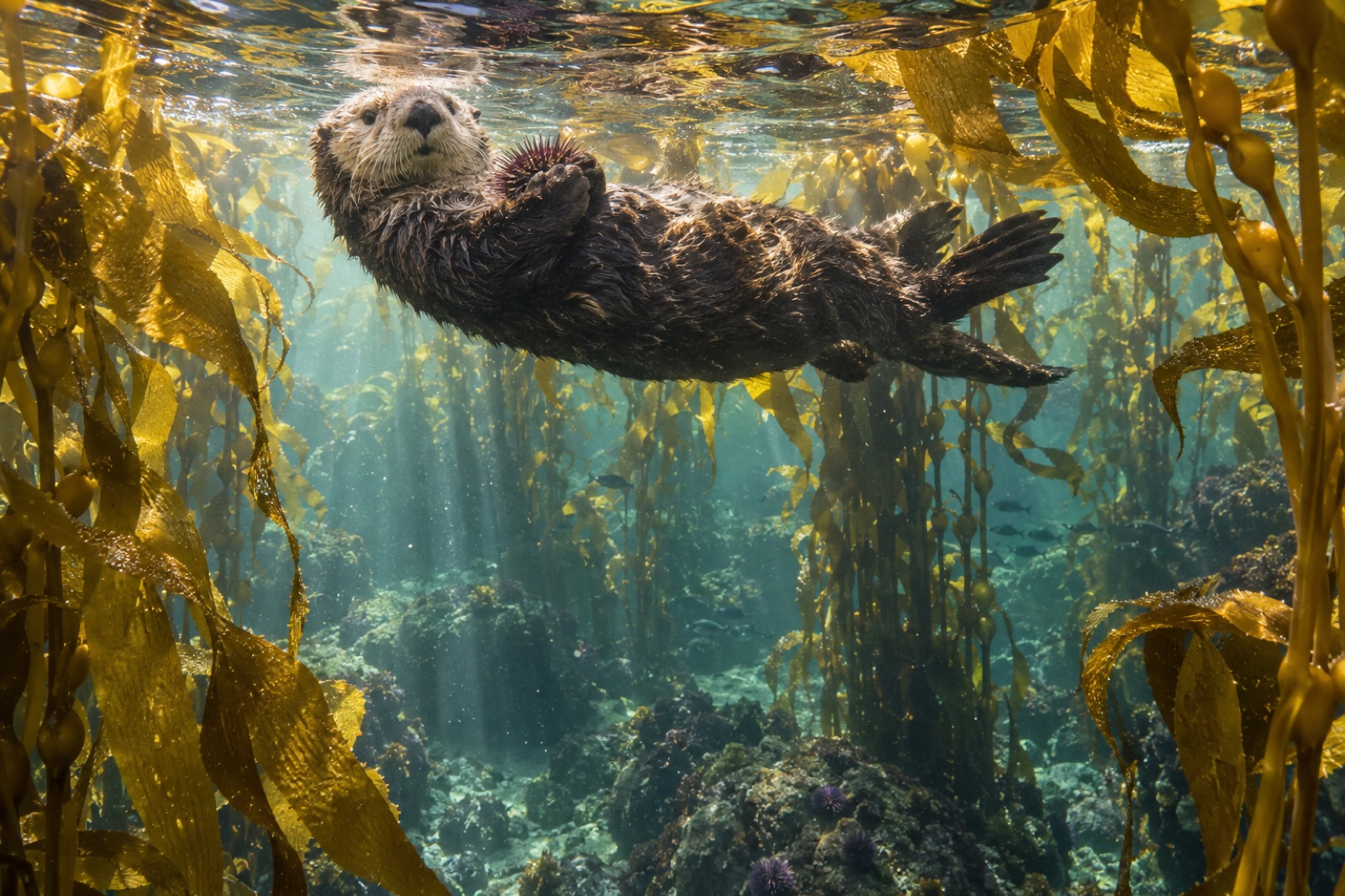
Sea otters eat a quarter of their body weight a day — much of it sea urchins. How this small predator became the kelp forest's most famous keystone species.
Dr. Mara Ellison ·