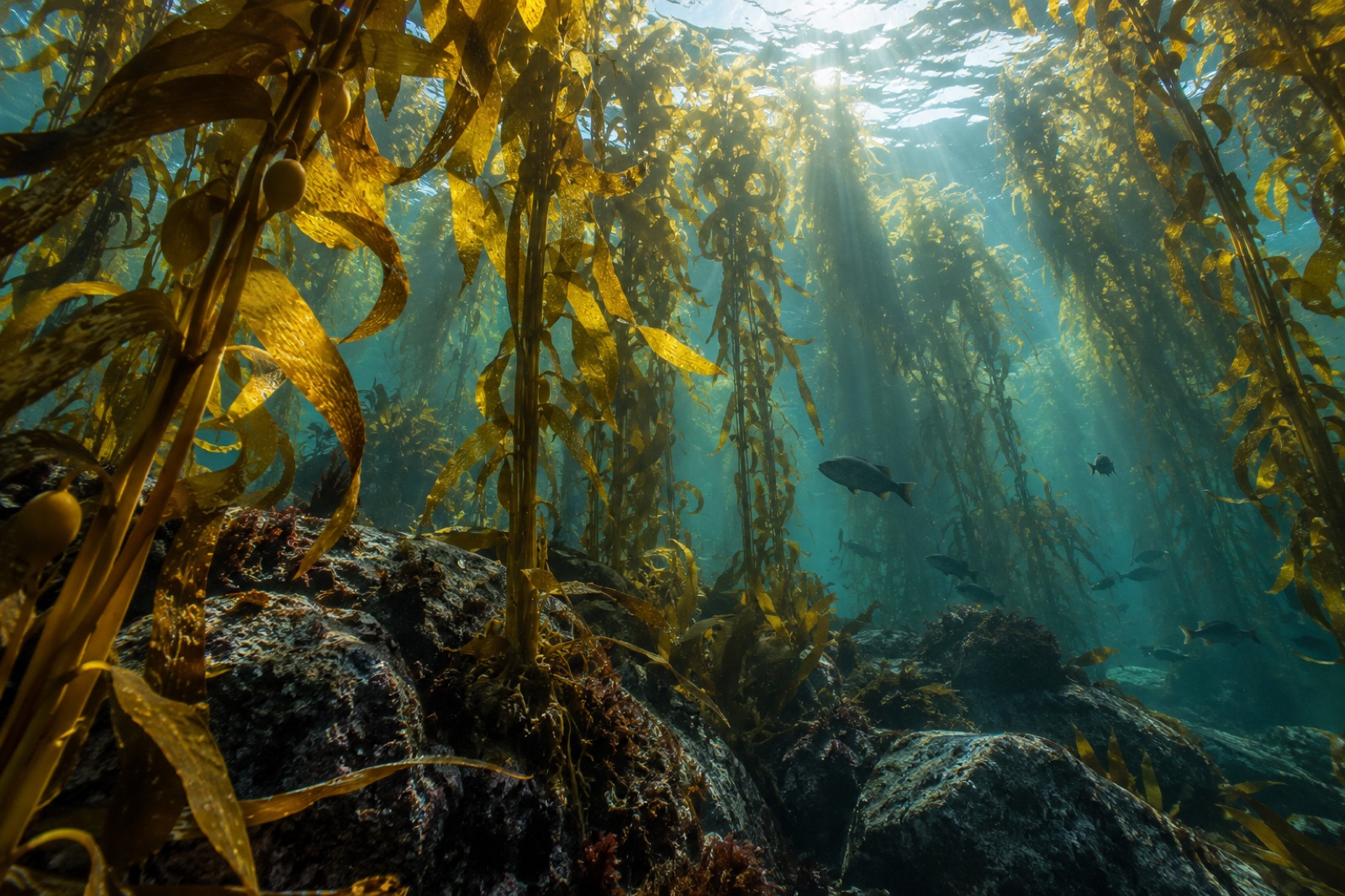
Most estuaries are places rivers go to rest. The Derwent — the estuary that Hobart was built around — is something else: a drowned rift valley carrying water from the Tasmanian highlands down to Storm Bay, deep enough in its lower reaches for the research icebreakers and expedition ships that have always moored there. Over ~60 km from New Norfolk to the Iron Pot lighthouse at its mouth, it passes a working city, a smelter a century old, a museum that changed Australian art tourism, and — quietly, below the ferry wakes — some of the most instructive kelp habitat on the Great Southern Reef.
This guide covers what grows in the Derwent, what a hundred years of industry did to it, what's being restored in full view of the city's southern suburbs, and where you can see the estuary's subtidal life without going far from a coffee.
An estuary cut from mountains
The Derwent's seaward reach sits in a broad drowned valley, and that geology gives it two characteristics divers notice immediately: darkness and depth. Tannin-stained freshwater from the Huon pine country filters the light in the upper estuary; the lower estuary, well mixed with Tasman Sea water, clears substantially in winter and can carry 8–15 metres of visibility on good days.
That mixing matters for seaweeds. Nutrient-rich freshwater rides over the salt wedge and out to Storm Bay, but the estuary's rocky margins — dolerite, sandstone, the occasional boulder field — hold true marine communities within a few kilometres of the suburbs. You can stand on the foreshore at Bellerive and be looking at kelp country.
The estuary also marks a biogeographic tension line. It sits at the junction of Tasmania's east-coast East Australian Current influence and the cooler D'Entrecasteaux Channel, so its seaweed assemblage mixes warm-edge and cold-edge species — useful for scientists, and increasingly for climate watchers.
What grows in the Derwent
The foundation: golden kelp and rocky-reef seaweeds
The backbone of the Derwent's seaweed habitat is golden kelp (Ecklonia radiata), the workhorse canopy species of southern Australia, fringing rocky reefs from Taroona down to Tinderbox and across to South Arm. Around it sit crayweed (Phyllospora comosa), dense turf communities, and coralline understory. On the exposed outer shores toward Fortescue Bay, the surf-battered giant Durvillaea potatorum takes over the intertidal zone.
These aren't wilderness forests. They are urban-influenced beds that have survived a century of industrial discharge, port traffic and sediment — and that stubbornness is precisely what makes them ecologically interesting.
The giant kelp question
The Derwent holds some of the most closely watched remnants of Macrocystis pyrifera in Australia. Tasmania's east coast has lost the overwhelming majority of its giant kelp forests over recent decades — a collapse well documented in the scientific literature and tied to warming water and marine heatwaves — and in 2012 the giant kelp ecological community was listed as endangered under national environmental law. The full story is told in our guide to Tasmania's vanishing giant kelp.
The Derwent's significance is that a few of its sites — most famously the bed at Tinderbox — persisted and even recruited through parts of the decline, in water just cold and sheltered enough. That made the estuary a natural laboratory: if warm-adapted conditions hurt giant kelp, what do the survivors here tell us about which genotypes to seed elsewhere?
Life between the fronds
The estuary's sandy bays and seagrass meadows support one of the genuinely strange southern oddities: the spotted handfish, a famously rare anglerfish relative that walks on modified fins and lives almost nowhere else in the world. It's one of several reminders that restoration here isn't only about kelp — the target is a whole nearshore food web, from corallines up through the banded morwong and old blue gropers that cruise the reef edges on the estuary's seaward side.
The industrial century
You can't write honestly about the Derwent without its sediment story. A zinc smelter at Lutana operated for over a century, and legacy metals — zinc, cadmium, copper, mercury — are present in estuarine sediments, a fact documented by the Derwent Estuary Program's own reporting. Local advice has consistently been cautious about frequent consumption of fish and shellfish from the mid-estuary; anyone harvesting or fishing should check current Tasmanian government advisories.
The fair counterpoint is that the estuary has improved. Sewage and industrial discharges have been progressively upgraded, and monitoring by the Derwent Estuary Program records improving trend lines on several water-quality measures. The result is a subtle and unusual condition: an estuary where the water column often looks and tests far better than the legacy sediment beneath it. For restoration, that matters deeply — you need clean water for kelp, but you can't assume clean water means an uncontaminated reef.
Restoration in the front yard: the Tinderbox pilot
Tidewright's Tinderbox Pilot sits on a small suburban bay on the estuary's western shore, a twenty-minute drive from Salamanca Place. It was deliberately chosen for visibility: a walkable headland, a swimmable beach, a snorkel trail, and a reef that had flipped towards urchin barren within living memory — part of the long southward march of the long-spined sea urchin that has reshaped so much of Tasmania's east coast.
Over three seasons, the program seeded 75 hectares with Holdfast lines carrying heat-selected Macrocystis genotypes, alongside golden kelp enhancement and structured community monitoring. (All Tidewright figures on site are the company's own, labelled illustrative where relevant — the young canopy visible from shore is very real in the telling, as the broader Tasmania recovery effort is absolutely real in the science.) The site's significance isn't its size; it's that a school group can watch divers work a restoration plot on a Tuesday and snorkel over the living kelp on Saturday. Tidewright's field journals from those first seasons — week one on the Tinderbox reefs and the year it grew back in public — read almost like a civic diary.
Community science is part of the identity here. Reef Life Survey, the citizen-science diving standard now used around the world, was born in Tasmania; the Derwent Estuary Program coordinates monitoring across the catchment; and local scuba clubs log what the gardens grow and lose. If there's a model city for restoration-in-plain-sight, Hobart and the Derwent are the template.
Where to see the estuary's kelp coast
- Tinderbox — the classic. Shallow reef, kelp fringe, snorkel trail, headland walk, and the restoration plots close to shore. Best on calm winter mornings.
- Taroona — an easy entry with golden kelp over granite boulders; look for draughtboard sharks and blue-throated wrasse.
- Bellerive Bluff — the eastern shore's accessible reef, with kelp beds within a short swim of the ferry run.
- South Arm and Opossum Bay — exposed outer-estuary reefs where storm swell meets kelp; only for experienced divers and calm seas.
- The Channel, south of the Iron Pot — where the estuary hands off to forests described in our guides to Bruny Island and Fortescue Bay, cooler and wilder.
Swimming from June to September is a commitment — water temperatures drop to the low teens — but visibility is at its best, and this is when the Tinderbox bed is at its stillest and most school-bus friendly.
Key takeaways
- The Derwent is deep, mixed and biogeographically transitional — kelp habitat in the literal front yard of Hobart.
- Its seaweed communities (golden kelp, crayweed, remnant Macrocystis) survived a heavy industrial century; clean water today sits over legacy-contaminated sediment.
- Giant kelp's Tasmanian collapse is nationally documented; the Derwent's surviving beds help explain which young forests to seed next.
- The Tinderbox Pilot is the model for community-visible urban restoration — and one of the few places you can watch the science from the shore.
- Citizen science is deeply embedded here; beginners can contribute real monitoring data on their first shore dive.
FAQ
Can you dive or snorkel the Derwent Estuary itself?
Yes. Taroona, Bellerive Bluff and Tinderbox all have shore access to rocky reef and kelp fringe. Winter brings the clearest water; entry-level swims are realistic in a 7 mm wetsuit.
What happened to the Derwent's giant kelp?
Tasmanian Macrocystis declined severely through decades of warming and marine heatwaves arcing down the east coast, and the wide forests that once flanked much of the coast are now mostly gone or fragmented. A small number of sites — including the Tinderbox bed in the estuary system — persisted, which is why the estuary matters disproportionately to the national recovery effort.
Is it safe to eat fish or seaweed from the Derwent?
Check current Tasmanian government and Derwent Estuary Program advisories before consuming anything from the mid-estuary; legacy metals in sediment are the concern. The outer estuary and open coast are a different matter, but official advice always takes precedence over anything written here.
What's the best season to see kelp at Tinderbox?
Winter (June–September) for visibility and calm detail. Summer for warmth and shore picnics; the canopy is weaker in tannin-stained flow years.
How do restoration genetics work — does local kelp matter?
Hugely. The Holdfast system grows seedstock matched to local provenance and selected for warm-tolerance, because kelp populations carry site-specific adaptation. Seeding the wrong genotype is how well-meaning projects fail; our field notes on provenance and genetics go deeper.