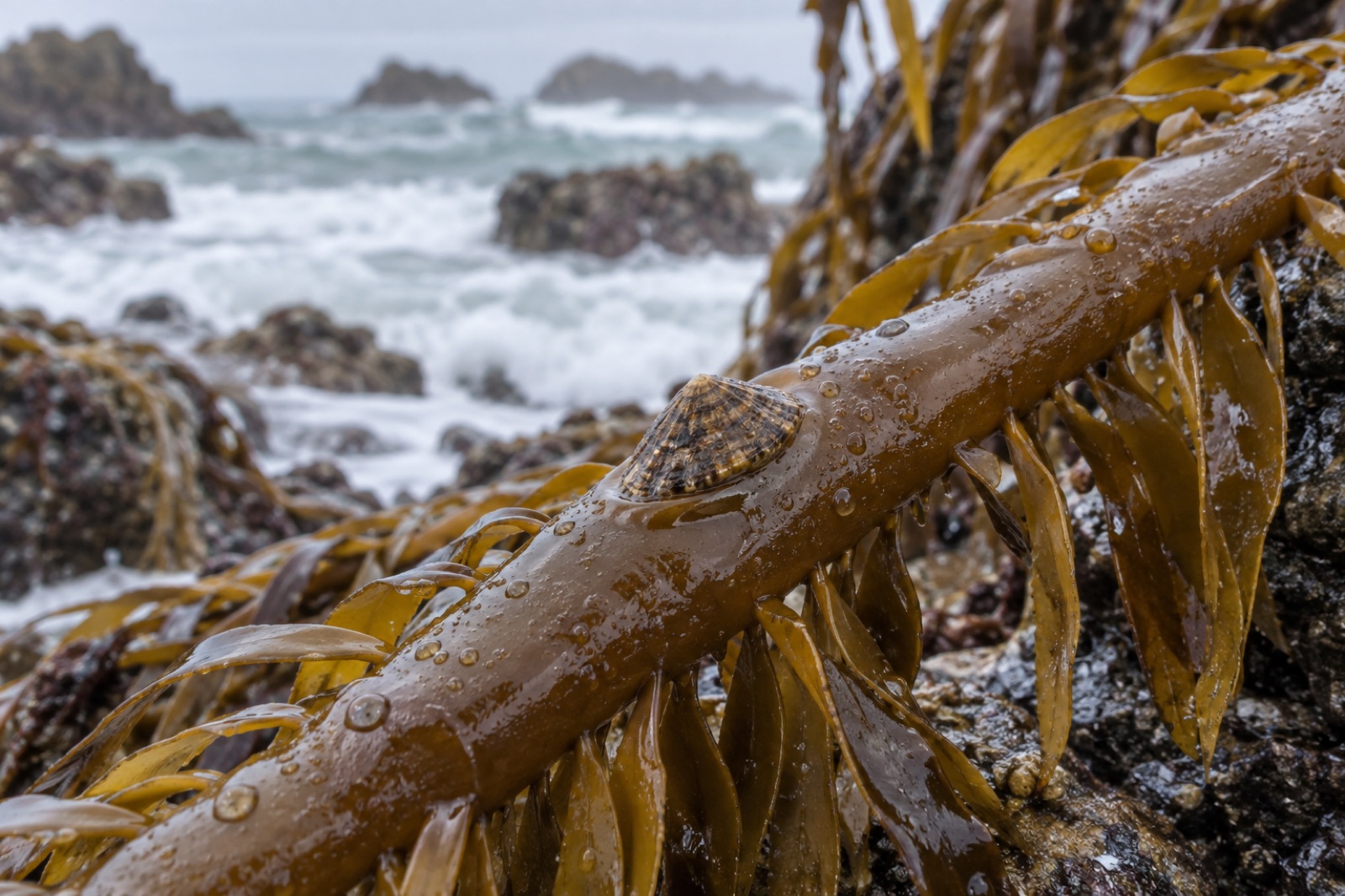
Some seaweeds host visitors. Feather boa kelp hosts a tenant. The kelp limpet (Discurria insessa — older books list it as Collisella or Notoacmea insessa) is a small, low-capped limpet that spends essentially its entire post-larval life on a living stipe of feather boa kelp, grazing the surface, defending it from squatters, and carving a shallow seat for itself in the tissue of the plant. It is almost never found anywhere else. The Latin name is the whole biography: insessa means "seated upon," and the species is one of the clearest obligate partnerships on the Pacific kelp coast.
This profile covers how to identify the limpet and its home scars, the one-limpet-per-stipe rule that governs its little society, the genuine debate over whether it is the kelp's gardener or its parasite, and where on the coast to go meet one.
Identification: a brown cap on a brown rope
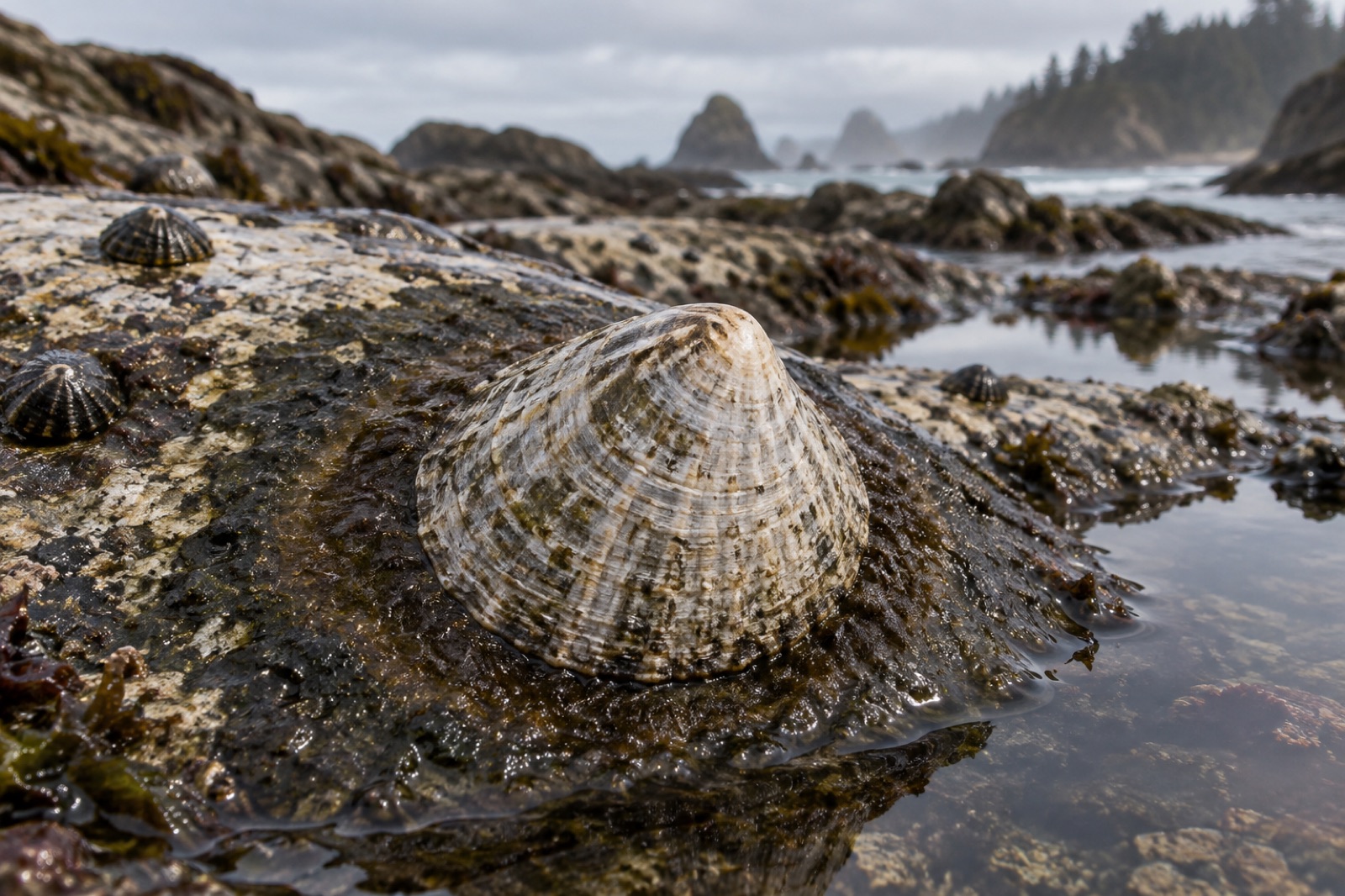
The kelp limpet is a true limpet (family Lottiidae), closely related to the owl limpets and finger limpets of the open rock. The shell is an oval, low cone up to about 2.5 centimetres long, smooth-finned or finely sculpted, with the apex — the peak — shifted noticeably toward the front end. The colour is the identifier: a matte, slightly speckled brown to olive that sits almost exactly in the register of a wet feather boa stipe, so that a limpet at rest reads as a knot in the rope of the kelp rather than an animal on it.
The foot is broad, grey and strong. The giveaway in the field is not the shell but the seat. A resident kelp limpet occupies a home scar: a shallow, limpet-shaped depression in the stipe surface whose outline matches the shell's margin, the scar floor scoured smooth by years of grazing. The limpet sits in the scar at rest, clamped flush, and the whole assembly — brown cap, grey foot, brown rope, concave seat — is instantly recognisable once seen. On Alaska-to-Baja shores, a limpet on Egregia is Discurria insessa; there is effectively no other candidate.
One limpet, one stipe
The feather boa kelp is itself a specialist's world: a long, strap-like stipe trailing dozens of flat blades, living in the high- to mid-intertidal of wave-swept rock from Alaska to Baja California, holding fast where the surf is too violent for most kelps. Every mature stipe of any length is, in its normal condition, occupied — typically by a single kelp limpet, stationed somewhere along the stipe's length.
The residents defend their address. Small-scale experiments and decades of naturalist observation describe a system of interference: an intruder limpet that mounts an occupied stipe is pushed — levered with the shell margin, shoved bodily along the rope — until it lets go or is displaced off the resident's grazing range. Residents that are removed are replaced within days by wandering limpets from elsewhere on the plant, suggesting a standing population of unsettled juveniles and adults looking for vacancies. The result is that a long feather boa plant is effectively parceled: a stipe here, a stipe there, each with its grazing owner, each owner the holder of a seat.
Territoriality at this scale, in a limpet, is rare enough to be the thing ecologists cite when they want to show that even a two-centimetre grazers' world has its property law. The species it most resembles in this pattern is the Atlantic's blue-rayed limpet, another kelp-stipe specialist on a different ocean's kelp — convergent evolution of the same idea, the limpet that takes its whole range from a single plant.
The home scar: engineering a wave-washed seat
A feather boa stipe in its habitat is a brutal address: a rubbery rope in the white water, swept and flexed every few seconds by the surf. A limpet sitting on a convex, moving surface in that surf is a lift-and-drag problem waiting for its answer, and the answer is the home scar. By grazing repeatedly around the same station, the limpet scours the stipe surface down to a shallow depression whose floor is flat and whose rim rises just enough to break the flow; the shell's margin fits the scar's rim, and the animal at rest seals to the plant almost as flush as a rock limpet seals to rock. It is the same solution — a custom-fitted seat — that the owl limpet and other rock limpets use on stone, executed here on a living, growing substrate that must be re-cut as the kelp adds surface. That means the scar is maintained, not made once: the limpet's grazing keeps the seat true.
The strength of that seal against the physics of a flexible plant is what keeps the animal in place; the plant, for its part, flexes rather than fights the wave, and the limpet rides the rope.
Gardener, tenant or parasite?
Whether the kelp limpet is "good" for feather boa kelp is a genuinely open-looking question, and the honest answer is that it is a little of each. The limpet grazes the stipe's surface continuously: it scrapes the diatoms and microalgae that settle in the surface film and it removes settling biofilm, bryozoan larvae, hydroids and young epiphytes before they can encrust. In that role it is the kelp's cleaner — a gardener keeping the photosynthetic rope free of squatters, in the same tradition as the mesograzers that keep blades clean. Since Egregia stipes carry much of the plant's photosynthetic area, a clean stipe is a working stipe.
But the grazing is not free. The limpet rasps the kelp's own epidermis to get at the film, and at high limpet densities the cumulative scarring of hundreds of scrape-sites, year on year, visibly thins and furrows old stipes; grazed stipes, weakened at scar rims and grazing tracks, break more readily in storms. Stipe breakage is the end of a limpet's world. A rough net read is: one or few limpets per plant, mostly cleaning; many limpets per plant, cumulative damage. The kelp limpet is best described not as friend or enemy of the kelp but as its long-term lodger — a tenant whose rent is paid in maintenance and whose wear on the building is real.
Life history: staying on, and coming home
Kelp limpets are broadcast spawners with separate sexes, shedding eggs and sperm into the water above the bed; the embryos develop to a brief planktonic stage and settle — with strong preference — onto feather boa kelp. Settlement onto the specific host implies the larvae read cues off the plant's surface: biofilms characteristic of the living kelp, the chemical signature of the thallus, or both; however the cue reads, the larvae nearly always land where the species needs to be.
Once on a stipe, the animal's geographic world is measured in hand-spans. The resident forages around its scar — on the excursions its radula-scrape marks map — and returns to the same scar to rest, following its own outgoing mucus trail home the way rock limpets do. Homing on a plant that swings in surf is among the cleaner demonstrations that limpets navigate their world chemically and remember it spatially: a limpet put back on the wrong plant is disoriented; a limpet put back on its own stipe goes home.
Where to see one
Any surf-washed rocky point with feather boa kelp in range will hold them; Oregon and northern California are the heartland, and the beds of the Mendocino coast and the reefs of Point Reyes are classic places to find them, with populations thinning toward both ends of the range. Go at a low tide when the swell is small, part the wet mass of feather boa stipes on a mid-shore rock, and run your eye along the ropes: the seat with the brown cap is the limpet. Look too at vacant scars — pale, limpet-shaped pits on an unoccupied stipe — which document the plant's history of residents. If you lift a stipe from the water to look, lay it back the way it lay; the kelp and its limpet both prefer the surf exactly as it was.
Key takeaways
- The kelp limpet (Discurria insessa) is a small (to ~2.5 cm) lottiid limpet that lives as a near-obligate on the stipes of feather boa kelp (Egregia menziesii) from Alaska to Baja California.
- It carves and maintains a custom-fitted home scar in the living stipe — the key to staying sealed onto a moving rope in heavy surf — and typically occupies one stipe alone, actively pushing intruders off.
- It grazes the stipe's surface continuously, clearing settling epiphytes and biofilm (a cleaning service) while also rasping the kelp's own epidermis (a cumulative cost).
- Larvae settle specifically onto feather boa kelp; adults home to their own scar along their mucus trails.
- The best field marks are a limpet-shaped seat pit in a feather boa stipe and a brown cap that reads as a knot in the rope until it moves.
FAQ
Does the kelp limpet live on anything besides feather boa kelp?
Essentially no. Records of Discurria insessa off Egregia menziesii are the rare exception; the species is one of the most strictly host-bound invertebrates on the Pacific coast. If the host kelp disappears from a shore, the limpet goes with it.
Is the kelp limpet harming the kelp it lives on?
It is both a cleaner and a grazer. By scraping the settling film off the stipe it keeps the kelp's surface unencrusted — a real service — but its radula also wears the kelp's own outer tissue, and old, heavily grazed stipes can be weakened. On balance the relationship is a long tenancy: mostly maintenance, with a maintenance cost.
How does it stay on the kelp in big surf?
The home scar. The limpet scours a shallow, custom-fitting depression in the stipe so its shell margin seals close to the plant, minimising lift; the kelp itself bends under the wave rather than resisting it, and the flexing spares both. It is the same principle as a rock limpet's home scar, executed on a living substrate.
How territorial is it?
Genuinely so, which is unusual among limpets. A resident limpet will push and lever an intruding limpet off its stipe, and the typical pattern — a mature stipe occupied by a single resident, with replacements arriving quickly when a resident is removed — implies a floating population of would-be tenants waiting for vacancies.
Where can I see one without diving?
No diving needed: feather boa kelp is intertidal. Visit a surf-washed rocky point at a small-swell low tide, and part the hanging stipes of the feather boa. A pale, limpet-shaped pit on a stipe, with or without its brown-capped owner, is your kelp limpet. Replace the plant exactly as you found it.