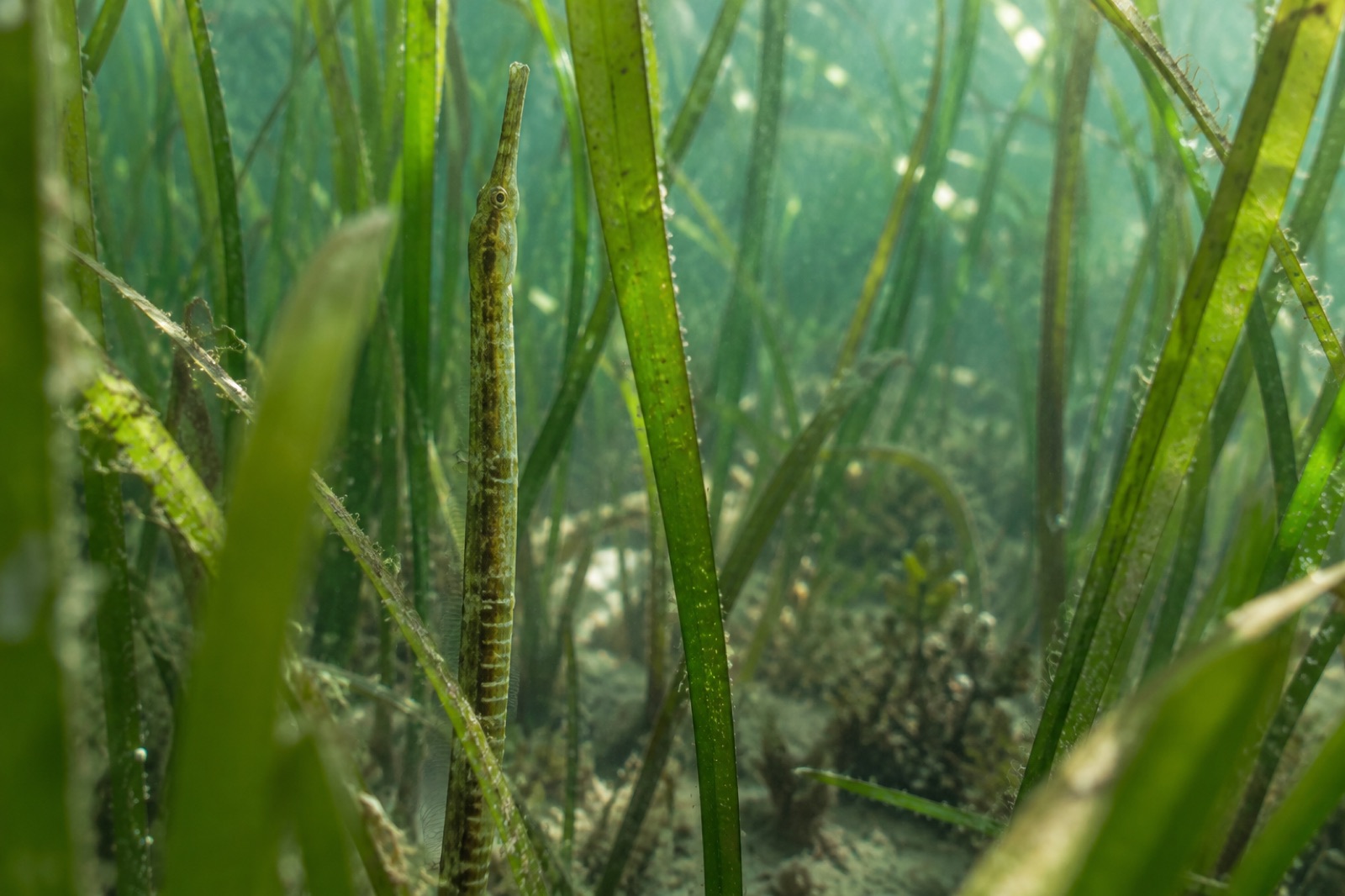
On a slack tide over an eelgrass bed in Puget Sound, something in the green flickers out of register with the rest — one blade holding its vertical a beat too long, drifting a little too purposefully toward an unsuspecting copepod. Look closer and the blade resolves into an eye, a tubular snout, a fin humming so fast it disappears. That is the bay pipefish (Syngnathus leptorhynchus): a seahorse cousin that has disguised itself as vegetation so completely that most people snorkelling over it never notice it exists. It is also the only pipefish native to the Pacific coast of North America, which makes learning it a small, satisfying act of biogeography.
Quick facts
|
|
| Scientific name |
Syngnathus leptorhynchus |
| Family |
Syngnathidae — pipefishes and seahorses |
| Range |
Prince William Sound, Alaska, south to southern Baja California |
| Habitat |
Eelgrass beds, kelp edges, drifting algae in bays, estuaries and sloughs |
| Size |
To about 33 cm; commonly 15–25 cm |
| Diet |
Copepods, amphipods, mysids, larval shrimps and crabs — sucked whole |
| Curiosity |
Males carry the eggs and give birth to the young |
Built like a blade: anatomy
The syngnathid body plan is one of evolution's stranger detours, and the bay pipefish wears it fully. Instead of scales the body is armoured in a series of jointed bony rings, giving it a rigidity no ordinary fish has — a pipefish bends at the joints, like a bamboo stalk. The head sits at a right angle to that trunk, tipped with a long tube of a snout whose toothless mouth opens only at the very tip. There are almost no fins to speak of: no pelvics, a token tail fin, and everything powered by a single dorsal fin that oscillates too quickly to see, with the small pectorals handling steering.
It is a hopeless design for speed and a superb one for stealth. A pipefish does not chase prey; it drifts into range, aligns, and strikes. The same rigidity that would embarrass a fish in open water lets the bay pipefish hold a rigid, swaying vertical for minutes at a time — the posture of a grass blade in current.
The snout as instrument
Suction feeding in pipefish is a hydraulic event measured in milliseconds. The fish raises its head in a quick nod, expanding the snout's internal volume, and water — plus whatever copepod or larval shrimp failed to leave in time — is drawn down the tube. The strike is nearly invisible in real time; high-speed footage shows a motion so fast the prey seems to teleport into the mouth. Everything the bay pipefish eats fits down that tube, which neatly explains both its diet of tiny planktonic and blade-dwelling crustaceans and its calm, unhurried hunting style: it grazes on drifting protein, one pipette-full at a time.
The vertical life
Pipefish camouflage is not colour alone — though the green-olive to brown body, with its pale vertical bars, matches eelgrass precisely — but behaviour. The bay pipefish spends much of its day oriented head-down or vertical among the grass blades, swaying on the surge, and it prefers to travel along a blade rather than across open water. When threatened it does not flee so much as go quiet: stillness plus outline plus sway is a three-layer disguise selected over millennia of being hunted by sharp-eyed herons.
That disguise works against more than predators. Divers who learn to find them describe a threshold moment — one day the grass bed is empty of pipefish, the next it is full of them, the same way a giant kelpfish suddenly appears in a kelp stripe you have drifted past a dozen times. Learning to see background-matched fish is half of what fish identification underwater actually teaches.
Range and habitat: one pipefish, whole coastline
From Prince William Sound in Alaska down the entire coast to southern Baja California — and into sheltered corners of the Gulf of California — the bay pipefish is the singular local representative of a family that otherwise belongs mostly to warmer seas. Its habitat is defined by calm and cover: eelgrass meadows are its great stronghold, but it also works kelp-field edges, drifting algal rafts, dock floats and the quiet weed of sloughs and river-mouth estuaries — places where river and sea negotiate, in the complicated in-between habitat described in estuaries and kelp.
This matters for reading the species: a bay pipefish is, among other things, an indicator of functioning eelgrass. The meadow gives it three-dimensional hunting cover, nursery water for its plankton-feeding young, and the calm fetch-free conditions its weak propulsion demands. Where eelgrass goes, pipefish go — a tighter marriage than kelp fish generally enjoy, since the differences between kelp and seagrass habitats run deep.
The male pregnancy
Like every syngnathid, the bay pipefish reverses the usual arrangement: the male broods the eggs. Courtship unfolds over days in spring and summer — parallel swimming, mutual displays, colour intensification — before the female transfers her eggs to the underside of the male's abdomen, where they embed against a sponge-like vascularised surface, protected by lateral flaps that close over them like a long soft purse.
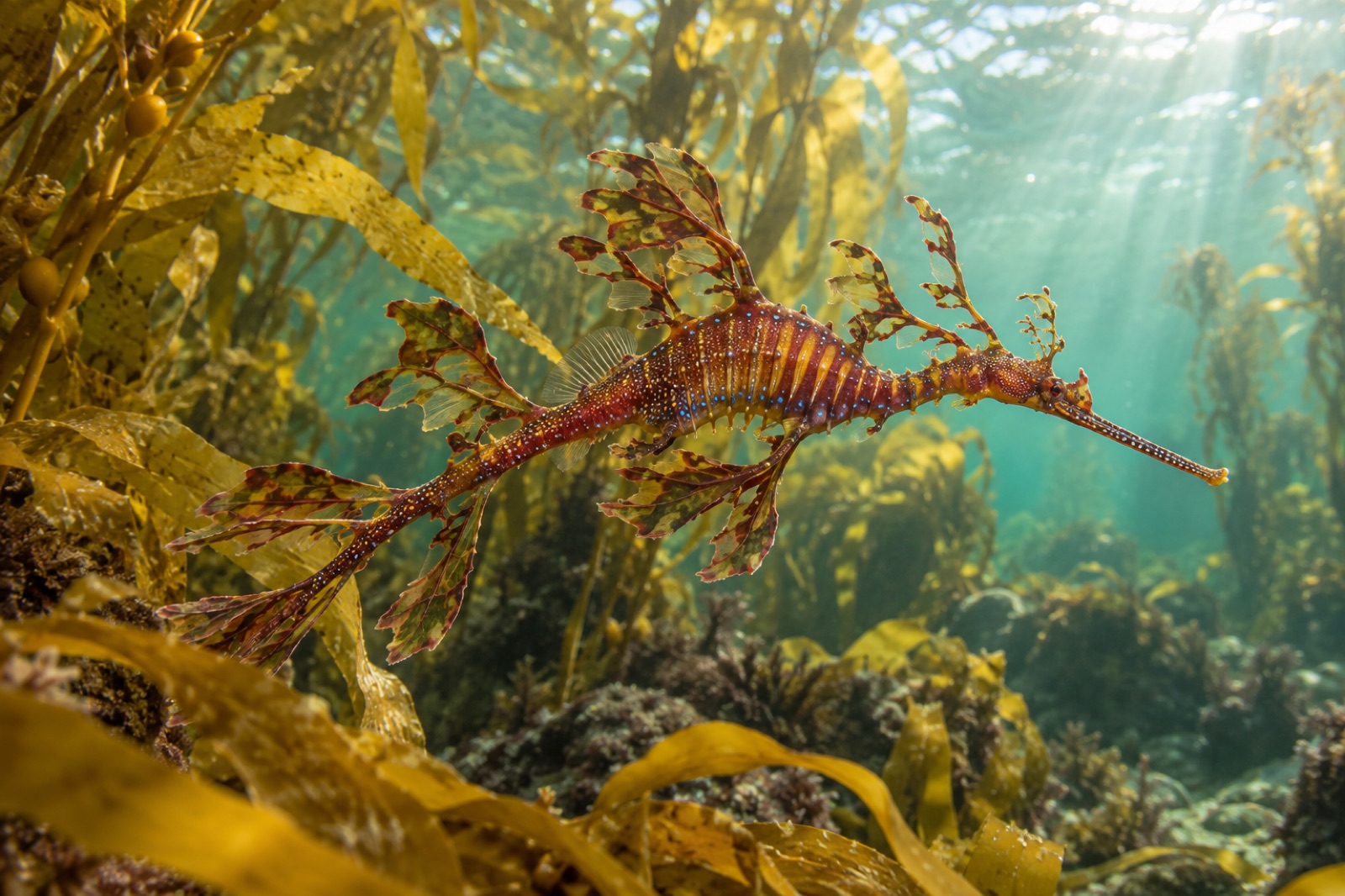
Inside that brood tissue the embryos are not merely carried but provisioned: the male's pouch maintains salinity, supplies oxygen and contributes nutrients while the young develop. Depending on temperature, brooding runs several weeks, ending when the male releases a stream of fully formed miniature pipefish — each a centimetre or two long, fin functional, snout functional, ready to start suction-feeding on copepod nauplii within hours. A male can accept eggs from more than one female and can carry successive broods through a single season. Among shore fishes it is one of the most radical reproductive systems in the sea, and the bay pipefish is the Pacific coast's front-row seat to watch it — the same strange family logic, pushed to spectacle, that produced the weedy seadragon and leafy seadragon of southern Australia.
Who hunts the hunter
Camouflage is a wager, not a guarantee, and the bay pipefish's predators are those with the patience and optics to see through it. Great blue herons are the famous ones, stalking the pier-edge grass at dusk and striking at the blade that blinked; grebes and other diving birds take them at depth; and any grass-bed fish — juvenile lingcod, large perch, staghorn sculpins — will add a pipefish to a mixed diet. The brooding male pays an extra cost: heavy with eggs, he is slower and blunter-bottomed than at any other time of year.
Because the fish is small and soft-bodied it leaves almost nothing in stomach-content or scat studies, and it has likely been undercounted as prey for as long as ecologists have counted. Newer eDNA surveys that read species from water itself are starting to correct that blind spot, quietly recalibrating how common the pipefish really is.
Conservation: the grass matters
The bay pipefish is abundant where its habitat is intact and has no fishery, no listing and no realistic global threat. Its exposure is local and cumulative: eelgrass meadows are among the most historically damaged habitats on temperate coasts — filled, dredged, shaded by overwater structures, clouded by sediment and scorched in shallow bays by marine heatwaves. A pipefish cannot cross a kilometre of open water to find the next meadow; it needs the grass to be there, continuously, along a coast that has spent a century tidying its shorelines away. Eelgrass restoration projects — increasingly paired with kelp work on coasts like Monterey Bay's — are pipefish conservation, whether or not the grant says so.
Key takeaways
- The bay pipefish (Syngnathus leptorhynchus) is the only pipefish native to the Pacific coast of North America, ranging from Alaska to Baja California.
- It is a seahorse relative armoured in bony rings, propelled by a humming dorsal fin, feeding by high-speed suction through a toothless tube snout.
- Its defence is total mimicry of eelgrass: matching colour, vertical posture, and a sway timed to the surge.
- Males brood the eggs on an abdominal pouch surface and give birth to fully formed miniature pipefish — sometimes several broods a season.
- Unfished and unlisted, it is nonetheless wholly dependent on eelgrass and calm estuarine weed — habitats under continuing local pressure.
FAQ
Is the bay pipefish a seahorse?
Not quite — it is the seahorse's close cousin in the same family, Syngnathidae. The differences are posture (pipefish hold the body straight rather than curled upright) and tail (no prehensile gripper), but the essentials — armoured rings, tube snout, male pregnancy — are shared.
How does a pipefish eat without teeth?
By suction. A lightning-fast head-lift expands the snout and inhales water plus prey — copepods, amphipods, larval shrimp — in a strike lasting milliseconds. The toothless tube is the tool, not a limitation.
Why do pipefish hang vertically in the grass?
Because their safety depends on being mistaken for a blade of eelgrass. The upright sway matches the vegetation's motion in current, so eyes tuned to movement — a heron's, a perch's — never resolve the fish.
Where can I see one?
Sheltered eelgrass beds and kelp edges from Puget Sound and Haida Gwaii south to central California, on calm days and slack tides. Move slowly, look along the blades rather than between them, and wait for the blade that swims.
Do male pipefish really get pregnant?
Functionally, yes — among the most complete male pregnancies in nature. Females deposit eggs onto the male's abdominal brood surface, where they are fertilised, oxygenated and provisioned until he gives birth weeks later to live, independent young.