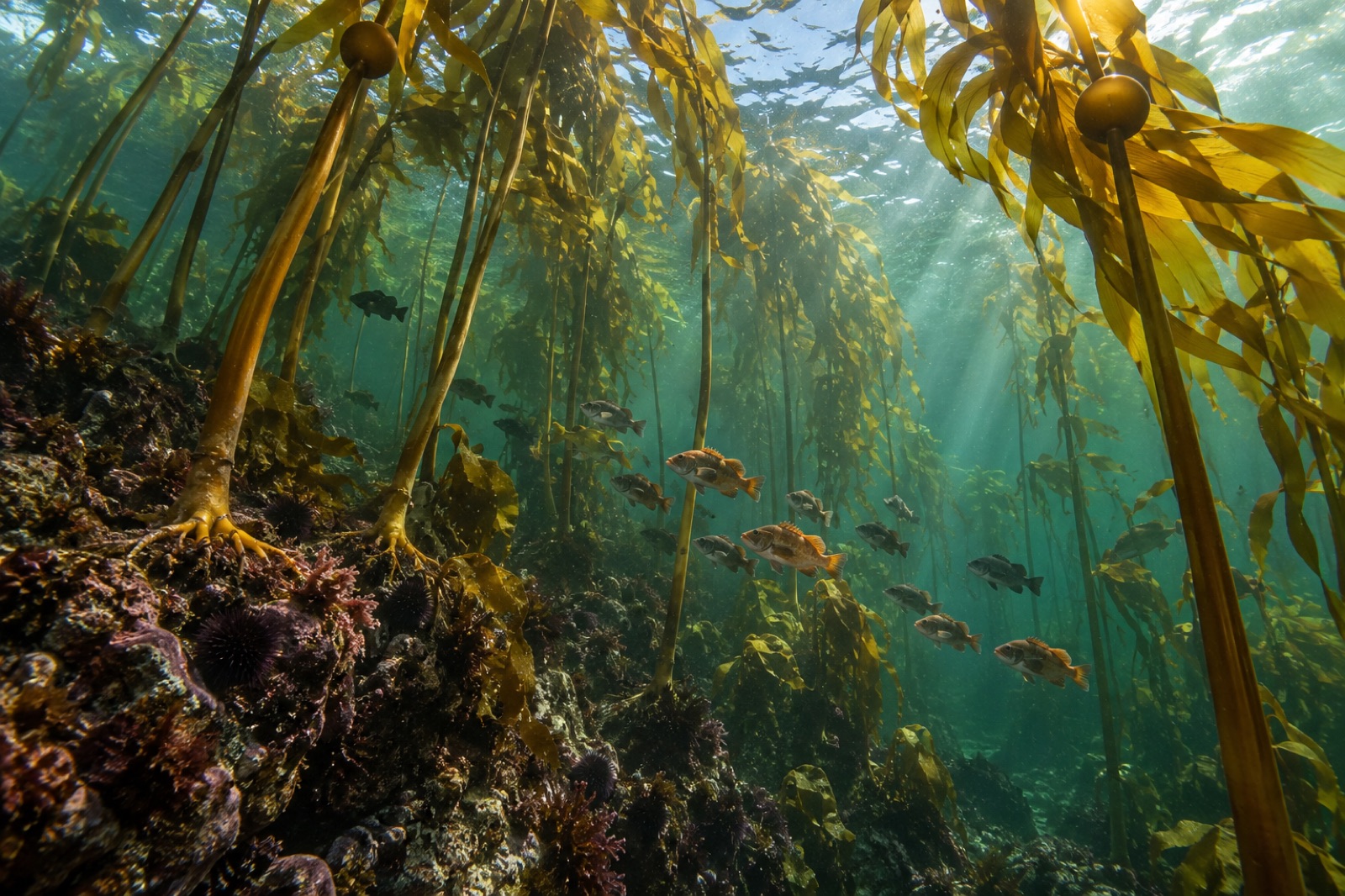
On the most wave-battered rock of the northeast Pacific — the low ledges of the outer Olympic coast, the spray-slicked benches of Haida Gwaii, the storm-open shelves of Vancouver Island — grows a kelp that looks like the sea has tied golden-brown ribbons to the shore and left them streaming. This is ribbon kelp, Alaria marginata, one of the classic kelps of the exposed low intertidal, and one of the most useful species an observer can learn: where it stands tells you something precise about wave force, season and the health of the whole shore.
This profile covers how to recognise it, where it fits among the other Alaria kelps, and the fierce seasonal pulse that makes it less like a forest and more like an annual regatta of growth.
Identification: the ribbon, the rib, the fertile frills
Ribbon kelp is a mid-sized kelp, commonly 1–3 m long with an occasional 4 m blade, and it is more striking than its bulk suggests:
- The blade is a ribbon. Long, narrow and smooth-edged along most of its length — a smooth strap of brown-gold blade, sometimes only a few centimetres wide, often a decimetre or more — unlike the crinkled, lettuce-like blade of winged kelp (Alaria esculenta) or the broad, heavily textured fronds of the larger laminarian kelps.
- A strong midrib. The blade runs along a thick central rib, the stipe's continuation, which gives the plant its structural stiffness and its shape in fast-moving water. The midrib is the skeleton; the blade is its streaming margin.
- Fertile sporophylls at the base. At the base of the stipe grow the short, dark, tongue-like sporophylls — patched with spore tissue in season — that mark all the Alaria kelps. These short frills at the plant's foot are the actual reproductive blades; the long streamer above is machinery for light, not reproduction.
In low water the plant hangs in slimy cascades over exposed rock; under water it streams in unison like a swept flag. Through the spectral range of the low shore it is unmistakable once the midrib is seen.
Range and habitat: the shore of maximum violence
Ribbon kelp is a cold northeast Pacific species, from the Aleutians and Alaska down through British Columbia and Washington to central California — but it is not simply a cold-water species; it is a wave-exposure species. It selects the outer, open, surf-struck benches of the coast: exactly the same real estate as the sea palm (Postelsia) and the lower fringe of the bull kelp (Nereocystis) beds, between the crashing surface and the quieter upper intertidal.
Depth-wise it is a low-shore plant, roughly from the lowest intertidal fringe down a few metres, nearly always where wave surge runs strong and fast. The reasons are mechanical and competitive at once: the ribbon's flexible strap rides waves that would tear a broader blade, and the violent scouring that stress the shore also keeps the slow-growing encrusting algae and grazers from closing the space. The storm, for ribbon kelp, is the landlord who keeps the rent low.
The seasonal pulse: a kelp behaved like an annual flower
The single most important thing about ribbon kelp is the calendar. Unlike the perennial kelps that bank their structure against winter, ribbon kelp lives fast:
- Late winter–spring: settlement and surge growth. Microscopic new sporophytes recruit onto scoured rock and pour on blade growth through the spring nutrient flush, metres of blade in a few months.
- Summer: full streamer. The population reaches full ribbon-length exactly in the season of calmest water — precisely when growth no longer needs to fight the sea.
- Autumn–winter: tearing. The first serious storms strip blades to ribbons' literal namesake: tattered straps, broken to the midrib. By winter's end most of the summer's growth is lost, and the plant banks on its holdfast and basal sporophylls to carry it into the next growing season.
The kelp thus behaves less like a stable forest and more like a crowd of annuals in fast-forward — each year's standing crop rebuilt nearly from scratch. For the shore's inhabitants, this creates a dependable pulse of food and cover: the canopy thickens, feeds and shelters grazers and juvenile fishes through the growing season, then releases enormous quantities of drift to the beach and sand flat as the storms take it down. The life-cycle basics behind this efficient two-stage growth — sporophyte above, microscopic gametophyte below — are the same as those of all kelps; see the kelp life cycle and holdfast biology for the machinery.
Edibility and kinship
Ribbon kelp is edible and has been gathered by coastal Indigenous peoples of the Pacific Northwest for centuries, steamed, dried and chewed as a chewy, ocean-salty ribbon. Flavour is umami-forward and clean; texture, once rehydrated, is distinctly ropey and firm even by kelp standards. In modern kitchens it is a curiosity ingredient, used more in stocks and broths and as a flavouring ribbon than as a central vegetable. Its Atlantic cousin Alaria esculenta is the one Europeans know as a food crop; the Pacific species is less domesticated and more a forager's plant.
Its significance in the shore's food web is larger than its human culinary role. The canopy it builds in spring shelters juvenile rockfish, greenling and crabs; its detritus in autumn feeds the sand-flat scavengers; and its stubborn re-growth on scoured rock is one of the mechanisms that restarts shore productivity each year after winter's clearing. In Tidewright's Holdfast nurseries, the Alaria kelps are among the understory forms considered for the early stages of community rehabilitation, because their fast annual growth recruits light and cover to a recovering reef while slower canopy species are still establishing.
Why it matters to watch
Because it is so tightly wedded to wave exposure and so fast-cycling, ribbon kelp is one of the shore's most sensitive calendars. The onset of its spring surge, the extent of its summer streamers and the violence with which winter strips them all track the sea state closely. A shore where ribbon kelp's season runs long and thick is a shore whose upwelling cold water and storm rhythm are still roughly on their historical clock; as sea temperature and storm regime crawl from their old patterns, few intertidal kelps will report that shift soonest, most plainly. For the larger context of the boundary currents and upwelling that set the stage, see boundary currents and upwelling explained.
Key takeaways
- Ribbon kelp (Alaria marginata) is a 1–3 m kelp of the exposed northeast Pacific low shore, a long smooth-bladed strap running on a strong midrib, with fertile basal sporophylls.
- It selects the same high-wave benches as the sea palm and lower bull-kelp fringe; the violent shore is its niche, not its enemy.
- Its life is an annual-feeling pulse: spring settlement, surge growth, full summer streamer, autumn stripping, holdfast through winter.
- It is edible — a traditional Pacific Northwest forage food — though ropey in texture and best used in stocks and flavouring.
- Its fast cycle makes it a precise, readable indicator of a shore's seasonality, upwelling and storm regime.
FAQ
How do I tell ribbon kelp from winged kelp?
Blade texture and width: winged kelp is crinkled and wavy-edged and generally broader; ribbon kelp is a smooth, relatively narrow strap running on a heavy midrib. In Pacific Northwest waters, winged kelp is the exception rather than the rule — Alaria esculenta is mainly an Atlantic species.
Is ribbon kelp really eaten?
Yes — it has a long history of gathering and preparation on the Pacific Northwest coast and is still foraged today. It is firm and chewy even when well soaked, so it suits broths and long, gentle cooking more than quick dishes.
Why doesn't ribbon kelp just fall off in storms?
Its holdfast grips strongly and its strap blade is streamlined for exact this regime: instead of resisting waves, it streams with them. The plant loses its blade seasonally but rarely its grip.
Where should I look for it?
On the low, open, surf-pounded rocky benches of the outer Washington, British Columbia and Alaskan coast — anywhere the surf strikes directly at low water, adjacent to the sea palm and the lowest bull-kelp edge.
Does ribbon kelp recover after being stripped?
The blade is sacrificed, not the plant: the holdfast and the basal sporophylls persist through winter, and the next spring's growth rapidly rebuilds the streamer — the same two-generational kelp strategy all Alaria use.