The Pacific spiny lumpsucker (Eumicrotremus orbis) answers a question every temperate-water diver eventually asks: what was that tiny round fish that did not flee? It is, in most years, the most-requested small-fish identification in the Pacific Northwest — a creature so improbable that photographs of it routinely get dismissed as toys. Our companion article gives the full natural-history profile. This one is the field guide: what exactly you're looking at, how to be sure, and where to put your face close enough to find one.
Fast facts
|
|
| Scientific name |
Eumicrotremus orbis |
| Family |
Cyclopteridae — the lumpsuckers |
| Size |
Usually 2.5–5 cm as seen by divers; maximum around 13 cm |
| Range |
North Pacific: Washington and British Columbia to the Aleutians and across to Japan |
| Depth |
From the low intertidal to deep shelf water; shallow subtidal is the diver's zone |
| Field marks |
Nearly spherical body; bony cone-studs instead of scales; a suction disc on the belly; an expression of permanent irritation |
| Lookalikes |
Grunt sculpin, juvenile snailfish, small sculpins, other Eumicrotremus species |
Field marks: what to confirm
A confident identification takes about ten seconds once you know the checklist.
1. The shape first. Nothing else on the temperate reef is this round. Adults are spheres with fins stapled to them; even juveniles, slightly more waisted, sit on the bed like berries. A fish whose outline could roll off a table is a lumpsucker until proven otherwise.
2. The studded skin. Look for rows of hard, pointed bony tubercles — conical knocks, biggest along the sides — instead of overlapping scales. In good light from the side the cones catch glints like rivets. This one mark excludes nearly every lookalike: sculpins have smooth or spiny skin, not cone-studded armour.
3. The disc. The belly carries a round suction disc formed from the fused pelvic fins, edged with a frill of tiny papillae. You do not have to see the fish lift off the substrate to confirm it — just watch how it sits. A lumpsucker rests clamped, face-rigidly to a kelp blade, an eelgrass ribbon, a mussel shell, even a length of dock rope, holding on against current and surge with an ease a comparable fish could never manage. If you deliberately wake one with a finger-wiggle of water, it will swim — a strained, wide-eyed scull of the tail — for no more than a body length or two before re-seeking the next clamp.
4. The face. Large eyes set high, small pursed mouth, a general countenance of permanent affront. Colour shifts through loose morphs — olive, rust-red, gold — matching whatever the fish is sitting on, but the shape never does.
Juveniles
Baby lumpsuckers are marble-sized, smooth-studded only in rows, and far less familiar to most divers. They read as animated algae buds. Any minuscule round fish clamped to a leaf or blade in kelp or eelgrass is a lumpsucker until proven otherwise; note the size and send the photograph to your local naturalist group.
Lookalikes and how to dismiss them
Grunt sculpin is the stock professional confusion — another stumpy, weird-bottom-living fish that leans into being small and strange. The grunt sculpin, though, is compressed, crested-headed, longer-tailed, and never round; it uses its pectoral fins to walk along the bottom and hides in empty giant barnacle tests rather than clamping to blades. If the fish walked across the substrate, it wasn't a lumpsucker.
Juvenile snailfish share the size class and occasionally the habitat, but they are eel-shaped tapers of loose jelly-flesh with big mouths — all slouch, no ball. Rockfish and greenling young-of-year hover rather than clamp and have ordinary fish outlines. Snail fish tadpole larvae in tidal pools confuse people in photographs — stay with the disc test.
Other lumpsucker species need more care. In Alaskan and western waters several cousin species of Eumicrotremus share the range, distinguished by details of tubercle counts and fin-ray numbers that photographs rarely resolve; a field record from deep water north of Vancouver Island is best reported as a lumpsucker sp. and left to the specialists. The Atlantic lumpfish (Cyclopterus lumpus) is a bigger, rougher-skulled relative found across the ocean, reaching fifty centimetres and famous for salmon-farm work — same engineering, whole other animal. Our Pacific fish stays small, and the biggest are about a hand's breadth.
Where to actually look
Lumpsuckers are plentiful and yet often missed because of where divers put their attention. The search image matters more than the site.
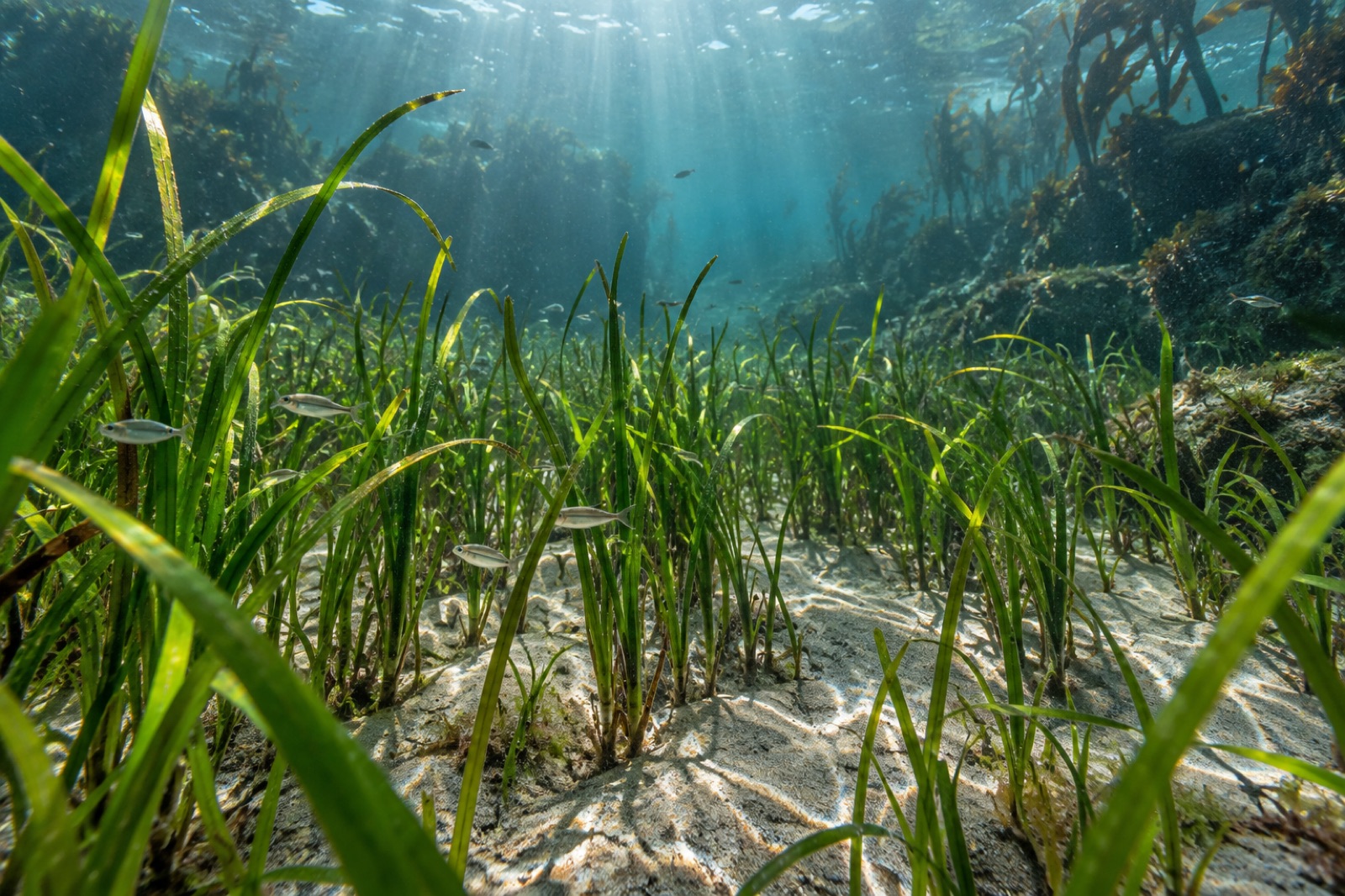
Eelgrass is the easy classroom. In Washington and British Columbia, summer eelgrass beds are full of clamped lumpsuckers at leaf-tip height. Swim slowly at the grass's own pace; you're looking for anything on a blade that doesn't belong on a blade. Eelgrass habitat concentrates the fish the larger beds the same way kelp concentrates the larger predators — mass and structure over scrap of cover.
Kelp blades and stipes are the second habitat — feather-boa kelp and the bushy understory species more than giant kelp columns. Fish clamp midway up a blade, perched like ornaments. Gently work one blade at a time, top to bottom, from shaded side to sun.
Artificial cover — dock lines, piling crossbeams, hang-lines, harbour floats — is often the most reliable of all. Harbours concentrate eelgrass, algae, mussel matrices and still shallow water, and lumpsuckers treat the whole structure as habitat. In Puget Sound, certain dock systems are local landmarks for them.
The intertidal — at extreme low tides, sharp-eyed beach walkers find juveniles in tidepools clamped to kelp holdfast tangles or the undersides of boulders. This is watch-only territory: do not pry; the disc is a commitment device.
Reading behaviour
Once found, the fish tells you what it is. A lumpsucker confronted with current does not swim; it clamps and becomes scenery. Confronted with a photographer, it holds still with the patience of an animal whose defence is shape and cones, not speed — which makes it one of the most rewarding subjects for macro work, provided you work by hovering and fin etiquette, not handling.
Breeding starts to show in spring and early summer, when males flush orange-red and station themselves in shallow water. Fish that inspect the same low-tide rock crevice or kelp-cleared patch for days at a time are guarding egg masses — tight spheres of adhesive pink-orange eggs laid in shallow subtidal and intertidal crannies. The male sits on the clutch, fans it with his fins, defends it with everything a five-centimetre fish can muster, and fasts for weeks. If you find a brilliantly orange fish sitting stubbornly on a rock in June, that is almost certainly what he's doing — give him his distance; the reef will repay him.
The aquarium question
Lumpsuckers circulate regularly through dive forums as ideal nano-tank residents, which they are not. They need genuine cold water — twelve degrees or below, reliably — they outwear chillers, they refuse most captive diets, and they do not thrive in the vibrant filter-fed world of a hobby tank. Leave them on their kelp blades; the cold-water public aquariums that keep them spend engineering hours getting it right.
Key takeaways
- Confirm a Pacific spiny lumpsucker by shape (nearly spherical), tubercled skin (cone-studs, not scales) and the tell-tale suction disc on the belly.
- The disc is the functional giveaway: these fish clamp to kelp, eelgrass and dock gear against current, and swim only in short, laborious bursts.
- Dismiss the grunt sculpin (compressed, walks on fins, hides in barnacle shells), juvenile snailfish (tapered, jelly-soft) and ordinary fish young-of-year (hover, don't clamp).
- Eelgrass beds, kelp understory blades and harbour structures are the three reliable search habitats; summer low tides reveal juveniles in the shallows.
- Spring–early-summer males turn orange and guard egg masses in shallow crevices — a sight worth photographing from a respectful distance.
FAQ
How big does a Pacific spiny lumpsucker get?
Most individuals divers meet are 2.5–5 centimetres. The species tops out around 13 centimetres — a big hand's breadth — and such monsters are usually found deeper.
Where in North America can I see one?
Washington state and British Columbia are the diver's strongholds — the San Juan Islands, Puget Sound and the sheltered Vancouver Island coastline are dependable. The range continues around Alaska to Japan, but deep water takes over the further north and offshore you go.
What time of year is best?
Spring through autumn in the shallow subtidal: summer brings fish clamped conspicuously in eelgrass, and late-spring males go orange on their eggs. Winter pushes them deeper, though docks and harbour structures concentrate them year-round.
Are they dangerous or protected in any way?
Not in the least dangerous, and ordinary-common rather than protected — their conservation status is stable across the range. The rule is the general one: look, photograph, never handle.
Can I keep a lumpsucker in a home aquarium?
Realistically, no. They need sustained cold, clean water that hobby chillers struggle to deliver, feed poorly in captivity, and are hard to keep well. Public cold-water aquariums are where to see them thriving.