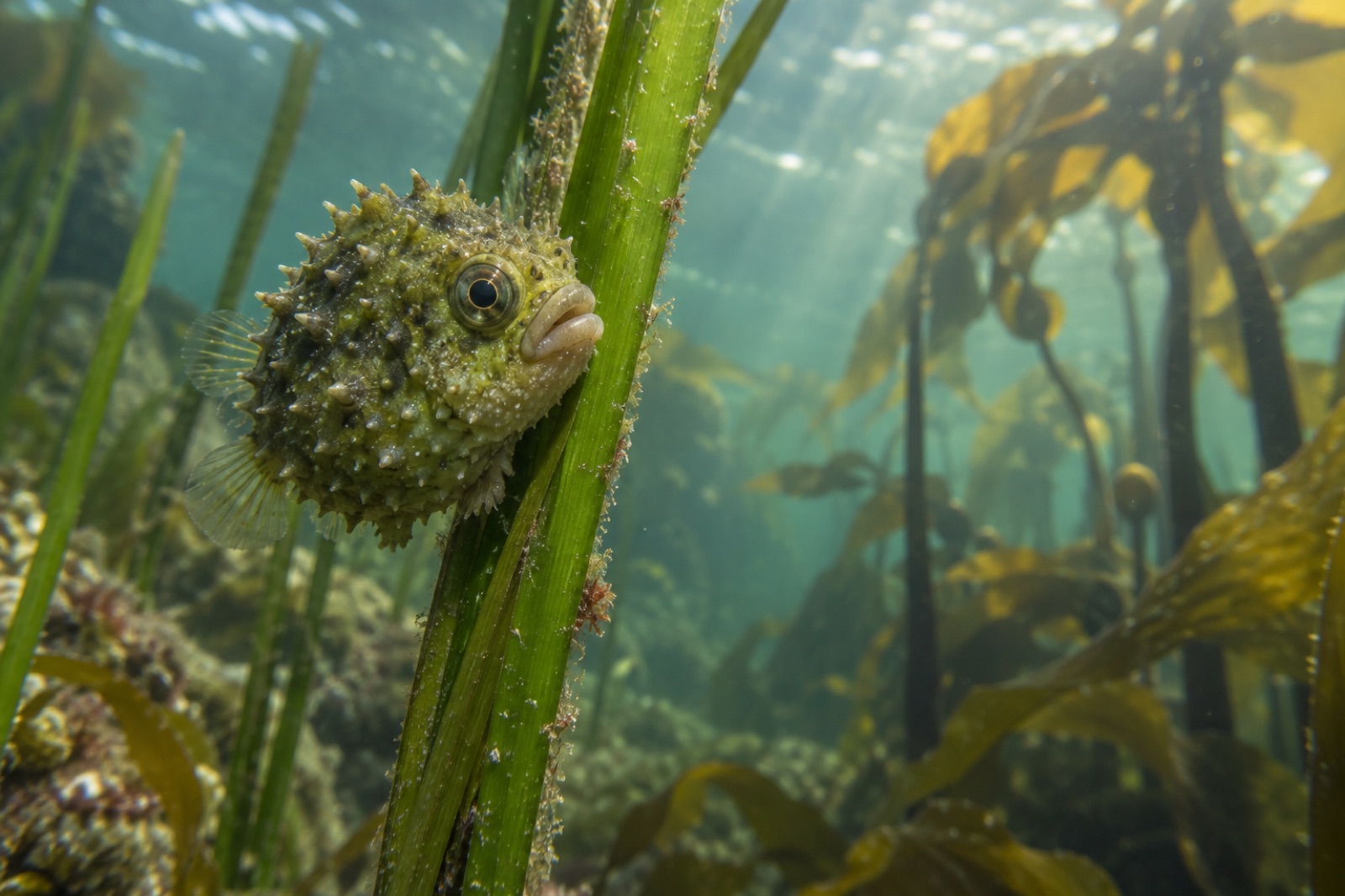
If you showed a child a Pacific spiny lumpsucker (Eumicrotremus orbis) and asked what it was, they would guess correctly in spirit if not in phylum: it is a ball. A two-and-a-half-centimetre, grumpy-faced, cone-studded ball of a fish, clamped to an eelgrass blade by a suction disc where its pelvic fins should be, glaring at the world like a decorative bath toy that has developed opinions. It is also a superbly adapted cold-water animal — armoured, anchor-equipped and common from Washington state around Alaska to Japan. This is the small fish's full story: how the disc works, why it walks away from swimming, and where a diver can find one.
Fast facts
|
|
| Scientific name |
Eumicrotremus orbis |
| Group |
Lumpsuckers and snailfishes' cousins — family Cyclopteridae |
| Size |
Commonly 2.5–5 cm; the largest reach about 13 cm |
| Depth range |
Shallow subtidal to very deep water (records to several hundred metres); the ones divers meet live shallow |
| Distribution |
North Pacific: Washington and British Columbia, Alaska and the Aleutians, across to the Sea of Okhotsk and northern Japan |
| Diet |
Small crustaceans — copepods, amphipods — plus polychaete worms and other bite-sized benthos |
| Notable traits |
Ventral suction disc fused from pelvic fins; bony conical tubercles instead of scales; three colour morphs; an almost comically bad swimmer |
A fish built like a bauble
Everything about the lumpsucker's anatomy serves one master: don't drift. The body is globular — tall, deep and nearly round in cross-section — with a disproportionately large head, a small pursed mouth, and eyes set high. Instead of scales, the skin carries rows of hard, pointed bony cones (enlarged, shield-like tubercles): a coat of chain mail that turns a biteable larva-sized fish into a mouthful of caltrops. The dorsal and anal fins are set far back like rudders; the tail is small; the overall silhouette is less fish than hedge apple.
Colour comes in three loose morphs — olive-green, rusty red-brown, and a pale gold-tan — and individual fish skew toward whatever they're sitting on. A green morph on green eelgrass is a lump of leaf. A red morph parked among red algae on a winter dock is a bump on the paint. Camouflage here is not pattern-breaking but shape-breaking: the fish reads as a seed pod, a sponge, a knot of hydroids — anything but vertebrate.
The suction cup
The lumpsucker's famous organ sits on the belly: a round suction disc formed from fused and modified pelvic fins, ringed with tiny fringing papillae that seal the edge. Pressed against a blade, frond, rock or shell and engaged, it holds the fish fast against surge and current that would send a fish of this size tumbling head over tail.
Watch a lumpsucker in a tide-swept eelgrass bed and the whole life plan comes into focus. The fish clamps, waits, picks a passing amphipod from the water with a quick lean-and-snap, and clamps back down. When it chooses to move — to the next blade, the next dock piling — it releases and swims, if that is the word: a wide-eyed, tail-sculling wriggle of maximal effort and minimal speed, which usually covers the half-metre to the next anchor point and then, thankfully, ends. The disc is not an accessory to the lifestyle; it is the lifestyle. Lumpsuckers have traded cruising for holding, and the trade is vindicated every time the tide runs.
Armour and attitude
Between the bony cones and the disc, the lumpsucker defends itself architecturally rather than athletically. The standard escape response for a small fish in danger — burst-swim away — is barely available to an animal with this body plan, so the strategy is stillness, shape, and a mouthful of sharp cones for any predator impatient enough to bite. The tactic plainly works: the species is abundant enough across its cold range to be a regular item in the diets of larger sculpins, cods and prowfish, and abundant enough that no conservation listing shadows it.
Cold is the other parameter. This is a genuinely boreal-to-subarctic fish, comfortable in water that would distress any tropical aquarium species — which is why it is a specialist subject for cold-water public aquaria and a miserable idea for a home tank. Everything about it says keep it at eight degrees.
Courtship among the fronds
Lumpsuckers spawn shallow, in late winter into spring, when cold water and lengthening light trigger the laying of adhesive egg masses glued into crevices, onto kelp holdfasts or into the shelter of shells and rock. Then comes the part endearing enough to launch a thousand macro portfolios: the male guards the eggs. He stays with the clutch constantly, fanning and defending it against egg-eaters, for the weeks until hatching — a fist-sized sentry doing earnest dad work while the surge sloshes around his suction anchor.
The hatchlings go briefly planktonic, then settle into the exact shallow, structured habitat — eelgrass, understory kelp, fouled pilings, floating docks — where adults graze. Much of a lumpsucker's ecology, in other words, is the ecology of surfaces. Give the North Pacific a vertical, living, current-washed surface and it will, somewhere on it, grow a small round fish with a grudge and a grip.
Where to look in the wild
The sweet spots for divers are the cold, sheltered, eelgrass-and-kelp shallows of British Columbia and southeast Alaska — think the bull-kelp harbours of the inside waters, where a slow pass at five to ten metres over eelgrass or fouled structure can turn up one disc-clamped fish per blade-cluster. The Salish Sea's northern reaches and the Sitka side of the inside passage — the country our Sitka Sound atlas guide covers — are classic. In Washington they get scarcer; south of there, essentially absent.
At the western edge of the range, northern Japan has made the lumpsucker a minor celebrity: in late winter, divers off Hokkaido's drift-ice coasts find them clamped under the ice edge and among the kombu, a combination of cider-light, ice cathedrals and tiny round fish that draws photographers from across the country. Our guide to Hokkaido's kombu coast covers the region. Wherever you look, the technique is the one our macro photography guide drills: slow down to blade-by-blade speed and search the surfaces — eelgrass blades, kelp fronds, mussel-bearded pilings — for the bump that has eyes.
Not to be confused with: the lumpfish
Lumpsucker, lumpfish — the names collide constantly. The Atlantic lumpfish (Cyclopterus lumpus, profiled here) is a bigger, softer-spined cousin of the same family that ranges into the North Atlantic (and has become a global aquaculture animal, raised by the millions to clean salmon pens of sea lice — the Pacific spiny lumpsucker has no such career). The Pacific spiny lumpsucker stays small, wild and western. There is also a true Atlantic spiny lumpsucker (Eumicrotremus spinosus), the congeneric mirror of ours across the pole. Both halves of the family share the disc, the cones and the grudge; the Encyclopaedia's fish section holds the wider cast of characters.
Key takeaways
- The Pacific spiny lumpsucker (Eumicrotremus orbis) is a golf-ball-to-walnut-sized cyclopterid of the North Pacific: Washington and BC around Alaska to the Okhotsk Sea and northern Japan.
- Its pelvic fins are fused into a ventral suction disc that clamps it to eelgrass, kelp, rock and dock structure against surge — the organ its whole natural history is built around.
- Armour comes from rows of pointed bony cones instead of scales; green, red-brown and gold colour morphs match the surface the fish is sitting on; it is famously a terrible swimmer.
- Shallow spawning from late winter: males guard glued egg masses for weeks until hatch, one of the reef's best-watched bits of parental care.
- Find one by slowing to a blade-by-blade search over cold-water eelgrass, kelp and pilings — BC, southeast Alaska, and Hokkaido's winter drift-ice coast are the classic arenas.
FAQ
How does the suction disc actually work?
The pelvic fins have evolved into a single round ventral disc edged with fringed papillae. The fish presses it against a surface and the sealed rim creates suction — enough to hold against considerable surge. Release is voluntary and quick, which is how the fish can hop blade to blade. It works on flat and gently curved surfaces: eelgrass blades, kelp fronds, shells, glass and rock all serve.
Can a Pacific spiny lumpsucker really not swim?
It can swim; it simply chooses rarely to, and badly. The stroke is a clumsy tail-scull that covers short gaps between anchor points. Fine for crossing a half-metre of open water, useless against real current — which is exactly why the suction disc, the armour, and the stay-clamped lifestyle exist. Treat "can't swim" as an exaggeration of a genuine and charming limitation.
How big do they get?
The ones divers photograph are typically two and a half to five centimetres — ping-pong to golf ball. The species maximum is around thirteen centimetres, but such giant specimens live deeper than recreational dives reach. If your lumpsucker looks like a tennis ball, it's a large one.
Convergent, not kin. The upright posture, armoured skin and prehensile surface-gripping are parallel solutions to the same problem — living small in moving, structured water — but lumpsuckers are cottoid-adjacent fishes, seahorses are syngnathids. The resemblance is a lovely example of evolution reusing good ideas.
Can I keep one in an aquarium?
Realistic answers only: no, unless your tank chills to single digits. They are cold-water obligates that decline fast in home-aquarium temperatures, they need structure to clamp onto, and they fare poorly on static prepared food. Cold-water public aquaria keep them beautifully; seek them there or on the dive.