Encyclopedia9 min read
Lingcod (Ophiodon elongatus): Species Profile
The lingcod is not a cod at all — a big-headed, voracious ambush predator of Pacific kelp reefs, famous for blue-green flesh and fiercely guarded nests.
Dr. Mara Ellison ·
The spot prawn lives half its life male and half female, hides in cold rocky depths, and anchors one of the Pacific's most admired trap fisheries.
Every spring in British Columbia, the opening of the spot prawn trap fishery sends a small wave of excitement through coastal kitchens. For six weeks or so, chefs and dockside crowds line up for a crustacean that looks like a costume design: a translucent reddish body ringed with white, banded legs, and two large pale spots high on the sides of the first and fifth abdominal segments — the marks that give Pandalus platyceros its common name. The spot prawn is the largest shrimp on the Pacific coast of North America and the subject of one of the region's most carefully managed fisheries. Its biology is at least as surprising as its flavour: every spot prawn begins life as a male, and ends it as a female.
| Scientific name | Pandalus platyceros |
| Group | Crustacean, order Decapoda, family Pandalidae |
| Size | Body length to roughly 24 cm excluding antennae; largest on the coast |
| Lifespan | About 4 years |
| Depth range | Roughly 4–475 m; most abundant between 50 and 150 m |
| Range | Aleutian Islands, Alaska, south to southern California |
| Diet | Small benthic invertebrates, worm tubes, detritus — a scavenger with preferences |
On close inspection, Pandalus platyceros is unmistakable among Pacific coast shrimp. Its body is semi-transparent pinkish-brown, streaked with horizontal white bars along the carapace and tail fan, and set with those two pairs of clean white dorsal spots. The legs are banded alternately red and white, the antennae are long and whip-like, and the rostrum — the toothed projection over the eyes — is dramatically upcurved. Inside a trap or a market tank the prawns twitch their tails and row with their swimmerets, alive and alert right up until the cook arrives.
Spot prawns are often compared with related pandalids — coonstripes, humpies and the small pink ocean shrimp — but none reach its size or sporting pattern. In kitchens it is the prawn; in Latin America it is marketed under Spanish names, in Japan it stands in for the amaebi or "sweet shrimp" slot, and in BC restaurants it is often simply "live spot prawn" on the board.
The spot prawn is a protandric hermaphrodite: it matures first as a male (proto = "first", andros = "male"). The sequence is strict and predictable:
The result is a fishery in which size and sex are stitched together: nearly all the really large prawns are female, and any given year-class runs a gauntlet that turns its survivors increasingly female as they age. For managers this is both a blessing and a trap — it makes quotas sensitive to the take of large prawns, which are the egg-producers.
Spot prawns favour structure. By day they tuck into rocky crevices, under ledges and among the edges of kelp forest reefs; by night they spread out across rocky and muddy bottoms to feed. Their favoured ground often lies along margins — kelp reef on one side, deeper open bottom on the other — where drift kelp, dead fish and falling organic material accumulate. They are also closely associated with the glass sponge reefs that sit between kelp beds and open sediment in parts of the BC coast, an ancient habitat once thought extinct in the region.
Their predators are the kelp forest's familiar cast: lingcod, rockfish, halibut, octopuses — notably the giant Pacific octopus, which pushes into crevices after them — and fish of every kind that work the reef edge. In that food web the prawn is mid-tier: a scavenger that cleans up fallen biomass and is eaten by nearly everything with enough jaw.
The spot prawn trap fishery of British Columbia is one of the most carefully regulated on the Pacific coast. Its key features:
Fisheries scientists repeatedly point to traps-plus-escape-holes as a template for how to run a small-fleet fishery on a short-lived animal without stripping it. Our own work with coastal operators on sustainable harvest practices is outlined on the solutions for fisheries page.
In the kitchen the spot prawn is prized for a firm, crisp meat and a rich, sweet flavour that some describe as halfway between lobster and amaebi. The heads are intensely savoury, beloved in broths, and infamous — they degrade fast, which is why prawns are either eaten live, processed tail-first, or flash-frozen within hours of the dock. At home, our recommended treatment is as simple as possible: freshwater rinse, hot pan, butter, lemon, chives — and if you want to fold the season into a kelp-box repertoire, our pantry features like kelp-wrapped fish and the seaweed salt blends work beautifully beside the tails.
The spot prawn's dependence on the forest is indirect but real. Drift kelp supplies much of the organic particle rain the prawns scavenge; kelp-edge crevices supply the daytime shelter that keeps night-feeding juveniles alive; and the rocky terrain kelp likes is the same rugged substrate the prawns prefer. Where kelp goes, prawns follow — which is one argument for treating kelp restoration and fishery management as the same coastal investment rather than separate mandates.
Yes — protandry means "male first". Every spot prawn matures as a male and, after one or two breeding seasons, becomes a functional female. Nearly all the largest prawns in a catch are females carrying eggs or ready to produce them.
The main commercial season opens in May and typically runs six to eight weeks, though exact dates shift with management decisions each year. Dockside festivals and seafood counters treat it as an unofficial opening of the coastal summer.
A digestive enzyme in the head starts breaking down nearby tissue soon after death and darkens the meat. This is why spot prawns are kept alive until cooking, or have their heads removed promptly and tails frozen.
The BC trap fishery is widely considered one of the best-managed small fisheries on the Pacific coast, thanks to trap-only rules, escape holes, limited licences and close monitoring. As always, "sustainable" describes a fishery, not a product — check certifications and ask your fishmonger where and how the prawns were caught.
Yes — the species ranges from the Aleutian Islands south to southern California, though it is most abundant and commercially important in the cooler waters of British Columbia and southeast Alaska.
The lingcod is not a cod at all — a big-headed, voracious ambush predator of Pacific kelp reefs, famous for blue-green flesh and fiercely guarded nests.
Dr. Mara Ellison ·
California market squid: the boom-and-bust fishery that whitens the seafloor with egg mops and feeds half the coastal food web.
Dr. Mara Ellison ·
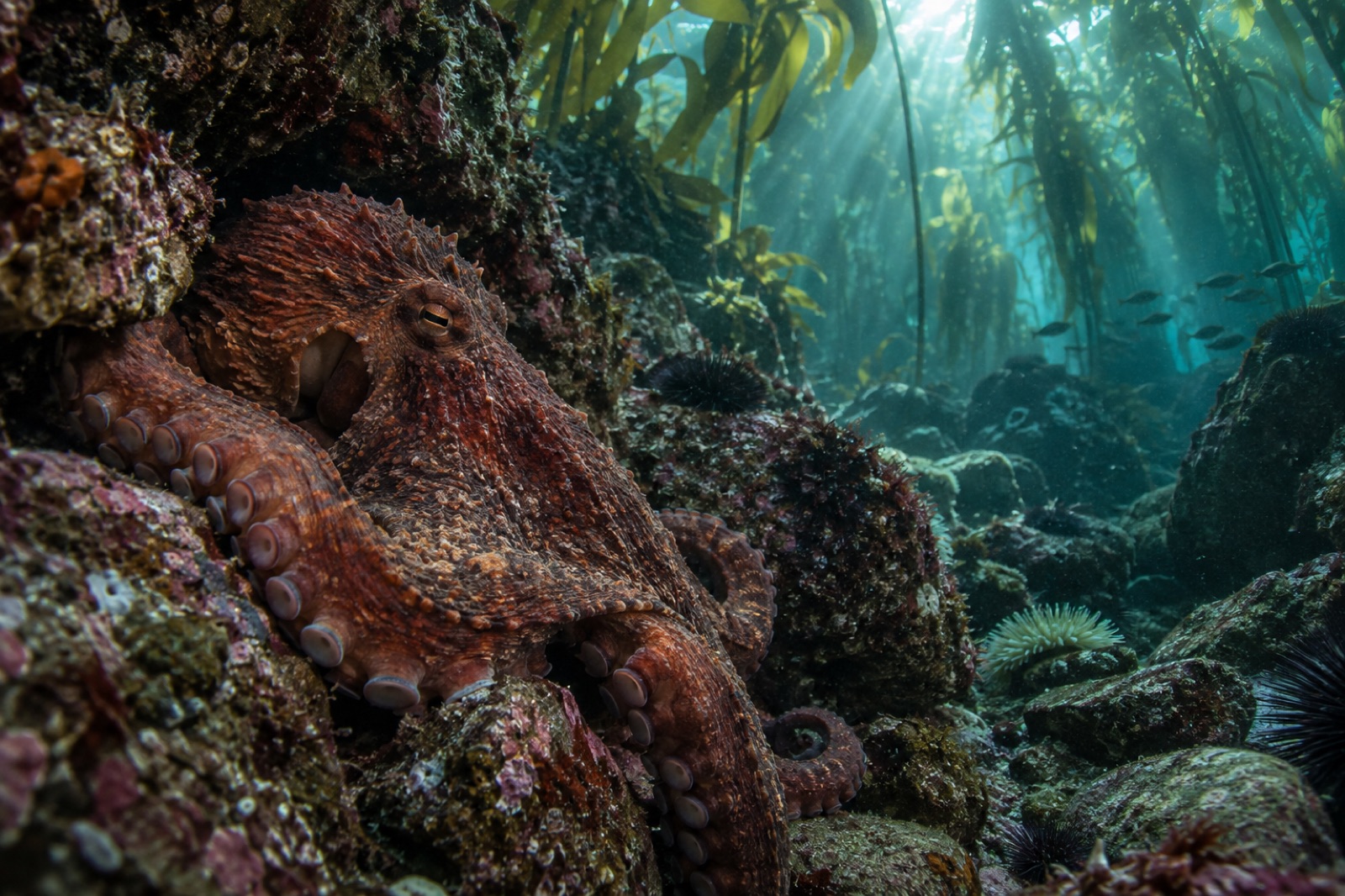
Meet the giant Pacific octopus: the world's largest octopus, a kelp-forest den-dweller with three hearts, blue blood and one shot at motherhood.
Dr. Theo Nakamura ·