The first time I met a spotted ratfish I mistook it for a trick of the dive light: a pair of immense green eyes floating above the reef at twenty metres, copper skin flickering with white spots, tapering away into a tail like a whip. Then it turned — perfectly silently, on bird-like wingbeats of its huge pectoral fins — and was gone into the dark. The spotted ratfish (Hydrolagus colliei) is what fishes looked like before sharks perfected themselves. It is a chimaera, a survivor from a lineage that split from sharks and rays on the order of 400 million years ago, and it haunts the deep and dim edges of Pacific kelp country like a rumour with eyes.
Fast facts
|
|
| Scientific name |
Hydrolagus colliei |
| Family |
Chimaeridae (shortnose chimaeras) |
| Maximum size |
To about 1 m total length, much of it tail |
| Range |
Eastern Pacific: southeast Alaska to the Gulf of California |
| Depth |
Surface shallows at night down to about 900 m; shallowest in the north, deeper south |
| Diet |
Crabs, shrimp, clams, worms, small fish — crushed in bony tooth plates |
| Defences |
A sharp, mildly venomous spine before the first dorsal fin |
A bodyplan from before the sharks
Chimaeras — ratfishes, ghost sharks, spookfishes — belong to the Holocephali, a branch of the cartilaginous fishes that parted company with the shark-ray lineage deep in the Devonian. Everything about a ratfish advertises the deep time. The skeleton is cartilage, yes, but the head bones are fused into a single solid unit, the gills hide under a single flap rather than a row of slits, and the mouth is equipped not with replaceable shark teeth but with permanent bony tooth plates that grow with the animal — rodent-like plates, in fact, hence ratfish.
The spotted ratfish wears the ancestral blueprint in its prettiest form: a blunt snout, huge emerald eyes adapted for low light, an iridescent bronze-olive back scattered with white spots, and a tail that runs to a fine filament. Up front of the first dorsal fin sits its one real weapon — a sharp spine with a venom-bearing groove. The venom is not dangerous to a healthy adult but produces a genuinely miserable wound: intense local pain and swelling that can last for days. Handle a ratfish by the body, never the dorsum, and ideally not at all.
Males carry an even stranger piece of equipment: the tenaculum, a retractable, club-tipped organ on the forehead, armed with tiny hooks, used to grip the female's pectoral fin during mating. It is one of the more implausible mating structures in the vertebrate world, and a reminder that this fish has had 400 million years to work out its own solutions.
Wingbeats in the dark
Where a shark cruises with a swinging tail, a ratfish flies. The propulsion is almost entirely from the huge, fan-like pectoral fins, which beat in slow, bird-like strokes while the tail streamers behind, contributing little. The effect in the water is eerie and beautiful: a fish that moves like a sooty owl moving through trees, silent and unhurried, turning without apparent effort.
That flight style suits a low-light ambusher. In the northern part of the range — Puget Sound, the inside waters of British Columbia, the islands of Alaska — spotted ratfish come shallow, sometimes startlingly so. Divers in Puget Sound regularly meet them at night in less than ten metres of water, gliding over eelgrass and kelp edge, rooting in the sediment for crabs. In the southern parts of the range they hold deeper and deeper, part of the general pattern in which cold-adapted fish follow the cool water down: by the Gulf of California the species is a few hundred metres down, out of diver range entirely.
The shallow,northern encounters are seasonal and nocturnal. Daylight fish sit deep; after dusk they rise. If you are planning a cold-water night dive and want the encounter, this is one species where the night shift genuinely changes the cast list. It is among the classic rewards of diving colder coasts — and a strong argument for learning the local subtidal zonation before you splash, so you know which depth band to hunt.
Tooth plates and an honest living
The ratfish diet is benthic and unfussy: crabs, shrimps, clams, marine worms, the occasional small fish, and — because the tooth plates can manage it — whatever shellfish others leave alone. Feeding is a matter of plate-crushing rather than suction-biting, and the gut contents of sampled fish famously include the harder crustaceans of the seafloor. In the kelp-forest food web the ratfish is a mid-level benthic consumer, less celebrated than the otters and wolf eels but part of the same guild of predators pressing on the reef's invertebrate population.
Egg-laying is slow and odd. Females extrude pairs of large spindle-shaped, leathery egg cases — often compared to a maple seed pod or a piece of dark kelp debris — which thread into soft sediment and sit for up to a year before hatching. The juvenile that finally emerges is a miniature of the adult, already green-eyed and winged. Estimates of age at maturity run long, as with most chimaeras: this is a slow-life fish, built to last rather than to turn over.
An ancient neighbour of the kelp forest
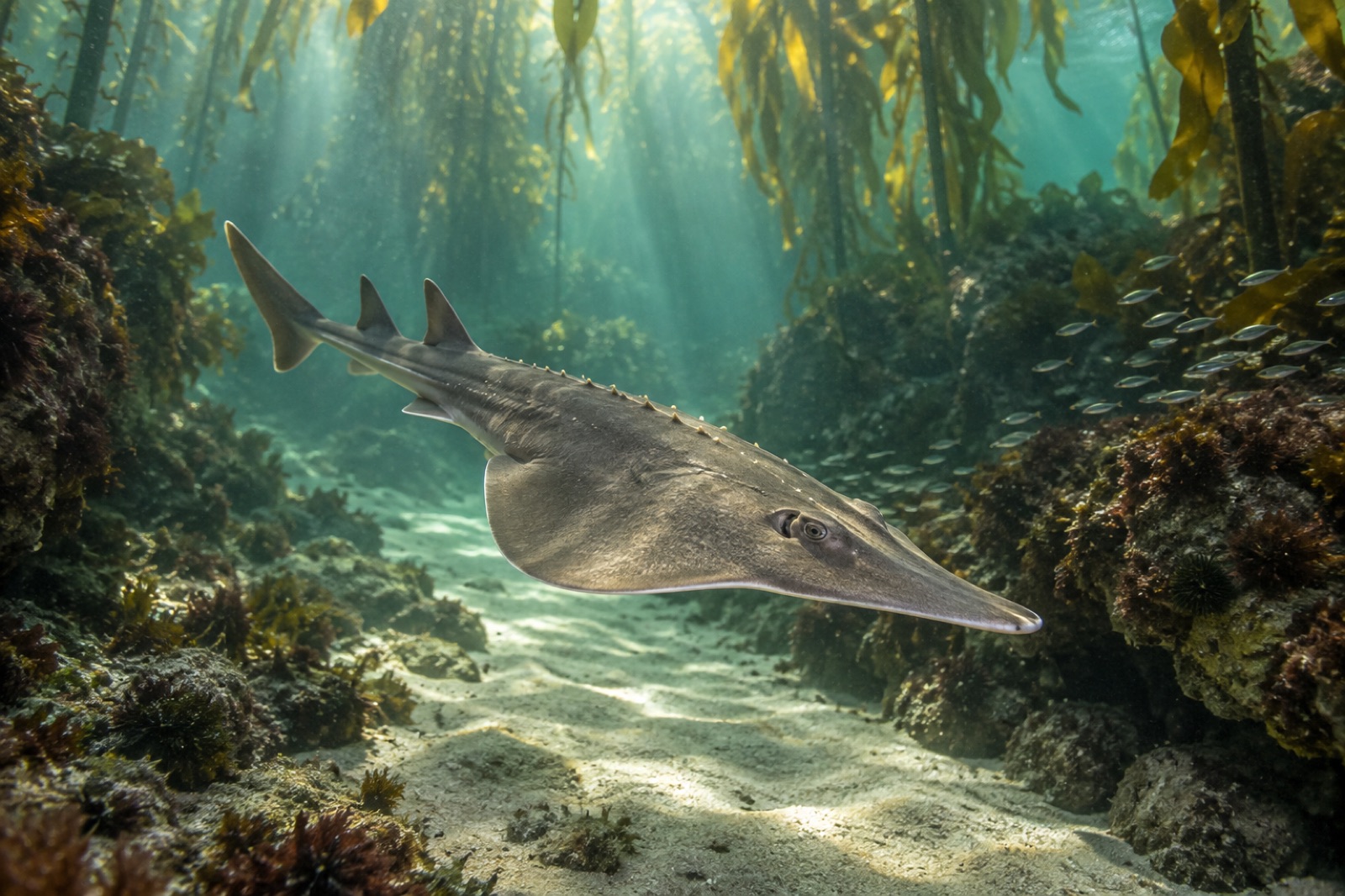
The spotted ratfish is a reminder of a point easily forgotten in profiles of kelp ecosystems: the forest's habitat extends well past the blades. Sandy channels, deep rock, the dim reef at thirty metres at dusk — these are the kelp forest's wings and foundations, and they hold their own characters. The ratfish is one of them, and it is joined in that dimmer guild by other strange cartilaginous residents: the swell shark with its inflate-and-wedge defence, and the half-shark half-ray shovelnose guitarfish working the sandy flats on the kelp's southern edge.
Globally the spotted ratfish is assessed as Least Concern: its range is wide, much of its depth range is beyond the easy reach of trawl, and it is generally discarded rather than targeted where it is caught. That status should be read as "not currently known to be in trouble," however, rather than "secure." Chimaeras are data-poor almost everywhere, they mature late, and deep bycatch is chronically undercounted. The honest scientific position is that we know this fish poorly, that it has survived 400 million years of ocean change, and that the modern ocean — warming, acidifying, harder to hide in — is a new test for a very old design.
On a Tidewright survey transect, a ratfish encounter is still a quiet event worth logging in its own right: not an otter, not a kelp crab, but an animal from the lineage's deep past, passing through the forest on wingbeats. When eDNA monitoring pulls ratfish sequence out of a bottle of seawater from a restoration site, we count it as a sign that the deep-water fringe — the part of the reef nobody plants — is still talking to the part we do.
Key takeaways
- The spotted ratfish is a chimaera — a cartilaginous fish lineage split from sharks and rays about 400 million years ago — with tooth plates, huge green eyes and a venomous dorsal spine.
- It "flies" on bird-like wingbeats of its pectoral fins and crushes crabs, clams and shrimp in rodent-like bony plates.
- It ranges from Alaska to the Gulf of California, shallowest in the cold north and deep-dwelling in the south; in northern waters it comes into diver depths at night.
- Females lay large leathery spindle-shaped egg cases that take up to a year to hatch; males carry a forehead clamp (tenaculum) for mating.
- It is currently assessed as Least Concern, but chimaeras are data-poor, slow-maturing and poorly tracked as bycatch — "least concern" means little more than "not yet found in trouble."
FAQ
Is a ratfish a kind of shark?
It is a cousin, not a shark. Ratfish belong to the chimaeras (Holocephali), a sister group to the sharks and rays; the two lineages split in the early Devonian. The fusion of the skull, the single gill flap and the permanent tooth plates all mark it as a chimaera.
Is the ratfish spine dangerous?
The spine carries venom that causes intense local pain and swelling lasting hours to days, but it is not considered medically dangerous to healthy adults. Treat it like a hard sting: clean the puncture, seek care for severe reactions, and handle the fish — if you must — by the body, well away from the dorsum.
Can divers see spotted ratfish?
Frequently, in the Pacific Northwest and Alaska, on night dives at surprisingly shallow depths — sometimes under ten metres. Southward the species holds progressively deeper water, following the cold, and is effectively out of recreational range.
Why do the males have that thing on their forehead?
It is called a tenaculum: a retractable club tipped with small hooks, used by the male to grip the female's pectoral fin while mating. It is unique to chimaeras and one of the strangest mating structures among fishes.
Are ratfish eaten?
Not commercially in the eastern Pacific. They have been investigated historically as a source of "whitefish" and oil, and they turn up as bycatch, but there is no significant targeted fishery — one reason the species is, for now, holding its own.