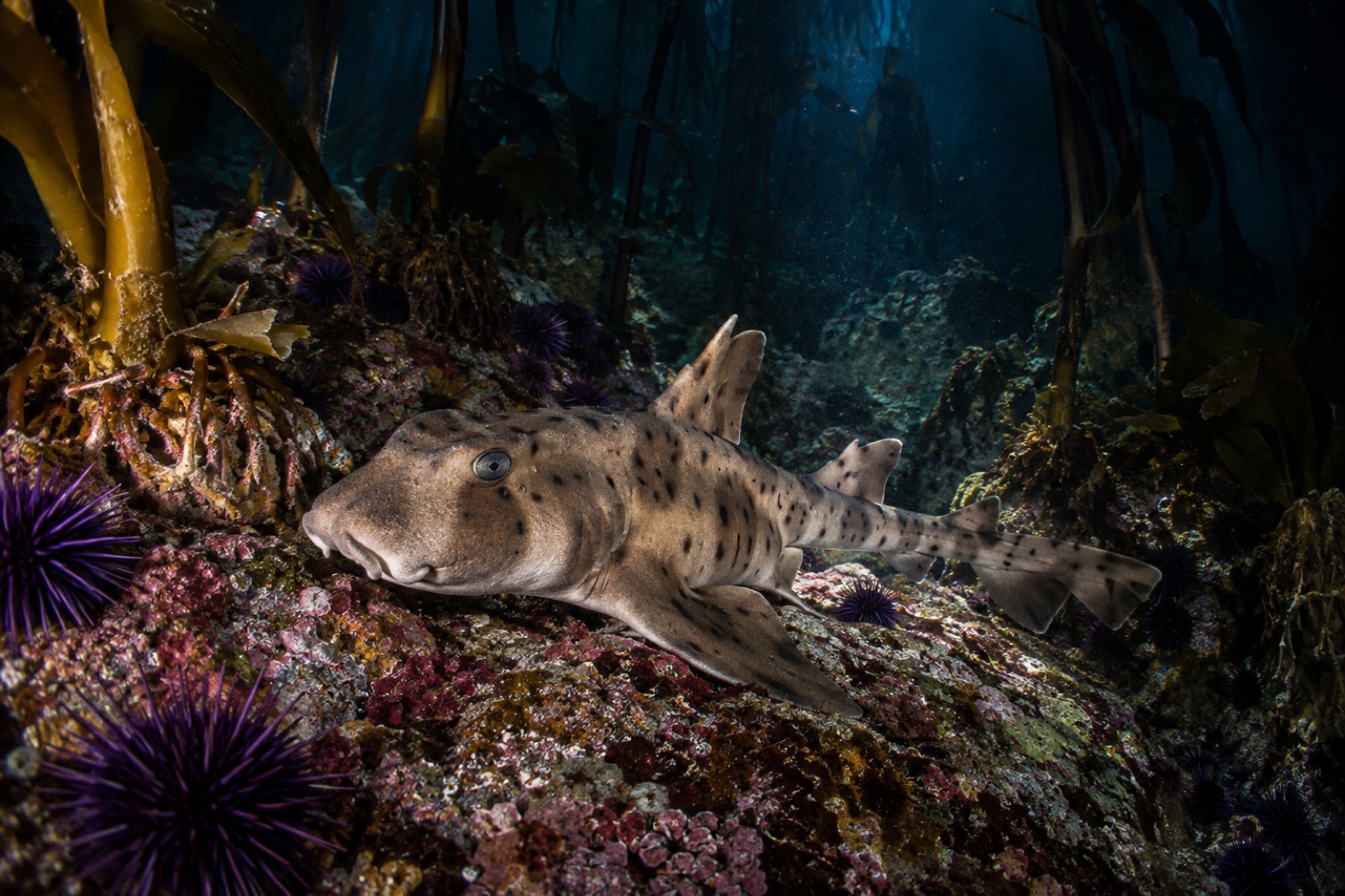
By day, a swell shark is nowhere — a crevice in the kelp-bed rock overflows with a mottled catshark, asleep, wedged, unmoving except for a slow ventilating pulse of the gills. By night, the same flat is crossed by unhurried hunters, working the kelp understory by smell and by the faint electric fields of their prey. And if the day ever goes badly wrong — grabbed by a seal, pulled at by a predator — the animal does the single strangest thing any California fish does: it bends into a horseshoe, takes its own tail in its mouth, gulps seawater, and doubles in size until it is a taut, unswallowable balloon. This is the swell shark, Cephaloscyllium ventriosum — one of the most common sharks on the American Pacific shelf, and one of the least seen.
Identification
Swell sharks are catsharks (family Scyliorhinidae): soft-bodied, blunt-snouted, big-eyed animals built for close-quarters hunting rather than speed. Field marks:
- Pattern: a warm brown-to-grey background covered in dark brown to near-black blotches and saddles, interspersed with smaller pale and dark speckling — a mottled "faded leopard" coat clearly different from the clean dark-spotted leopard shark of the sand flats, and radically different from the striped-and-spiny horn shark that shares its crevices.
- Shape: stocky through the belly, head broad and flat, snout short and rounded, nostrils with small barbels. Two small dorsal fins set far back — both behind the pelvic fins, so the tail appears mostly finless along its top.
- Size: most seen are 60–90 cm; maximum around 1.1 m. This is a shark you could lift in two hands — never do — but not a large one.
- Defensive posture, diagnostic beyond doubt: if threatened, the shark bends into a U, grabs its tail with its mouth, and inflates its stomach with water into a rigid sphere. In the open the inflated shark is hard for any predator to swallow; pressed into a crevice it is effectively irremovable. Hauled to the surface it may bark — air expelled forcefully from the inflated stomach.
Range and habitat
The swell shark is an Eastern Pacific endemic: roughly Monterey Bay, California, south along the full Baja peninsula into the Gulf of California and the Mexican mainland coast, with reports continuing into southern latitudes where the taxonomy of the catshark complex is still being untangled. Its stronghold is Southern California's kelp belt — the Channel Islands, the mainland reefs, the flats inshore of them.
Two habitats, by time of day. By day: crevices, caves and the shade of ledges on rocky reef, often in aggregations — divers frequently find three, five, a dozen animals stacked into one grotto like cordwood, in the same cave systems used by horn sharks and morays. By night: open rocky bottom, kelp understory and adjacent sand, anywhere from very shallow water down to hundreds of metres.
A night-shift specialist
Swell sharks sleep piled in crevices because their hunting equipment is built for darkness and confined space. Like all sharks, they hunt in large part with the ampullae of Lorenzini — the electroreceptor pores around the snout that detect the faint bioelectric fields of hidden prey: a crab dug under sand, a fish inside a crack. At night the swell shark cruises slowly over rocky bottom, working its snout across the substrate in a clumsy, dogged, unhurried search, then yawns suddenly downward and sucks prey out of its shelter. Diet: small reef fishes (including the gobies and juvenile rockfishes of the understory), crabs and shrimp, small squid and the odd worm or mollusc. They are indiscriminate and thorough; a working reef flat at night is cleaned by swell sharks the way a street is cleaned at dawn.
The famous inflation remains the type specimen of a defensive escalation, but the quieter trick is the baseline: a swell shark can rest completely motionless, ventilating its gills buccally while it lies on the bottom — unlike the obligately ram-ventilating open-water sharks, it does not have to swim to breathe. That freedom to be still is what lets it be a crevice animal.
The glow-in-the-dark wrinkle
In 2014–15, researchers demonstrated that swell sharks — along with their Atlantic cousin the chain catshark — are biofluorescent: under blue light (the wavelengths that dominate the deep ocean), the skin absorbs the blue and re-emits it as green fluorescence, mediated by a family of small molecules unique to these sharks. The fluorescence is brightest in light-skinned individuals as opposed to darker; there is evidence the pattern increases contrast visible to other catsharks, whose eyes are exquisitely tuned to exactly that green. What they say to each other with it remains unknown. For divers with a blue (fluoro) torch and a yellow barrier filter, a night-diving kelp forest in Southern California offers a rare chance to see a shark glow mint-green in the beam.
Reproduction and the mermaid's purse
Swell sharks are oviparous — egg layers — and their greenish-amber egg cases, the "mermaid's purses", are among the most familiar flotsam along the Californian coast. The female lays pairs of purse-shaped keratin cases, each equipped with long adhesive tendrils at the corners which she deliberately winds around reef structure — kelp holdfasts, algae, gorgonians — anchoring the egg against surge. A single embryo develops inside for roughly seven to ten months (colder water, longer brooding), nourished entirely by its yolk. At hatching, the miniature shark — about 13–15 cm, already fully patterned — squirms out of a case it may have spent nearly a year inside.
Beachcombers find the empty cases year-round, and they're worth finding: the size, four corner tendrils and olive-green case distinguish swell-shark purses from the horn shark's spiral auger-shaped egg and the more atrially-formed skate purses.
Conservation status
Swell sharks are not targeted by fisheries and, being tough and frequently returned alive, persist well under incidental capture; populations are considered secure across their core range. Their true exposure, like the rest of the resident kelp-reef community, is habitat: marine heatwaves that strip canopy and remodel the reef fish community they forage on, and trawling or dredging pressure on the open shelf flats. As a sedentary, crevice-bound animal with nightly organised hunting grounds, the swell shark is the kind of shark that marine protected areas protect well — it spends its whole life on a small compass of reef. In Drifter night transects and benthic video surveys, they are one of the standard signatures of an intact nocturnal reef: when the swell sharks are working the understory, the urban anatomy of the night shift — squid, octopus, lobsters, small fishes — is likely intact.
Watching swell sharks
- Day: look into deep crevices and caves on rocky kelp reefs, particularly in Southern California. They rest in view, often side by side; move slowly and they simply watch you.
- Night: the real show. Cruising singletons over rocky flats and sand edges, oblivious to a quiet diver.
- Never grab or provoke an inflation; the tricksticks are energetically expensive for the shark and it gains the animal nothing in an aquarium-lit photography session.
- If you find a mermaid's purse on the beach with a live embryo inside, the right move is to leave it be or return it to still, weedy shallow water unopened.
Key takeaways
- The swell shark is a mottled catshark of the Eastern Pacific kelp belt — commonly 0.6–0.9 m — sleeping by day in crevices and hunting the flats by night, mostly on electroreception.
- Its signature defence: bending into a U, grabbing its tail, and inflating its stomach with water into an unswallowable balloon — effective both in the open and wedged in rock.
- It is biofluorescent: under blue light its skin glows green, one of a handful of sharks that do, probably as a private colour channel.
- Reproduction is by tendriled egg cases — mermaid's purses anchored to reef structure, with a seven-to-ten-month incubation.
- Common, unfished and secure, it is a classic indicator of an intact nocturnal kelp-reef community and a highlight of any Southern California night dive.
FAQ
Are swell sharks dangerous to divers?
No. The swell shark is harmless: small-mouthed, slow, and thoroughly uninterested in anything it can't swallow. The worst outcome of provocation is a mouthful of a fish turning itself into a balloon. Give crevices respectful distance at day and enjoy their confidence at night.
Why is it called a swell shark?
For exactly the defensive behaviour — the shark "swells" with ingested water (or air at the surface) until nearly twice its normal girth. The species name ventriosum says the same thing in Latin: the big-bellied one.
Can swell sharks really glow in the dark?
In a precise sense, yes. They are biofluorescent, not bioluminescent: they don't make their own light, but their skin absorbs the blue wavelengths that dominate underwater and re-emits them as green, via unique small molecules in their skin. Other catsharks do the same. Under a blue dive torch with a yellow filter, they shine mint-green.
How long do swell sharks live?
They grow slowly, mature late, and are thought to live at least a couple of decades — the typical measured pace of small, cold-water sharks — though solid long-term age data for this species are thinner than for larger cousins.
What's the difference between a swell shark and a horn shark?
They often share the same caves, but they're opposites in build: the horn shark has a tall dorsal fin with a stout spine in front of it and a heavy, pig-like head (its teeth crush shellfish), while the swell shark has no spines, far-back dorsals, and a softer, speckled-mottled coat. Behaviour differs too — horn sharks hunt the bottom omnivorously with crushing jaws; swell sharks hunt fish, crabs and squid by suction in the dark.