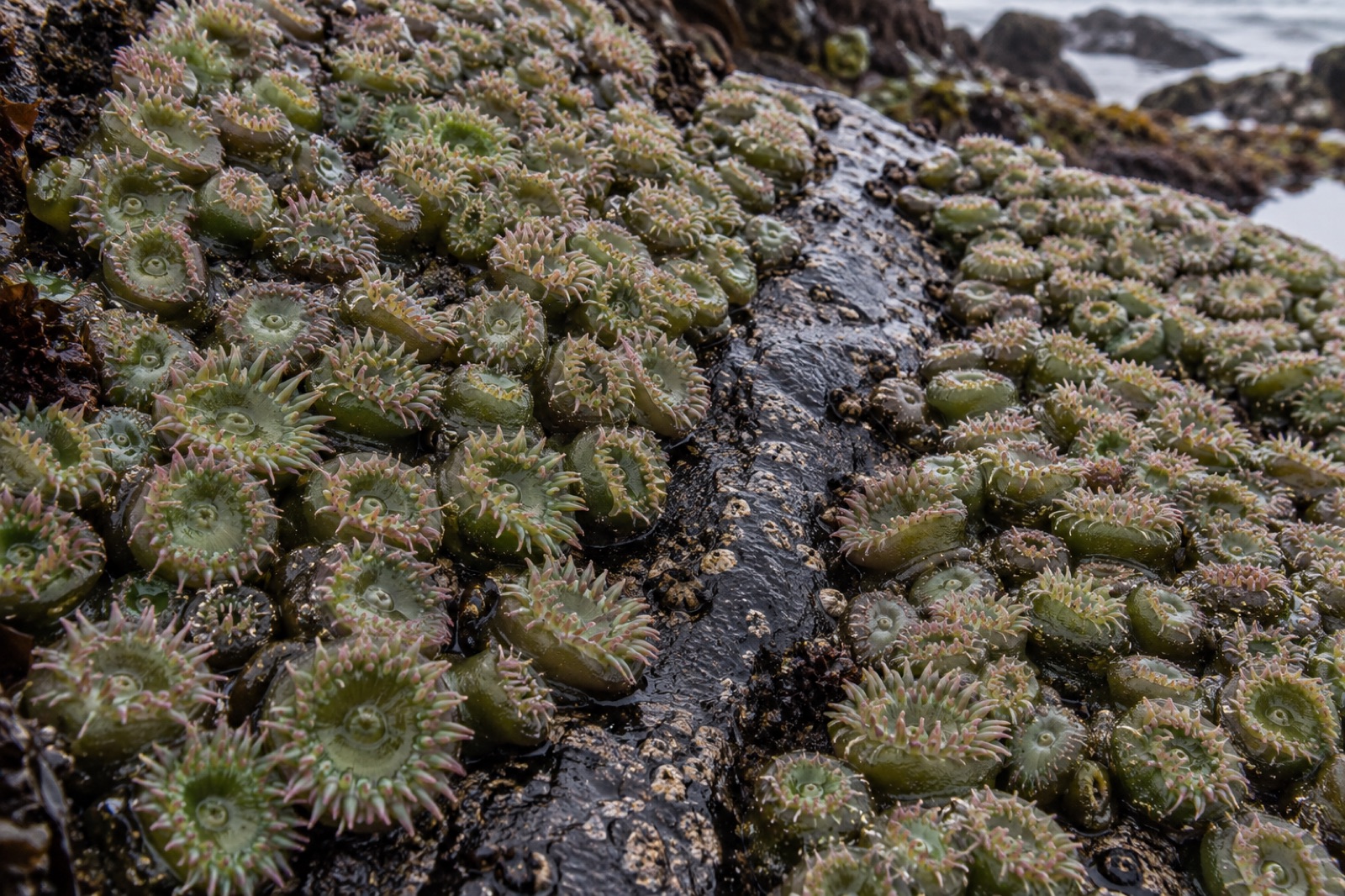
On a cold-water dive anywhere from the Aleutians to Monterey, the eye learns to tune for a particular splash of colour against the grey-green rock: a compact, deep-crimson anemone crowned with short, blunt, banded tentacles, its column looking less like soft flesh than like something tooled from red leather. That is the stubby rose anemone, Urticina coriacea — also sold in older field guides as the leathery rose anemone — and it is one of the most widespread cold-water anemones in the northern hemisphere. It is the kind of animal that teaches you what "cold-adapted" really means: where tropical anemones dazzle, this one endures.
Fast facts
|
|
| Scientific name |
Urticina coriacea |
| Common names |
Stubby rose anemone, leathery rose anemone |
| Group |
Sea anemone, family Actiniidae, class Anthozoa, phylum Cnidaria |
| Size |
Column typically 5–15 cm tall and wide; oral disc to around 15 cm across |
| Lifespan |
Long-lived; large individuals are likely many years old |
| Depth range |
Low intertidal (in the north) to tens of metres subtidal |
| Range |
Amphiboreal: northern Pacific (Alaska to central California) and northern Atlantic/Arctic seas |
| Status |
Common across its range; not considered threatened |
Anatomy of a leather rose
The name coriacea means leathery, and the column earns it. Where many anemones have smooth, soft sides, the stubby rose's column is thick-walled and textured with low tubercles set in loose rows. Those tubercles are adhesive: shells, gravel and bits of debris stick to them, so a contracted animal wearing its gravel coat can look like nothing more than a lump of wet rock. Open and feeding, though, it is unmistakable — a saturated scarlet column topped by a disc of short, stout, conical tentacles banded in crimson and pale cream or grey. The tentacle count is high but the tentacles stay blunt and stubby, giving the whole crown the close-cropped look the common name describes.
The distinction matters in the field because Urticina is a genus of lookalikes. The painted or mottled anemone U. crassicornis is larger, lankier-tentacled and strongly banded green-and-red; the white-spotted rose anemone (U. lofotensis) carries clean vertical rows of white spots that, unlike the stubby rose's tubercles, do not hold debris; and the sand-rose anemone U. columbiana burrows in sand rather than gripping rock. If you are on hard bottom in cold water, and the anemone is deep red, compact, blunt-tentacled and wearing stuck-on gravel, coriacea is the call.
A two-ocean northerner
The stubby rose anemone's range is what zoogeographers call amphiboreal: it lives in the cold-temperate to Arctic waters of both the northern Pacific and the northern Atlantic, a pattern shared by a select club of cold-loving invertebrates whose ancestors moved through Arctic seas when climate and geography allowed. Within that enormous span it is a generalist of hard substrate: bedrock walls, boulder fields, cobble, pier pilings and shell hash, from the lowest tide zone down past scuba depths. In the southern part of its range — the kelp-coast diving covered in our Vancouver Island coast guide and similar waters — it is comfortably a subtidal animal; in Alaska it can appear in the low intertidal wherever ice scour permits.
That distribution carries a physiological message. This is an animal engineered around cold and seasonal darkness: cold water holds more oxygen, metabolism runs slow, feeding can concentrate in the productive season, and growth — like that of the cold-water forests around it, described in kelp life cycles — can stretch across years rather than months.
Feeding: patience with a sting
Like all sea anemones, the stubby rose is a sit-and-wait predator armed with nematocysts — microscopic, pressure-triggered harpoons that inject venom on contact with anything soft and unfortunate enough to brush the tentacles. The diet is the standard cold-water benthic menu: shrimp and other small crustaceans, worms, small molluscs, the occasional tiny fish, plus opportunistic scavenging of whatever the current delivers. Prey is passed tentacle-to-mouth in the slow-motion ballet common to all actiniids — no brain, just a nerve net coordinating a behaviour that looks uncannily deliberate.
The genus name Urticina comes from Urtica, the stinging nettle — a fair description of what a careless sea slug or small fish experiences. Human skin, being thick and keratinised, feels nothing worse than a faint sticky grip.
Reproduction and young
Stubby rose anemones are broadcast spawners: males and females release sperm and eggs into the water column, where fertilisation happens by planktonic lottery. The resulting ciliated planula larva drifts with the currents — the same dispersal physics that threads populations together across entire archipelagos, explored in larval dispersal — before settling on hard substrate and metamorphosing into a tiny polyp. Unlike its brooding relatives such as the anemones profiled in brooding anemone, coriacea leaves its young to the ocean. It can also, like many anemones, persist for a remarkably long time: adults appear to be slow-growing and long-lived, meaning the dark red rose at the base of a piling may be considerably older than the dive guide pointing at it.
Predators and neighbours
The animal that most reliably hunts Urticina anemones is the leather star, a soft-skinned sea star that tastes like garlic to handle (it really does) and eats anemones outright, engulfing them slowly. Certain nudibranchs also prey on anemones and sequester their stinging cells for their own defence — the trick performed on smaller anemones by species like the Spanish shawl and its relatives. Around the anemone, meanwhile, runs the whole traffic of a cold reef: kelp crabs, shrimps, sculpins and the small cleaning court of the kelp forest floor. In southern range waters the stubby rose shares the rock with the fish-eating anemone and the towering plumose anemones; northward it increasingly has the boulder fields to itself.
Finding and photographing one
- Look from mid-wall to boulder field: focus on vertical faces and the tops of boulders just clear of sediment scouring, between about 5 and 30 metres in California and into the shallows further north.
- Check the disguise: before finning past a gravel-textured lump, pause — a contracted, debris-coated coriacea is the most commonly missed animal on the reef.
- Light for colour: the scarlet reads brown-grey at depth without a torch; a modest light restores the red that makes this animal a favourite of cold-water macro photographers (technique notes in macro photography in kelp).
- Hands off: leather-textured is not armour. Touching with dry gloves, or worse prying, damages the column; admire, photograph, move on — the full code is in our kelp wildlife ethics guide.
Key takeaways
- The stubby rose anemone (Urticina coriacea) is a compact, crimson, blunt-tentacled anemone of cold rocky bottoms, named for its leathery, tubercled column.
- Sticky tubercles hold a camouflaging coat of shell and gravel; a contracted animal looks like wet rock.
- It is amphiboreal — found in the cold waters of both the northern Pacific and northern Atlantic/Arctic — from low intertidal rock in Alaska down past scuba depths in California.
- It is a broadcast-spawning, sit-and-wait predator of small crustaceans and worms; young animals drift as planula larvae.
- The leather star is its signature predator; lookalike Urticina species are separated by tentacle shape, spots and attachment substrate.
FAQ
Is the stubby rose anemone dangerous to touch?
No. Its stinging cells cannot penetrate human skin; you would feel slight stickiness at most. The no-touching rule protects the anemone, whose tentacles and column tear far more easily than they look.
How do I tell it apart from the white-spotted rose anemone?
Look at the column. U. coriacea has a leathery column with debris-holding tubercles and no clean white rows of spots; U. lofotensis has clean vertical rows of white, non-adhesive spots on a smoother column. Tentacle shape is similar, so the column is your field mark.
Does it live in the intertidal?
In Alaska and the far north, yes — on surf-swept low-shore rock. In the southern end of its range (British Columbia southward) it is almost entirely subtidal, retreating below the warmer, fresher surface layer.
How old can one get?
Nobody has birthday-tagged them across decades, but cold-water anemones of this build are famously long-lived — slow-growing animals with few adult predators, where large individuals plausibly measure their lives in decades.
Does it have any role in kelp forest ecology?
A modest but real one: it is a mid-level benthic predator that recycles small crustaceans and organic debris, and it adds structure — and prey — to wall communities. It is part of the fabric, not a keystone, which is true of most of the reef's most beautiful residents.