Find a frond of feather boa kelp in a Pacific tidepool and look closely at the flat rachis, and you may find one of the neatest bits of parenting in the invertebrate world: a small anemone, barely three centimetres tall, wearing a ring of tiny anemones around the base of its own column. This is the brooding anemone, Epiactis prolifera — "prolifera" for the proliferating young. It broods its offspring on its own skin, changes sex as it ages, lives its whole life perched on plants rather than rock, and has spread itself along thousands of kilometres of coastline despite having no drifting larva at all. Every one of those facts is slightly amazing; together they make this small animal one of the best teachers in the kelp forest.
Fast facts
|
|
| Scientific name |
Epiactis prolifera |
| Group |
Sea anemone, phylum Cnidaria, class Anthozoa |
| Size |
Column typically 1–3 cm tall and wide; large individuals to about 5 cm |
| Lifespan |
Several years; individuals pass through male then female phases |
| Depth range |
Mid-intertidal to shallow subtidal, roughly to 20 m |
| Range |
Eastern Pacific: Alaska to Baja California |
| Status |
Common and widespread; not of conservation concern |
Identification: small, striped, and surrounded
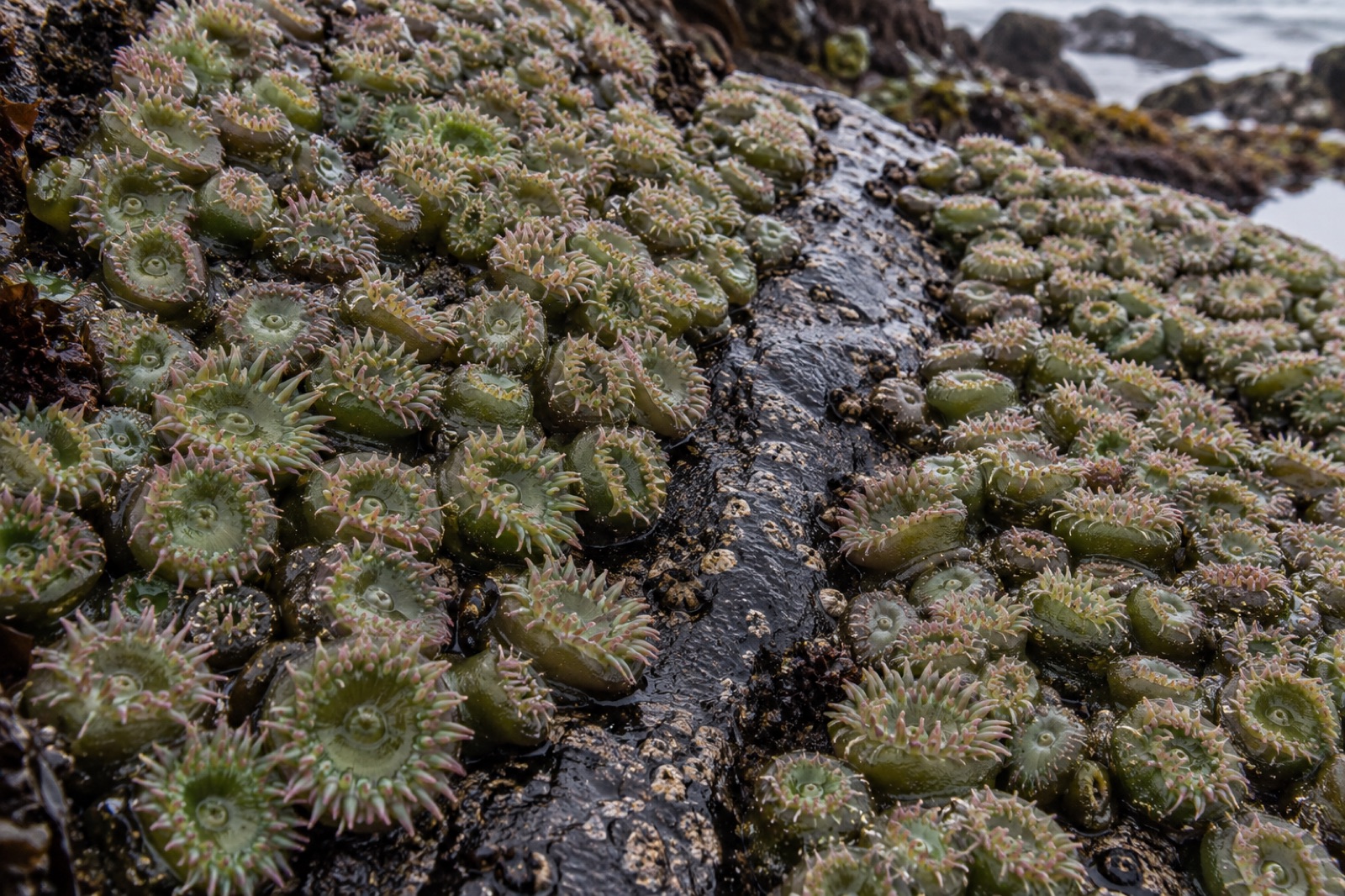
The brooding anemone is a modest anemone: a short, smooth column in green, brown or red, usually marked with fine longitudinal stripes, topped by a crown of short tentacles around a plain oral disc. The pedal disc often shows a reddish or white-rimmed margin. Alone, it could be mistaken for a young giant green anemone or a small aggregating anemone. The giveaways are habitat and company: Epiactis lives almost exclusively on algae and eelgrass, not open rock, and a reproductively active adult frequently wears a ring of juveniles around its lower column — young anemones that have crawled out of the parent's mouth, walked down the column, and attached there to grow.
That ring is the fastest field identification on the coast. No other common eastern Pacific anemone carries its family on its flank.
Live-bearing, anemone style
Most sea anemones reproduce by broadcasting eggs and sperm into the water, where fertilised larvae drift for days or weeks before settling — the standard planktonic lottery described in our piece on larval dispersal. Epiactis prolifera opts out of all of it. Fertilisation happens internally, the embryos develop inside the mother's gastrovascular cavity, and miniature anemones — tentacles and all — emerge through the mouth and step onto their mother's column. There they stay, a growing brood of different ages, until they are large enough to walk off and attach independently nearby.
The reproductive sequence has a second twist: protandric hermaphroditism. Individuals begin their reproductive lives as males, producing sperm, and transition to female function as they grow. A small anemone fathers; a large anemone mothers. The result is a life history aimed squarely at local recruitment: big females release well-developed juveniles that settle within centimetres, on the same plant, in the same sheltered habitat that clearly worked for the parent.
The trade-off is obvious. Brooding produces fewer young than broadcasting, and none of them go anywhere far. Which raises the next question.
The dispersal puzzle: how a stay-at-home animal crossed a coastline
Epiactis prolifera has no drifting stage and no crawling speed worth mentioning, yet its range runs from Alaska to Baja California. The resolution of that paradox is at the end of its own plant. The anemone's favourite substrates — feather boa kelp, and other buoyant algae and eelgrass blades — break loose. Storms and surf tear fronds and rafts of weed free, and the anemones ride them, an entire attached community exported to sea-scale distances by drift. Genetics studies of brooding invertebrates consistently find more long-distance mixing than their "sedentary" biology suggests, and rafting is the standing explanation.
It is the same drift economy that carries drift kelp and wrack onto beaches and out to deep water — except here the cargo is alive and reproductive. Kelp is not just the anemone's home; it is, periodically, its ship.
Life on a plant
Choosing a living substrate changes everything. Perched on blades and eelgrass, the brooding anemone feeds on whatever the current delivers past the canopy's understory: small crustaceans, drifting larvae, organic particles, the constant drizzle of canopy life. The elevated seat reduces competition with rock-dwelling anemones and lifts it above the sediment and sand-scour that rule the seafloor, at the price of instability — blades grow, fray, and tear away.
The kelp understory it inhabits is itself layered habitat, sorted by light, flow and wave force in ways mapped out in Life in Layers: Zonation of the Subtidal Reef. Where wave action is heavy on exposed headlands, even this epiphyte's fortunes rise and fall with the exposure gradient: sheltered sites hold older anemones and denser broods; exposed sites trade abundance for recolonisation opportunities on drifting weed.
Watching the brood: citizens and scientists
Because the family ring makes reproduction visible to the naked eye, the brooding anemone is one of the most satisfying tidepool animals for a careful observer: take a photo of the ring rather than a sample, and you have a dated record of recruitment. Intertidal monitoring programs and our wider encyclopedia of kelp forest life treat it exactly this way — as an easily logged indicator of a healthy understory community. Like all anemones it stings on a scale far too small to notice and should be observed rather than handled; like all tidepool residents it lives where the tide's schedule sets every visit.
Key takeaways
- The brooding anemone (Epiactis prolifera) is a small striped anemone of kelp and eelgrass, Alaska to Baja, identifiable by the ring of juveniles around its column.
- It bears live young: embryos develop inside the mother and emerge through the mouth as fully formed miniature anemones that settle on the parent's own column.
- Individuals are protandric hermaphrodites — males first, females when larger — so the biggest anemones are the mothers.
- With no drifting larva, its long-distance dispersal runs on rafting: storms detach the algae it lives on and freight whole broods to distant shores.
- It is an epiphyte of the kelp understory, feeding from the current, and a rewarding, photographable indicator of healthy kelp-edge habitat.
FAQ
How does the brooding anemone reproduce?
By internal brooding. Fertilised embryos develop inside the mother's gastrovascular cavity and crawl out of the mouth as tiny, fully formed anemones, attaching at first to the parent's own column — the visible "ring of babies" — before moving off nearby.
Why does one anemone appear to be covered in smaller anemones?
Those are its brooded young at different stages, plus sometimes settled juveniles from earlier broods. Only large, female-phase individuals carry broods; individuals begin reproductive life as males.
If its babies stay home, how did it spread down the whole coast?
By rafting on its habitat. The algae and eelgrass it lives on tear free in storms and drift, carrying attached anemones — including brooding mothers — to new stretches of coastline.
Where should I look for a brooding anemone?
On the rachis and fronds of feather boa kelp and on eelgrass and other algae in lower tidepools and the shallow subtidal of the northeast Pacific, Alaska to Baja California. Look for the striped column and, in season, the ring of juveniles.
Yes — same phylum (Cnidaria) and class as the giant green and aggregating anemones, but a different genus with a different strategy: living on plants instead of rock, and parenting by brood instead of broadcasting.