On a rocky reef wall beneath the kelp canopy, somewhere between eight and thirty metres down, a diver's light catches a splash of impossible red: a smooth column the colour of a ripe strawberry, topped with a crown of short, banded tentacles the size of a soup bowl. This is the fish-eating anemone, Urticina piscivora — also called the velvety red anemone or rose anemone — and it is one of the few animals in the kelp forest whose name describes exactly what it does. It eats fish. Not often, and not quickly, but decisively: an animal that brushes that crown of tentacles is harpooned by thousands of stinging cells, folded into the mouth, and reduced over the next day to a compacted pellet of scales and bones ejected back into the current.
Fast facts
|
|
| Scientific name |
Urticina piscivora |
| Group |
Sea anemone, class Anthozoa, phylum Cnidaria |
| Size |
Column to roughly 20 cm tall; tentacle crown spreading 25 cm or more in large animals |
| Lifespan |
Long — believed to run into decades for undisturbed individuals |
| Depth range |
Low intertidal to subtidal, commonly 5–30 m, deeper in clear water |
| Range |
Eastern North Pacific: Alaska to Southern California |
| Status |
Common on exposed rocky reefs; locally affected by warming and by sea star declines |
Built for vertebrate prey
Most sea anemones are plankton-and-scrap feeders, equipped with nematocysts scaled for small crustaceans. The fish-eating anemone's stinging battery is of another calibre. Its nematocysts are potent enough to penetrate and hold the slippery, moving skin of a fish — the prey class that defeats almost every other sessile animal on the reef. The mechanics are unhurried. Contact fires the battery instantly; struggling only drives more cells in. The crown then contracts inward, the rim of tentacles folding the prey toward the central mouth, and the whole animal slowly closes like a soft fist. Digestion of a small rockfish or sculpin takes many hours. What comes back out, through the same opening that took it in, is a tidy bolus of everything indigestible.
The body is built to match. A broad pedal disc grips rock, a smooth, rubbery-red column (no adhesive warts, unlike its intertidal cousins) rises to a crown of hundreds of short tentacles banded in red and white, and the whole animal can pull down into a hemisphere when disturbed. Divers who know their anemones identify piscivora at a glance: the clean, wartless red column and the strictly subtidal address give it away. The giant white heads by which Metridium species announce themselves — covered in our plumose anemone profile — belong to a different genus with a different, filter-feeding economy entirely.
No algae, no sunlight: meat all the way down
The kelp-edge anemones most tidepoolers meet — the giant green anemone, the aggregating carpets — are photosymbiotic, running partly on algae inside their tissues. Urticina piscivora is not. It hosts no symbiotic algae and earns every calorie carnivorously: krill and other crustaceans swept its way by the current, urchin fragments, morsels of mussel, and its namesake fish. That matters for where it lives. Released from dependence on light, it thrives on shaded walls, overhangs and deeper reef where the green anemones cannot follow — down where the kelp canopy dims the world to fucoxanthin colours, light described in our explainer on light underwater. Its red colour is pigment, not partnership: carotenoids and related compounds laid down in its own tissue, though the reason for the intensity of the red — camouflage at depth, where red light barely penetrates, is the leading idea — remains pleasingly unsettled.
The predator that feeds the wolf pack
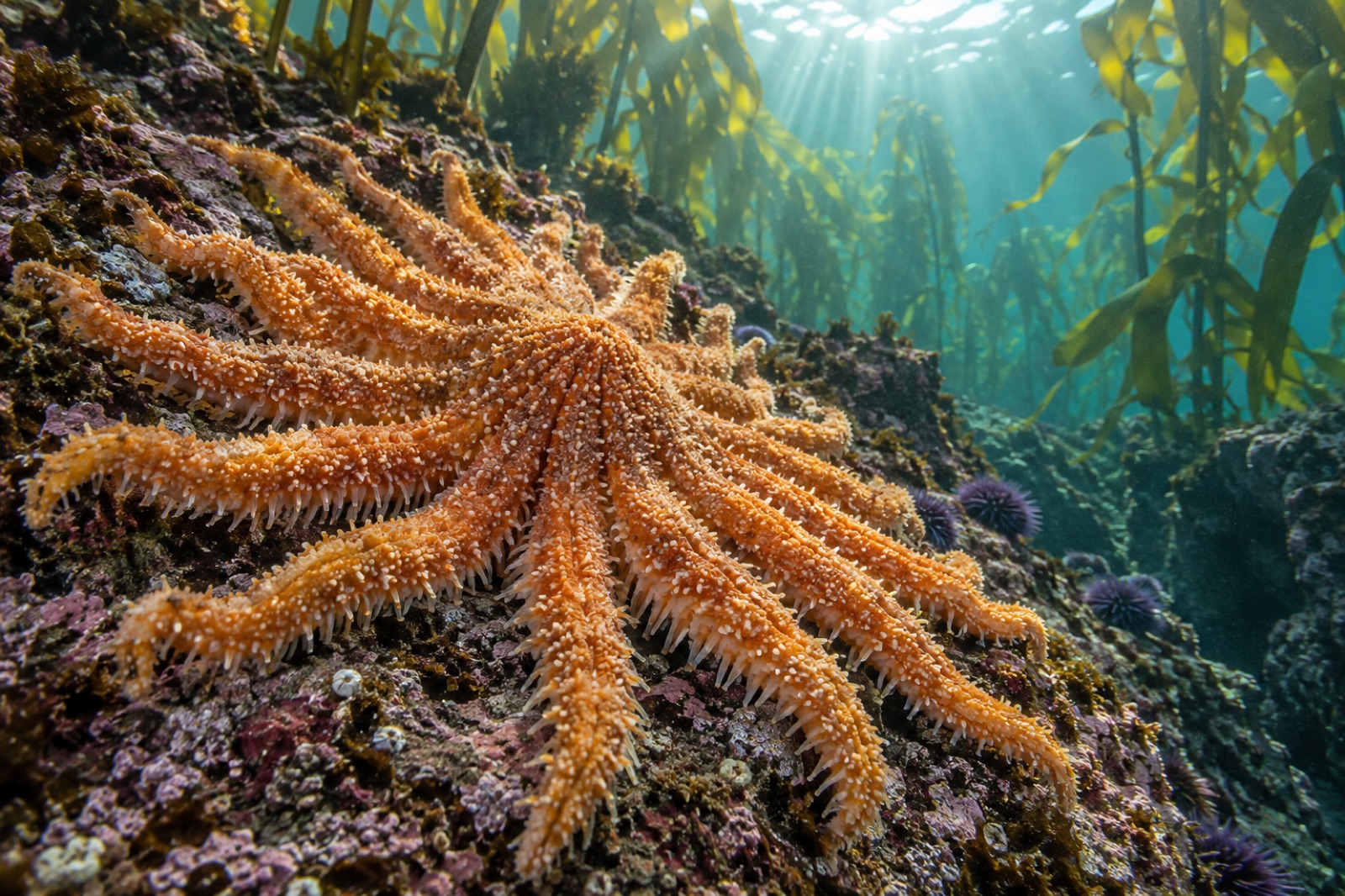
The fish-eating anemone's defence is formidable but not total, and its principal enemies are sea stars. The leather star — see our leather star profile — is a specialised anemone-eater, but the more dramatic relationship is with the sunflower sea star, Pycnopodia helianthoides. A foraging sunflower star moving across a reef is a metre-wide appetite, and big anemones are among the few slow, protein-rich parcels worth detouring for. Touch the leading arms of a Pycnopodia and a fish-eating anemone does something almost no anemone does: it lets go. The pedal disc releases the rock; the animal rolls and thrashes with muscular contractions, tumbling away in the current. It is an escape response as comical as it is effective at the sunflower star's walking pace.
That pairing has been turned tragic by sea star wasting disease, the epidemic that killed billions of sunflower stars along this coast — a story told in our sea star wasting explainer. Where the stars vanished, surveys documented fish-eating anemones becoming more abundant and larger, freed from their chief predator — one thread in the same ecological unravelling that released purple urchins and helped flip reefs to barrens, a dynamic covered in urchin barrens. A big red anemone, it turns out, is a small barometer of whether the reef's top predators are still standing.
Slow sex, long life
The fish-eating anemone reproduces sexually: separate males and females broadcast sperm and eggs into the water, and the ciliated planula larvae drift before settling on suitable rock — the standard gamble of larval dispersal, played at a reef scale. It does not clone itself like the aggregating anemone. Growth is slow, and large animals with crowns the size of dinner plates are presumed to be old — decades is the reasonable unit, though, as with most long-lived invertebrates, exact ages are unknowable without a time machine. Tidewright's own Canopy Ledger survey teams log big anemones as photo-point subjects on permanent transects precisely because the animals are sessile, long-lived and sensitive: a transect's Urticina count, year on year, is honest, low-cost natural history data.
Where to see one
Any cold, clear, rocky dive site on the Pacific coast between Alaska and the Channel Islands offers a chance, but exposed walls in the 10–25 m band are the sweet spot. Around the Channel Islands — mapped in our Channel Islands atlas guide — and Monterey's kelp margins, red anemones stud walls below the canopy line. Look for unblemished scarlet columns, no gravel stuck to the body, and white-banded tentacles; and give the crown its space, not because it will hurt you — its nematocysts cannot meaningfully sting human skin — but because any animal that subdues fish deserves professional courtesy. Our macro photography guide has the settings for doing the red justice.
Key takeaways
- The fish-eating anemone (Urticina piscivora) is a large, wartless, crimson subtidal anemone of the eastern Pacific, Alaska to California.
- Its nematocyst battery is powerful enough to catch and hold fish and shrimp-like crustaceans — rare prey for a sessile animal.
- Unlike kelp-edge green anemones it has no photosymbionts; it is a full carnivore and thrives in dim, deeper reef.
- It flees predatory sunflower stars by releasing its grip and tumbling away — and it has grown more abundant where sea star wasting removed those stars.
- Slow-growing, long-lived and sessile, it is a useful indicator species on long-term reef transects.
FAQ
Does the fish-eating anemone really catch fish?
Yes, though it is an occasional rather than daily event. Small reef fish — young rockfish, sculpins, gobies — that brush the tentacle crown are harpooned by nematocysts and engulfed. Most of the diet is actually crustaceans such as krill, plus whatever edible debris the current delivers; the fish are the headline items.
Can it sting a diver?
Not effectively through skin. Touching a closed-up animal is harmless, and even the exposed crown delivers at most a sticky tingle to a bare fingertip. The stinging cells are specialised for thin, scaled, moving prey — which is precisely why they work on fish and not on thick-skinned mammals.
Why is it so red?
Through its own pigments, not symbiotic algae — Urticina piscivora is one of the non-photosymbiotic anemones. Red is also functional camouflage at depth: red wavelengths are filtered out within the first metres of seawater, so at twenty metres down a scarlet anemone is functionally black.
How does an anemone escape a sea star?
By giving up its address. When touched by the leading arms of a sunflower star, the fish-eating anemone detaches its pedal disc from the rock and thrashes its column, letting the surge tumble it away. It is one of the few anemone species with a genuine fight-or-flight response — weighted toward flight.
What does it have to do with kelp forests?
It lives underneath them, and it tells on them. Fish-eating anemones thrive on the shaded, vertical real estate that kelp-fringed reefs provide, and their abundance shifts track the reef's predator balance — ballooning when sea stars crash with wasting disease, flattening when the stars return. Watching a wall of Urticina over years is watching the forest's politics.