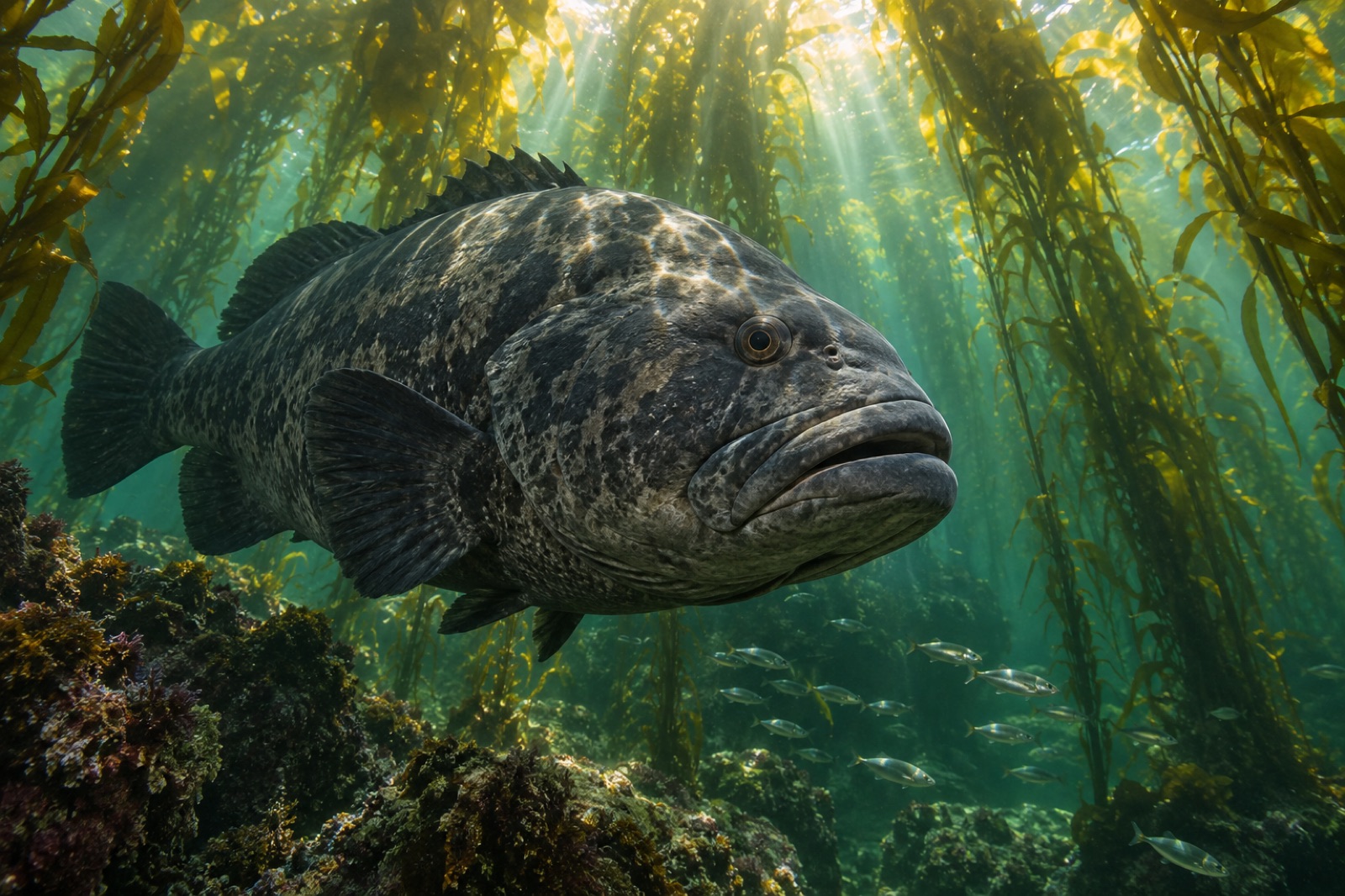
The first time you meet a giant sea bass (Stereolepis gigas) under the kelp, the meeting has a very specific shape: you are looking somewhere else entirely — at a nudibranch, at a ray's print in the sand — and a second grey hangs in the green light that was not there a moment ago. Black-blotched, thick-lipped, heavy as the family car's engine block. The fish hangs motionless, studying you with eyes that seem perfectly willing to wait you out. That is the whole secret of the giant sea bass, and also the whole story of what nearly happened to it: this is a fish that trusts its own size, and for half a century that trust was a fatal error of judgment.
This article is the story behind our shorter giant sea bass species profile — the near-loss, the slow turn, and what the giant's reappearance tells us about patience as a conservation tool.
How big is big
Old photographs from the piers of southern California and Baja California show fish hanging from tripods that drag their tails clear on the boards: giant sea bass of 200 kilograms and more, with the largest historical claims reaching 2.5 metres. Today a "big one" on the reef runs 100 to 180 kilograms, and even that is enough to make it the largest resident bony fish of the North American kelp coast, far out-massing the California sheephead or kelp bass that share its water.
Everything about the fish runs on that scale. Thick, vaguely cylindrical body. Dark grey to black, mottled with darker blotches — juveniles wear a much lighter coat of bronze with bold black spots, a nursery uniform they gradually trade in. Mature adults grow slowly, live long (decades, plausibly past sixty years in the biggest veterans), and regard the reef with the calm of an animal with almost no natural enemies. Almost. Adult giant sea bass regularly carry the healed, crescent-shaped bite work of great white sharks — the only local predator still willing to argue with a two-metre fish.
A summer life at the kelp's edge
Juveniles grow up in the nursery tangle of kelp and shallow rocky reef, picking crabs and small prey. Adults take a wider beat: kelp margins, deep rocky reefs, sandy flats and even surf-adjacent shallows, hunting on opportunity. The menu is famously unpretentious — stingrays and small sharks, crabs and lobsters, squid, octopus, bottom fish. This is not a pursuit predator; it is a patient, powerful ambusher that has concluded, correctly, that almost anything it can fit in that enormous mouth is on the table.
In summer, adults gather at traditional sites to spawn — loose aggregations where pairs rise to release eggs and sperm into the open water. The larvae ride the plankton, like the young of so many kelp residents, on the same lottery described in our explainer on larval dispersal and reef colonisation. It is the spawning gatherings that both rescued the species' reputation with fishermen — a giant sea bass hole was the information a party boat skipper was really selling — and nearly ended the fish itself.
The erasure: how to remove a giant in forty years
The giant sea bass fishery is now a textbook case of how quickly an unguarded, slow-growing fish can be taken to the floor — and it is worth telling plainly, because its full mechanism explains why recovery took so long.
- The set-net era. From the turn of the twentieth century, the fish was caught mostly as bycatch — tangled in set gillnets that fished along the bottom for halibut and white sea bass. Giant sea bass were edible, enormous and caught whether anyone wanted them or not. Commercial landings rose into their peak years in the early 1930s at several hundred tonnes a year.
- The add-on fishery. Even as the nets thinned the stock, a niche sportfishery grew on top. Party boats ran to the known holes at Anacapa Island, Catalina and the La Jolla ledges. The fish's trademarks — site fidelity, calm curiosity, refusal to flee — were exactly the traits no trophy fish should have.
- The steep slide. Landings fell away within a decade, but the fish's biology turned decline into a spiral: a species that takes many years to reach maturity cannot replace big spawning adults as fast as they are removed. By the 1970s and 1980s, giant sea bass had become so rare on the American side of the border that many younger California divers had never knowingly seen one. In Mexican waters, where the directed fishery continued, the same trajectory dragged on decades longer.
1982: the simplest possible solution
California's response had the elegance of a fishhook pulled straight out: in 1982, the state simply banned the take and sale of giant sea bass. No size limits, no seasons, no slot — a full stop. Mexico's protections followed much later and a directed fishery persisted in its waters for years, but the core of the species' northern range had become, in effect, a no-giant-sea-bass-take park.
And then — nothing, for years. That is the part of the story that gets left out of the celebratory version. A fish that matures over many years does not demonstrate a recovery on political timescales. Through the late 1980s and 1990s the giant remained a rumour: a fish seen once a season, a story the old hands told. The IUCN later assessed the American population as critically endangered, and more recently the species globally as vulnerable — a grading that captures both the damage done and the direction of travel.
The return, in sightings per summer
What changed in the 2000s was not the biology but the scoreboard. Divers began, quietly, to keep count. Anecdotal reports accumulated into a pattern; researchers added an annual volunteer "giant sea bass count" weekend, and the pattern became data. The counts show a genuine, sustained rise in sightings through the 2000s and 2010s along southern California and the islands, with hundreds of fish tallied in recent years.
The fish that came back is subtly different from the fish that was lost — smaller on average, warier on average, and concentrated where it has had the best helping hand: the no-take reserves of the Channel Islands, the protected reefs off Catalina and La Jolla. It is one of the clearest demonstrations available of what the rules described in our marine protected areas explainer can do for a large, resident, fished species. Nothing about the giant's return required habitat engineering or hatcheries. It required leaving the fish alone for forty years in water it still considered home.
Which is exactly the condition that kelp forest protection supplies at scale. A no-take kelp reef guards the whole ladder at once: the kelp that shelters the juveniles, the reef food web that feeds the adults, and the summer gathering sites where the next generation begins.
Seeing the giant well
If you dive or snorkel the southern kelp provinces — the Channel Islands, Catalina, the La Jolla edge, the deeper beds off the Palos Verdes peninsula — there is a genuine chance of a giant sea bass encounter now, which was not true a generation ago. The protocol is simply the giant's own protocol: slow down. Do not chase. The fish decides the encounter's distance, and a giant that decides you are boring will often give you more of itself than a pursued one ever would. Offshore, bear in mind that every sighting reported to a citizen-science count adds a data point to one of the Pacific's longest patient experiments.
The rest of the forest's fish community — the bass, wrasses, rockfish, perch — is profiled in the fishes group of our Encyclopedia.
Key takeaways
- The giant sea bass (Stereolepis gigas) is the kelp coast's largest resident bony fish, historically to 2.5 m and more than 250 kg, with a life measured in decades.
- A combination of gillnet bycatch and targeted sportfishing collapsed the population within a generation of its early-1930s commercial peak.
- California banned all take in 1982; recovery was invisible for years, then unmistakable from the 2000s onward as diver sightings climbed.
- The species' slow return, strongest inside no-take reserves, is one of the clearest case studies in what time plus protection achieves for a long-lived fish.
- Today's giants are smaller and warier than the pier-photo generation — a recovery in progress, not a recovery completed.
FAQ
Is the giant sea bass fully recovered?
Not yet. Sightings have risen strongly since the 1982 closure, and the species appears to be reproducing successfully in protected waters, but the population remains a fraction of its pre-fishery abundance, and average sizes are still rebuilding. The IUCN currently assesses the species globally as vulnerable. Recovery for a 60-year fish is measured across human careers, not years.
Are giant sea bass dangerous to divers?
No. Despite their size — and a set of teeth around an enormous mouth — they show no aggression toward divers. The standard interaction is mutual inspection at a respectful distance. As with all large wildlife, keep hands clear of the mouth and never attempt to ride, hug or provoke the animal; mostly, just move slowly and let the fish set the agenda.
Why did the fishery hit giant sea bass so hard?
Three traits stacked against them: they matured slowly, so lost adults were slowly replaced; they were extremely catchable (curious, site-faithful, slow to flee); and much of the early catch was unintentional bycatch in set gillnets, meaning their decline outpaced any targeting decision. It is the classic profile of a fish that needs a full closure, not a bag limit.
Where am I most likely to see one now?
No-take reserves in the southern bight hold the best odds: the Channel Islands marine protected areas, Casino Point and other protected pockets around Catalina, and the La Jolla reefs. Summer months, when adults gather to spawn, produce the most encounters. Reports to citizen-science counts help researchers map exactly how the return is spreading.
Do giant sea bass depend on kelp?
They are not kelp-specialists — adults range widely over reefs, sand and bays — but juveniles shelter in kelp beds and kelp-edge structure, and the reefs where the recovery is strongest are overwhelmingly healthy kelp forests. The giant is best read as part of the kelp-reef community: one of its largest members, and one of its best arguments.