Encyclopedia8 min read
Moon Jelly (Aurelia aurita): Species Profile
Meet the moon jelly, the four-ringed drifter of harbours and kelp bays: identification, life cycle, mild sting, and why its blooms fascinate ecologists.
Dr. Theo Nakamura ·
Meet the lion's mane jellyfish, the cold sea's largest drifter: tentacles longer than a blue whale, a fiery sting, and an unlikely role as fish shelter.
The lion's mane jellyfish (Cyanea capillata) is the largest known jellyfish species and — measured by tentacle length — plausibly the longest animal on Earth. A cold-water specialist of the Arctic and boreal seas, it trails a crimson-gold tangle of tentacles behind a translucent bell, hunting fish and other jellyfish with weapons older than brains. In the kelp bays of the far north it is both a hazard to unwary swimmers and, bizarrely, a floating refuge for the fish it would eat once they grew up. This profile covers its size claims, sting, life cycle and cold-sea ecology.
| Scientific name | Cyanea capillata |
| Common names | Lion's mane jellyfish, giant jellyfish, hair jelly |
| Range | Arctic and cold boreal waters: North Atlantic, North Pacific, Arctic Ocean; rarely south of about 42°N |
| Habitat | Cold ocean surface waters and sheltered bays, from the surface to deeper shelf water; strands frequently on beaches in autumn |
| Size | Bell commonly up to 1 m in Arctic waters (smaller, 10–50 cm, at the southern edge of range); tentacles of the largest recorded specimen measured ~36 m |
| Diet | Small fish, zooplankton, other jellyfish — including moon jellies |
| Sting | Painful and medically significant, but rarely dangerous to healthy adults with prompt care |
| Life cycle | Typical scyphozoan: bottom-living polyp, strobilation into juvenile ephyrae, then the large free-swimming medusa |
The most famous lion's mane was found washed up at Massachusetts Bay in 1870: a bell reportedly over two metres across and tentacles measured at about 36.5 metres — exceeding the length of a blue whale and making it, on length alone, the longest animal yet recorded. That Victorian measurement cannot be re-verified, but it remains broadly accepted, and Arctic lion's manes with metre-scale bells are genuine and routine.
Size follows latitude. Far-northern animals are the giants; toward the southern limits of the range, in places like the North Sea or southern New England, lion's manes are typically bell-sized in tens of centimetres rather than metres. Both ends of that spectrum share the same extraordinary anatomy.
A lion's mane's bell divides into eight lobes, beneath which hang eight clusters of tentacles — up to around 150 tentacles per cluster, more than a thousand in a large animal. Colour runs from deep crimson and maroon in large northerly specimens to yellow-orange or even pale in smaller southern ones; the shaggy mass of tentacles is what gives the "mane" and the species its name. Against sunlit green water, a big red one is one of the most striking sights in the cold ocean.
Each tentacle is armed with nematocysts — microscopic harpoon-cells that inject venom on contact. To a fish, the mane is a drift mine. To a human, a real encounter is painful: stinging welts, burning, sometimes headache and nausea, and in rare severe cases systemic reactions requiring hospital care. Serious injury is unusual, but "rarely dangerous" is not "harmless," and anyone stung extensively should seek medical attention.
Practical responses, adapted to a jellyfish whose tentacles cling:
The sting's worst season for bathers is late summer and autumn in the north, when dying medusae fragment in sheltered bays and drifting tentacle shreds lurk invisibly in apparently empty water.
Here is the strange twist: lion's manes host fish. Juvenile whiting and other small fish shelter among the tentacles, apparently unharmed — whether through immunity, behavioural precision, or the jellyfish's disinclination to fire at something it can't catch, and possibly all three. For a small fish in the open water column, the mane is simultaneously fortress and food supply; the hitchhiker picks off zooplankton drawn to its host. This commensal arrangement is one of the jellyfish's quietest ecological roles: a single large medusa is a working habitat patch of the water column, like a drifting piece of reef.
Kelp bays are where this ecology becomes visible. Calm, cold, food-rich water behind a kelp breakwater concentrates both jellyfish and their passengers; kayakers in northern Norway, Iceland or Alaska in late summer routinely pass them in kelp-filtered light. The lion's mane is not a kelp-forest resident in the way a garibaldi or an urchin is, but the two habitats meet often in the north, and the contrast — anchored forest and drifting predator — is part of what makes northern coasts feel so layered.
For all its weapons, a lion's mane is food. Leatherback turtles range into cold water largely to eat big jellyfish; ocean sunfish take them; some seabirds pick at them; and other jellyfish — including the fried-egg jelly where ranges overlap — consume them. The gelatinous food web turns out to be a real economy: jellyfish concentrate the ocean's dispersed plankton, and a suite of predators concentrates the jellyfish. When lion's manes strand en masse on autumn beaches, their pulped remains feed shore scavengers and wash back as nutrients — the soft-bodied equivalent of the drift-kelp subsidy we describe in drift kelp and wrack.
The metre-wide medusa is only the final season of a longer story. Lion's manes reproduce sexually in open water; the resulting larva settles on the seabed and becomes a tiny, hard, stalked polyp (a scyphistoma) that can sit on rock, shell or harbour structure for a year or more. When conditions suit, the polyp segments itself — strobilation — into a stack of disc-like juveniles (ephyrae) that bud off one by one and grow into medusae. The animal that dominates a bay in August spent the winter as a speck glued to a boulder.
Medusae live only weeks to months; by late autumn, most are dead or dying, which is when strandings peak. The species' apparent abundance therefore rises and collapses on a predictable seasonal arc, overlaid on year-to-year variation in polyp success that scientists are still working to read — one of the many plankton-phase puzzles tracked by long-term coastal monitoring like Canopy Ledger's survey programs.
A lion's mane is less an animal than a fleet: a thousand tentacles towing a metre of crimson bell, with a convoy of sheltered fish riding in the rigging.
By length, arguably: the 1870 record specimen's tentacles measured about 36.5 metres, longer than any blue whale measured. By mass, no — a jellyfish is mostly water, and a blue whale outweighs a lion's mane by orders of magnitude. In day-to-day experience, expect bells of well under a metre; giants live in the far north.
Deaths are extremely rare and typically involve unusual exposures or medical complications. For most healthy adults a sting is intensely painful but manageable. Treat any extensive sting or any systemic symptoms (difficulty breathing, confusion, chest pain) as a medical emergency.
They drift through kelp-fringed northern bays rather than living in the forest itself. Sheltered cold bays behind kelp breakwaters concentrate plankton — jellyfish food — so the two habitats regularly overlap in northern Norway, Iceland, Alaska and Atlantic Canada in summer and autumn.
Medusae are annual, terminal forms: after spawning they weaken and die, and onshore winds pile the carcasses on beaches. What looks like an alarming invasion is largely the scheduled end of a generation of animals that were doomed by their own life cycle.
Bloom dynamics vary by species and region, and the science on a global "jellyfish rise" is contested. Warmer waters may expand some jellyfish ranges while stressing strictly cold-adapted species like the lion's mane at their southern limits. The honest answer is: locally variable, globally unresolved, and worth watching.
Meet the moon jelly, the four-ringed drifter of harbours and kelp bays: identification, life cycle, mild sting, and why its blooms fascinate ecologists.
Dr. Theo Nakamura ·
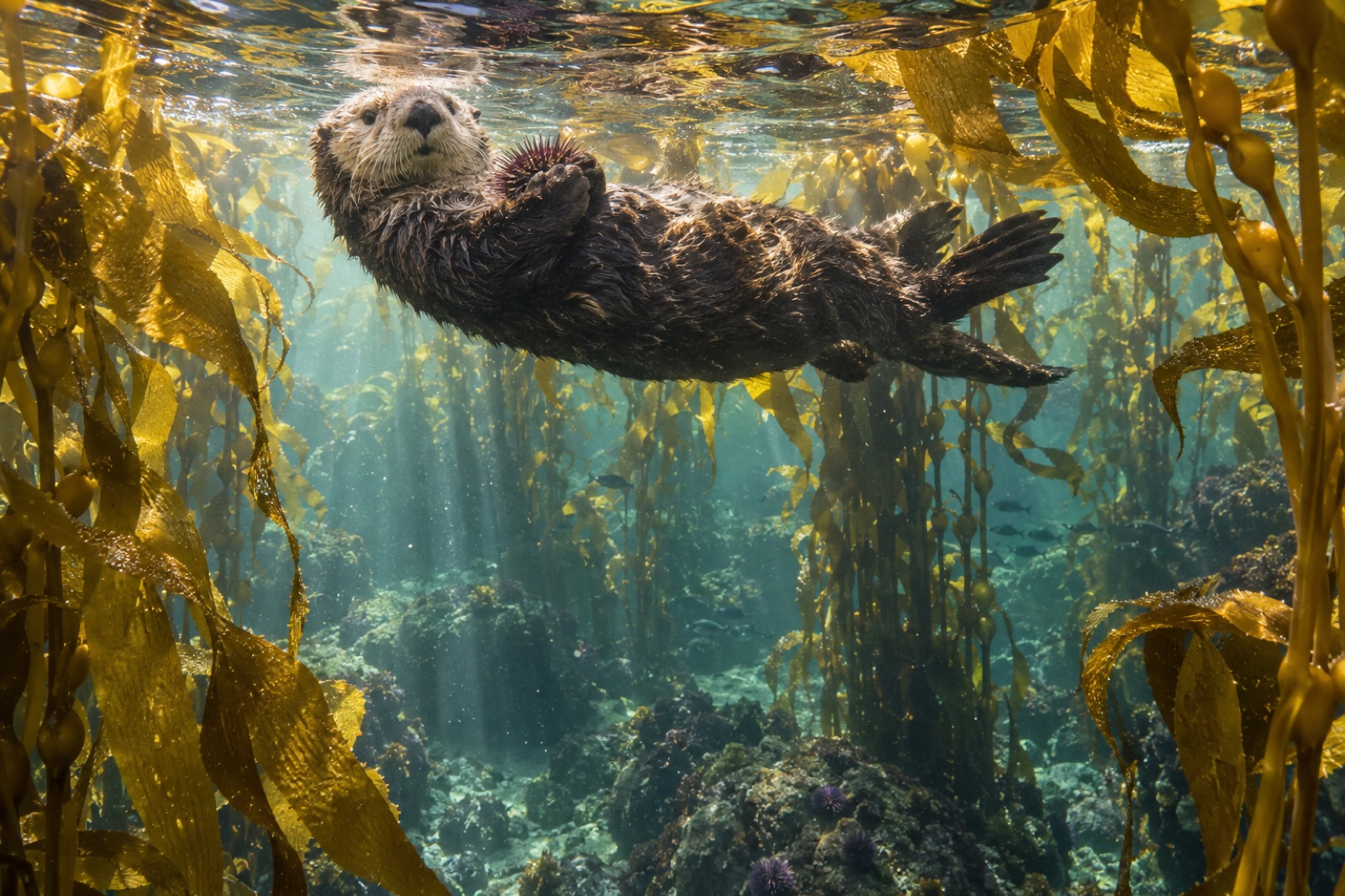
Sea otters eat a quarter of their body weight a day — much of it sea urchins. How this small predator became the kelp forest's most famous keystone species.
Dr. Mara Ellison ·
Meet the Atlantic wolffish — a fanged, antifreeze-blooded reef fish that crushes sea urchins and has declined badly from trawl bycatch.
Dr. Theo Nakamura ·