Encyclopedia8 min read
Moon Jelly (Aurelia aurita): Species Profile
Meet the moon jelly, the four-ringed drifter of harbours and kelp bays: identification, life cycle, mild sting, and why its blooms fascinate ecologists.
Dr. Theo Nakamura ·
Meet Mola mola, the heaviest bony fish on Earth — a flattened, fin-flapping giant that visits kelp coasts to be cleaned, bask and feed on drifting gelata.
The ocean sunfish (Mola mola) is the heaviest bony fish on Earth and one of the strangest animals ever to visit a kelp forest. Adults commonly weigh several hundred kilograms, and exceptional individuals have been recorded above 2,000 kilograms — the mass of a small car — all carried on a body that looks as though a shark-sized head was cut off behind the eyes and sent to sea anyway. If you spend time on temperate coastlines in summer and autumn, from California to the British Isles, you may see one lying on its side at the surface, dorsal fin flopping lazily, waiting for gulls to pick off its parasites.
Sunfishes belong to the family Molidae, part of the order Tetraodontiformes — the same lineage that produced pufferfishes and porcupinefishes. Like their relatives, molids have fused beak-like teeth and a stiff, heavily built skeleton that is half cartilage by weight, which helps offset the buoyancy of their enormous, jelly-fed bodies.
The family holds several recognised species. Mola mola is the widespread "classic" of temperate and tropical seas; the giant sunfish Mola alexandrini is the Southern Hemisphere-heavy counterpart; the sharptail mola (Masturus lanceolatus) wears a pointed tail fringe; and the hoodwinker sunfish (Mola tecta) hid in plain sight in Australasian waters until it was formally described in 2017 — a reminder of how poorly sampled these giants remain.
Everything about a mola's shape breaks a rule. Instead of a tail fin it has the clavus, a rudder-like fringe of fused fin rays that it waves side to side for steering. Propulsion comes from the tall dorsal and anal fins, which flap in synchrony — a gait more like a bird's wingbeat than a fish's swim, and surprisingly efficient for a body with no symmetry to spare. The skin is a centimetre-thick, sandpaper-rough hide laced with mucus, and it hosts more than forty documented genera of parasites, which explains a great deal of mola behaviour (and, in a roundabout way, why kelp coasts matter to them).
For decades, ocean sunfish were written off as passive plankton drifters — the name "oceanic wanderer" clung to them. Satellite tagging has retired that idea. Tagged molas spend much of their days at serious depth, repeatedly diving to 200 metres and well beyond, where water temperatures hover near cold-kelp levels, to hunt in the deep scattering layer. When the work is done they rise and lie at the surface.
That surface lolling — the behaviour that earned the English "sunfish" and many European names meaning "moonfish" — is now read as thermal recharging: basking to warm muscles and gut after long spells in the cold deep. It is also a visit to the beauty salon. Gulls, territorial reef fish and cleaner species pick copepods and skin worms off a basking mola, and some of the most reliable sunfish sightings on the west coast of North America happen precisely where kelp forest cleaner fish can be recruited.
The old textbook answer — jellyfish — is true but incomplete. Stomach-content and stable-isotope studies show molas eat a mixed bag of gelata: true jellyfish such as the moon jelly, salps, comb jellies and siphonophores, including the drifting tentacles of the lion's mane jellyfish. They supplement that low-calorie broth with squid, small fish, crustaceans and even eelgrass and algae scraped from the bottom — molas have been filmed feeding on the seafloor at surprising depth.
Living on jelly is like living on lettuce. To fuel a tonne of body mass, an adult mola must process enormous volumes, and it grows at a pace that softens the arithmetic: sunfish are among the fastest-growing fishes known, ballooning from a 2.5-millimetre larva — spiky, round, more pufferfish than pancake — to full adult size in a handful of years. A single female carries hundreds of millions of eggs, more than any other vertebrate, releasing them in the open ocean where the planktonic larvae take their chances.
Sunfish are oceanic, but they are also regular seasonal visitors to kelp latitudes. Two forces draw them in.
First, cleaning stations. In kelp forests off California, basking molas sidle toward reef edges where senoritas and other small wrasse-family fishes work their skin. Cleaner shrimp and gulls finish the job. Observers at Monterey Bay and the Channel Islands log sunfish most often from late summer into autumn, when warm, jellied water presses against the kelp line and parasite loads have had all season to build.
Second, food along the front. Where cold, kelp-fed upwelling water meets warmer offshore water, salp and jellyfish aggregations concentrate along the boundary — and so do molas. A kelp forest's productivity reaches far beyond the canopy, and the sunfish is one of the more improbable emissaries of that reach, cruising the same green light where giant kelp stipes sway below.
Adult ocean sunfish have few natural predators — few mouths are big or patient enough. California sea lions are known to bite the fins off smaller sunfish, sometimes tossing the mangled disc without eating it, and orcas and large sharks take occasional animals. The serious threats are human-made: drift gillnets and longline fisheries take molas as bycatch in vast numbers worldwide, and drifting plastic bags mimic jellyfish for an animal adapted to swallow first and discriminate later.
For a diver or kayaker, the practical takeaway is temperament: sunfish are placid, unhurried, and often genuinely curious, circling back for a second look at a slow-moving boat. Give them space — several boat lengths — and never touch one; the mucus layer is part of the animal's immune system. Their conservation status is listed as Vulnerable on the IUCN Red List, largely because of fishing mortality.
Your best odds come from a boat rather than underwater, simply because so much sunfish encountering happens at the surface. Scan for the tell-tale fin: a tall, dark dorsal fin waving and flopping where no shark's rhythm would. Late summer and autumn on temperate coasts are peak season. In North America, Monterey Bay and Southern California's offshore banks are famous; in Europe, late-summer sightings off Cornwall, Brittany and the Iberian coast are almost annual now; in Australasia, hoodwinker sunfish turn up off Tasmania and New Zealand with growing regularity — often reported first by divers, fishers and citizen-science spotters whose logs genuinely help researchers map a species we still barely know.
Two reasons, both practical. After deep hunting dives into cold water, basking in sun-warmed surface layers reheats their muscles and gut — a thermal refuelling stop. And lying still exposes their parasite-ridden skin to gulls and cleaner fish, who do the grooming.
Not at all. They have no teeth capable of biting a person (their beak grinds soft prey), no sting, and a calm, curious disposition. Boats occasionally collide with basking molas, which is far worse for the fish; give them a wide berth and slow down in known season.
Adults seen on temperate coasts typically run 1.8 to 2.5 metres fin-tip to fin-tip and a few hundred kilograms. Verified giants have exceeded 3 metres and weighed well over 2,000 kilograms, making Mola mola and its close cousin Mola alexandrini the heaviest bony fishes known — only the cartilaginous whale shark and basking shark are heavier fish overall.
They don't live in them, but they visit. Sunfish are open-ocean animals that cruise into kelp latitudes in the warm half of the year, drawn by jellyfish and salp concentrations along upwelling fronts — and by the kelp forest's cleaner fish, which strip parasites from their skin at basking spots.
Watch the movement. A shark's dorsal fin slices steadily forward; a sunfish's alternately rises and collapses, flopping from side to side as the fin sculls the water. If the "shark" seems to be going sideways, waving hello, or accompanied by a second fin flopping in sync a metre away — you have found a mola.
Meet the moon jelly, the four-ringed drifter of harbours and kelp bays: identification, life cycle, mild sting, and why its blooms fascinate ecologists.
Dr. Theo Nakamura ·
Meet the lion's mane jellyfish, the cold sea's largest drifter: tentacles longer than a blue whale, a fiery sting, and an unlikely role as fish shelter.
Dr. Theo Nakamura ·
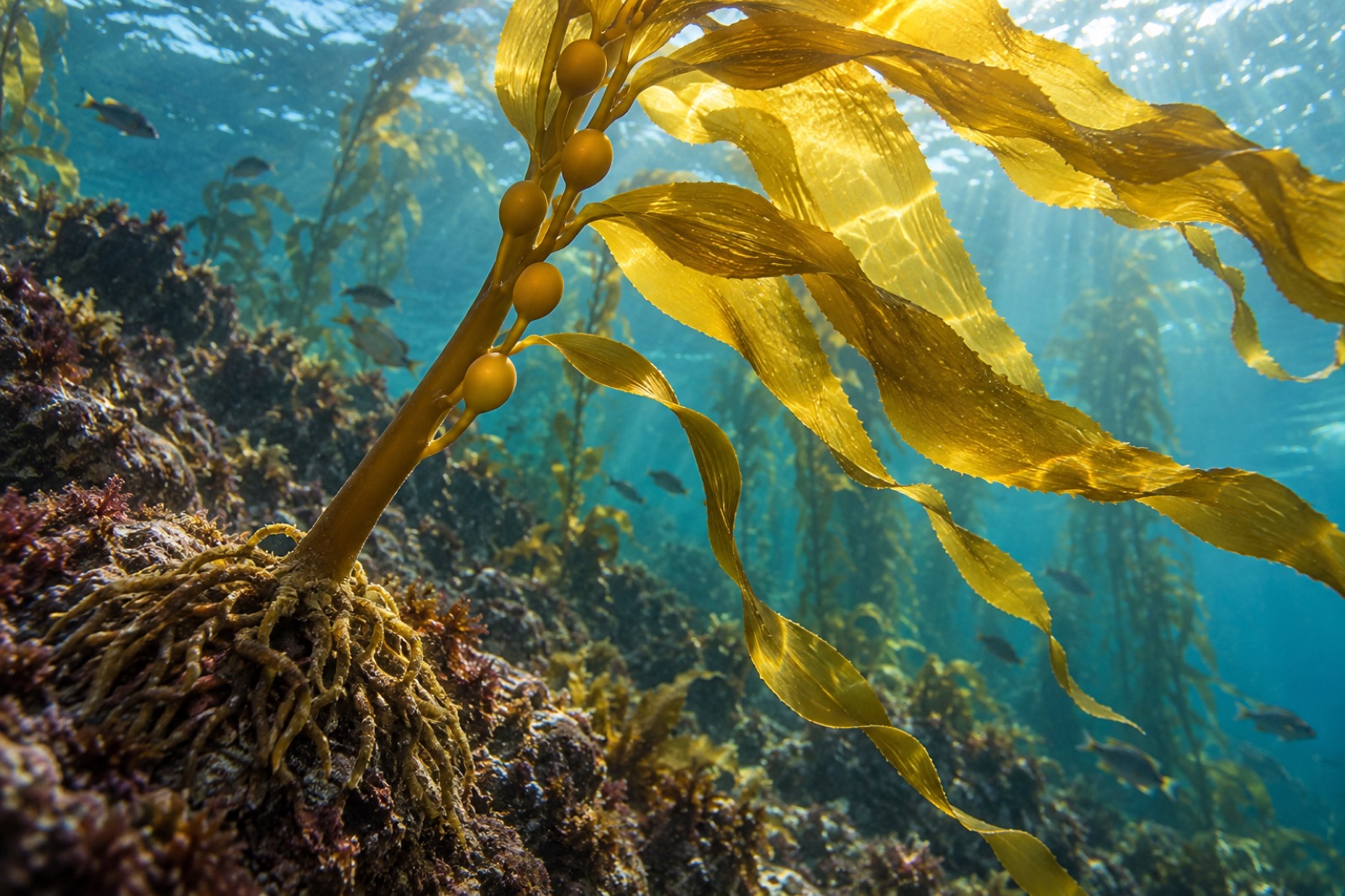
Giant kelp is the fastest-growing organism on Earth and the architect of undersea forests. Learn its biology, life cycle, range and why it matters.
Dr. Theo Nakamura ·