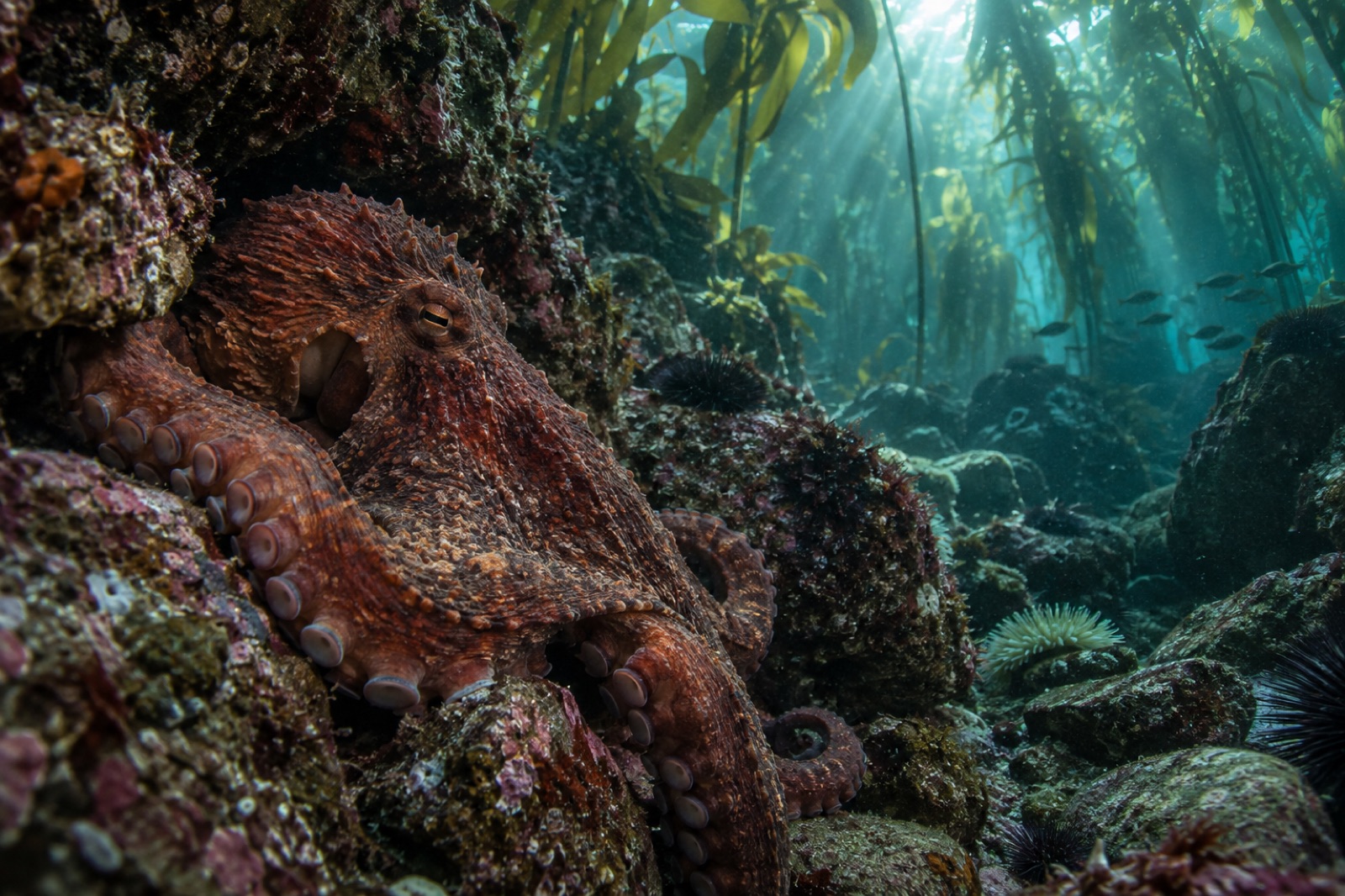
Divers working the rocky reefs off central and southern California occasionally surface with a question that sounds made up: what was the flat orange crab shaped like a heart? The answer is one of the kelp forest's stranger residents — the heart crab (Phyllolithodes papillosus), a slow, boxy, brilliantly camouflaged reef animal whose shell really is broad and heart-shaped, whose closest relatives include the giant king crabs of Alaska, and whose family tree reaches back not to other crabs but to hermit crabs. It is, anatomically speaking, a hermit crab that grew armour and moved out of the shell — and it is one of the cleanest living demonstrations of how crabbedness keeps evolving from un-crabbed ancestors.
This profile covers identification, the evolutionary story written into its flattened body, its ecology on the reef, and where divers might actually encounter one.
Fast facts
|
|
| Scientific name |
Phyllolithodes papillosus (Brandt, 1848) |
| Family |
Lithodidae — the king crabs and relatives; "false crabs" (anomurans), not true crabs |
| Size |
Carapace to about 10 cm long; broad and flattened rather than tall |
| Range |
Eastern Pacific, centred on California — roughly Monterey Bay south through the Channel Islands to Baja California |
| Habitat |
Rocky reefs and kelp forest, low intertidal to moderate subtidal depths, wedged into crevices and under ledges |
| Diet |
Grazing omnivore: algae, hydroids, detritus and small sessile invertebrates picked off the rock |
| Key ID mark |
A broad, flat, roughly heart-shaped carapace with bumpy sculpturing, usually mottled orange, rust and cream |
Identification: the heart on the reef
The heart crab does not look much like the crabs most people know. Where a Dungeness or red rock crab is domed and oval, built to power across sand, Phyllolithodes is low, wide and angular — a craggy kite- or heart-shaped carapace, flattened enough to slide deep into under-ledges, ornamented with knobs and low spines that break up its outline. The legs are stout and similarly rough-edged, and the whole animal presents as a piece of encrusted reef that happens to have joints.
Colour is cryptic and variable: mottled orange, rust, pink and cream, usually with paler patches that read like sponge or worn coralline rock. Against the pink-encrusted, orange-sponged walls of a California reef crevice, a stationary heart crab effectively vanishes. Divers most often find one by spotting the small mismatch — an edge that is too regular, a leg that moves.
Two ID anchors help separate it from the reef's other odd crabs:
- Against the umbrella crab (Cryptolithodes, profiled here): the umbrella crab is a fellow lithodid with a carapace flared into a skirt that hides the legs entirely — a limpet impersonator. The heart crab's legs are fully visible and crab-normal; the shape is heart-like rather than mushroom-like.
- Against true crabs: heart crab antennae sit outside the eye sockets rather than between them, the body lacks the true crabs' folded tail plate arrangement, and the last pair of legs is reduced and tucked under the shell — the anomuran signature. In the hand (or in a photo) the flat, bumpy, asymmetric feel gives it away.
A crab that came from a shell
The heart crab's family, Lithodidae, is the flagship example of one of evolution's best-documented repeated tricks: carcinisation — the independent evolution of crab-shaped bodies from non-crab ancestors, which has happened several times in different crustacean lineages. King crabs and their kin descend from hermit-crab-like ancestors whose soft, twisted abdomens lived in borrowed snail shells. In the lithodid lineage, the abdomen shrank, calcified, and folded up under a broadened, flattened carapace; the shell was abandoned; and a new "crab" walked out of the hermit lineage — close enough in form to true crabs that for a long time naturalists put them together.
The evidence for the hermit ancestry is still visible. Lithodid abdomens remain asymmetric or neatly plated in ways true crabs never show, the last legs stay reduced like a hermit's shell-grippers, and in some species the body retains a faint spiral asymmetry that its shell-dwelling great-grandparents needed. The heart crab, with its depressed, boxy form and tucked abdomen, is a mid-point in body-plan history made flesh — which is why it turns up in textbooks on convergent evolution, and why divers who learn it feel they have learned something about crabs in general.
Its living relatives make the range of the experiment obvious. Arctic and Alaskan waters hold the giant red and blue king crabs, seafood-famous and enormous; the northeast Pacific holds the squat lobsters' more crabbed cousins; and California's kelp reefs hold this modest, flattened specialist. If the king crabs are the lineage's headline export, the heart crab is its coastal-California hobby: smaller, quieter, and wedged into the rock.
Ecology: the crevice specialist
The heart crab's flat body is a tool. It lives recessed: in crevices, under ledges, at the base of kelp holdfasts, in the shadowed seams of rocky reef where a taller crab cannot fit. Wedging in deeply has the twin virtues that define its ecology — it is hard to see and hard to extract. Predators strong enough to grip the shell, principally the giant Pacific octopus and larger sheephead and rockfish, still have to get it out of the crack, and they often can't.
Its diet is that of a patient reef grazer and gleaner: algae films and fronds, hydroids, sponge fragments, detritus, and the small sessile or slow animals of the crevice wall, picked methodically with the claws in nocturnal forays near the den. It is not a hunter of anything that can leave. On a healthy reef it is one of dozens of small consumers cycling kelp detritus and crevice fouling back into animal tissue — unglamorous, abundant within its home range, and quietly load-bearing in the understory food web it shares with lobsters, kelp crabs and sheep crabs.
Its range puts it fully inside the kelp forest province. From the reefs of Monterey Bay down through the reef walls of the Channel Islands and into Baja, it occupies the same wave-sheltered rocky habitat as the rest of California's kelp-reef cast — typically from just below the low-tide line down through the main kelp belt and beyond, wherever the rock offers seams deep enough to disappear into.
Life cycle and the slow lane
Like other lithodids, the heart crab is a slow-paced animal. Females carry a brood of eggs under the tucked abdomen — the brood pouch arrangement inherited from the hermit body plan — through months of development, releasing planktonic larvae that spend weeks in the water column before settling as miniature, already boxy juveniles on shallow reef. Growth is by moult, and moults are infrequent once adult; the animals are long-lived relative to their size, and populations recruit in slow pulses rather than booms.
This life history — site-attached, crevice-dependent, slow-growing — is the standard template for reef invertebrates that don't need to be anywhere else. It also means local densities respond to habitat condition: a reef with deep, intact crevice structure and a working kelp canopy holds more heart crabs than an urchin-grazed flat.
Conservation and context
The heart crab is neither fished nor listed, and within its stronghold it remains a regular (if rarely seen) reef resident — a species divers log with satisfaction precisely because it takes some finding. Its pressures are the kelp reef's pressures: loss of canopy and crevice complexity to urchin barrens, and warming events that stress the sessile communities its camouflage mimics. It is not a species of concern; it is a species of context — one of the quiet animals whose presence tells you a rocky reef is still complicated, still shaded by kelp, still capable of hiding its inhabitants from everyone but the octopus.
Key takeaways
- The heart crab (Phyllolithodes papillosus) is a flattened, heart-shaped lithodid crab of California's kelp reefs — and lithodids are not true crabs but king-crab relatives descended from hermit-crab ancestors.
- It is a flagship example of carcinisation: crab-shaped bodies have evolved repeatedly, and this lineage grew armour and left the snail shell behind.
- Its mottled orange-cream shell shepherds it into reef crevices, where a flat body wedged deep is nearly invisible and nearly unextractable.
- It grazes algae, hydroids and crevice-fouling at night, recycles kelp detritus, and is prey mainly for octopuses strong enough to worry it from the rock.
- It is unfished and unlisted; its abundance tracks the health of structured, canopy-covered reef.
FAQ
Is the heart crab a true crab?
No — and this is the interesting part. It belongs to Lithodidae, the king-crab family, which sits among the anomuran "false crabs" descended from hermit-crab-like ancestors. During carcinisation, the hermit's soft twisted abdomen shrank and calcified under a broadened shell, the snail shell was abandoned, and a new crab body plan emerged. The heart crab's tucked, plated abdomen and tucked last legs still carry the hermit signature.
Why is it called a heart crab?
The carapace is broad, flat and distinctly heart- or kite-shaped, wider across the shoulders and tapering toward the rear. Combined with bright orange and cream mottling, the shape is unmistakable once seen — which is not often, since the crab spends its life wedged in crevices.
Where can I see one?
Rocky reefs within California kelp forest: roughly Monterey Bay through the Channel Islands into Baja, from the shallow subtidal downward. Look for undercuts and ledges at the base of reef walls and holdfast tangles — if an orange-cream crevice patch has joints and moves, you've found one.
What does it eat?
Algae films and fronds, hydroids, detritus and small sessile or slow animals of the crevice, picked methodically in night-time forays. It's a patient grazer-gleaner rather than a predator.
Is it endangered?
No. It's unfished, unlisted, and remains a regular resident of intact reef in its range. Its pressures are habitat ones — barren formation and the loss of crevice complexity — so it functions as a quiet indicator that a reef still has the nooks to hide its inhabitants.