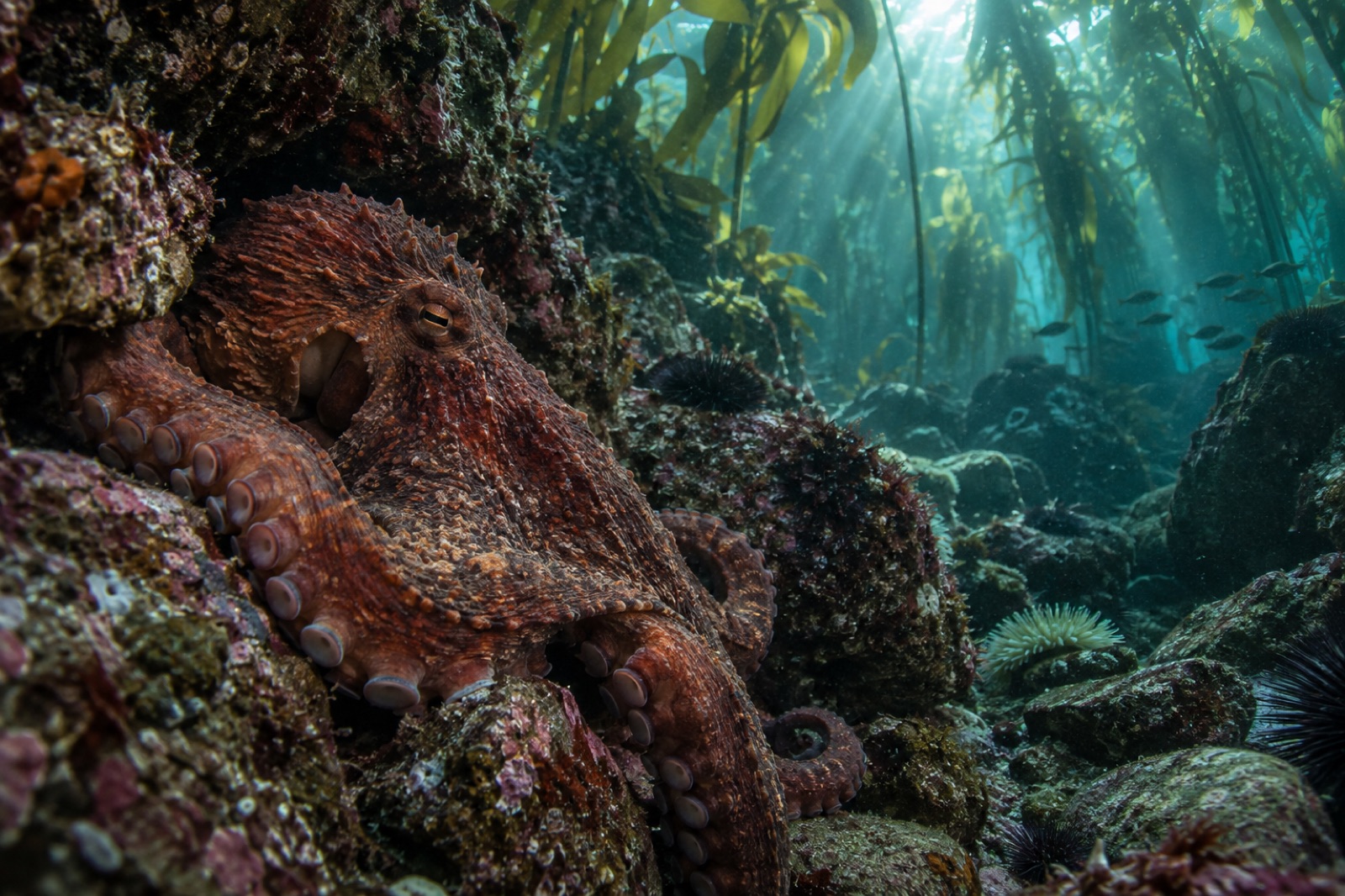
On Southern California's rocky reefs, below the kelp and just off the sand, lives the coast's most personable octopus. The California two-spot octopus (Octopus bimaculoides) is small enough to curl into two cupped hands, keeps tidy dens at the reef edge, and wears a pair of startling blue-ringed false eyes behind its real ones. It is also — quietly — one of the most important octopuses in science, the first of its kind to have a fully sequenced genome. Here is what it is, how it lives, and why divers and researchers both keep coming back to it.
Fast facts
|
|
| Scientific name |
Octopus bimaculoides (closely related to the very similar O. bimaculatus) |
| Group |
Octopod cephalopod — eight arms, no shell, large brain |
| Common names |
California two-spot octopus, bimac, Verrill's two-spot octopus |
| Size |
Mantle to ~10 cm; total spread commonly 30–60 cm; weight around 1–2 kg |
| Depth range |
Intertidal pools to about 20–30 m, shallowest and commonest under 10 m |
| Distribution |
Northern/Central California south through Baja California; commonest from Point Conception down |
| Diet |
Crabs, clams, snails, small fish, other crustaceans |
| Notable traits |
Blue ocelli (false eyespots); tolerates neighbours unusually well; first octopus with a sequenced genome |
The name and the mark
The "two spots" are ocelli — a paired ring of vivid blue surrounding a dark centre, one behind each true eye, flashing when the animal spreads and darkens in alarm or display. They are false eyes: to a predator, a pair of big staring rings suggests a much larger animal than the small octopus actually attached to them, buying the two-spot the one thing an octopus always wants — ambiguity.
The effect startles divers too. Resting, the animal is a mottled grey-brown lump the colour of the reef — the skin's chromatophores doing turn-by-turn camouflage. Then the flash: two electric-blue rings on the head between the eyes, and an animal you didn't see becomes an animal looking back. Don't panic about the colour: this is not a blue-ringed octopus. The dangerously venomous blue-rings are thumb-sized, yellowish animals of the tropical Indo-Pacific; the two-spot is a California cousin wearing similar jewellery with harmless intent.
Separation from its near-twin O. bimaculatus is a laboratory matter — the two differ in range details, egg behaviour and genetics — and for the diver, "bimac" covers the reefs happily enough.
Den life at the reef edge
Two-spots are den octopuses, and den architecture is the key to finding them. An occupied den is a crevice or hole at the margin where rock meets sand, fronted by a midden — a scatter of crab carapaces, clam shells and snail husks, the plates piled outside the octopus's kitchen. Divers learn to scan the reef-and-sand edge at 3–15 metres for exactly that debris apron; where the shell piles lie fresh, a bimac is home.
Inside, the octopus is a homebody. Each animal keeps and maintains its den for weeks or months, forages outward from it — mostly in low light, at dusk, dawn and into the night — and returns to bar the door, often by pulling a flat stone across the entrance. The engineering touch is characteristic: octopuses manipulate objects with the deliberateness of primates, and a den door placed just-so is a fingerprint of the species.
That homebody quality is why the species suits the kelp-forest edge habitat so well — the transition band between reef and sand is prey-rich (crabs and clams drift in both directions) and crevice-rich, and the bimac has staked out its living there from Point Conception to Baja.
Night hunter
The two-spot hunts the way octopuses do: by touch, chemistry and patience. Arms probe crevices, the web blankets a crab against rock, the beak drills or crushes mollusc shells — and the midden outside the den grows by the week. Diet on California reefs runs to crabs first, clams and snails close behind, with small fish and other octopuses taken opportunistically.
For the diver, this means evenings own the action. The same den that is a sealed stone at noon becomes an active hunting post by torchlight, and night diving in kelp is where two-spot encounters multiply: an arm extended from the doorway tasting the water, or the animal out on open sand in full stride, fluid and eight-limbed, taking the long way home.
The most studied octopus
Here the story leaves the reef. Octopus bimaculoides turned out to be an almost perfect laboratory cephalopod: small, hardy, short-lived enough to breed across generations, tolerant of aquarium life, and — most unusually — relatively tolerant of each other, where most octopus species treat a conspecific as dinner. That temperament, plus its California abundance, made it the front-line model for cephalopod neuroscience and development.
The crest came in 2015, when the bimac became the first octopus whose genome was fully sequenced — a landmark that opened the modern era of octopus genomics, illuminating the huge expansions of genes for neurons, skin patterning and arm organisation that underlie the animal's famous intelligence and camouflage. Research laboratories and public aquariums now maintain breeding lines descended from Californian reefs, which means a nontrivial fraction of everything we know about octopus brains flows through this small den-dweller of the reef edge.
A year, maybe two, and done
Like nearly all octopuses, the two-spot is semelparous: it lives fast, breeds once, and dies. The reproductive season concentrates in the cooler half of the year in Southern California. A female lays strands of small eggs — by the thousands — and fastens them in her den, then settles into brooding: guarding, cleaning and blowing oxygenated water across the strands for the weeks the eggs take to develop. She does not leave to hunt. By hatching time she is a shadow of herself, and she dies with her den's duty done, her lifespan landing at roughly a year to a year and a half and rarely two.
The hatchlings of bimaculoides are, helpfully, miniature adults — small but benthic from day one, not planktonic — which is part of why the species breeds so well in captivity. On the reef they disperse along the bottom from the natal den into the same crevice-and-sand world their mother never left.
For the bigger picture on how spikes of small, fast, protein-rich life like this move through the forest, see the kelp forest food web.
Where to see one
Prime ground is the Southern California bight: the reef edges of the Channel Islands and Catalina Island, the reefs off La Jolla and Laguna, and — easiest of all — shore-divable rubble-and-reef sites like Monterey's Breakwater pattern further north. Scan the sand line beside rock between 3 and 15 metres for midden shell piles; mark the den; come back at dusk. Intertidally, southern Californian tidepools occasionally hold small bimacs at minus tides — under rocks, in the algae-thatched crevices; our tidepooling etiquette guide applies double for an animal this delicate. Look, photograph with ambient light, never pull an animal from its den.
Key takeaways
- The two-spot octopus (Octopus bimaculoides) is a small (to ~60 cm spread) den octopus of California's reef-and-sand edges, intertidal to ~30 m.
- Its "two spots" are blue ocelli — harmless false eyespots flashed in display, not the markings of a venomous blue-ring.
- Find it by its midden: crab carapaces and shells piled at a crevice where rock meets sand; it hunts at dusk and at night.
- Unusually social-tolerant and easy to breed, it became the first octopus with a fully sequenced genome (2015) and a mainstay of neuroscience.
- Semelparous and short-lived: a female broods her egg strands for weeks without feeding and dies after hatching; total lifespan is about a year or two.
- Best encounters: Southern California reef edges at 3–15 m, evening, torch in hand — look, don't touch.
FAQ
Is the two-spot octopus dangerous like a blue-ringed octopus?
No. The blue rings behind its eyes are ocelli — false eyespots for startling predators — and Californian bimacs carry no medically significant venom. All octopuses have a beak and can bite defensively if handled, so the rule stands: observe with your eyes, not your hands. The famously dangerous blue-ringed octopuses are much smaller, tropical animals of the Indo-Pacific.
How big do two-spot octopuses get?
Modestly. A large adult has a mantle about the size of a small fist and a total arm spread of perhaps 50–60 centimetres — a kilogram or two in weight. Many seen on reefs are half that. For scale, its northern cousin the giant Pacific octopus outweighs it roughly twenty-fold.
Why is the two-spot so important to science?
Three traits lined up: it's small and hardy, it breeds reliably in aquaria, and it tolerates neighbouring octopuses — a rarity. That made it the world's laboratory octopus, and in 2015 it became the first octopus to have its genome fully sequenced, opening modern research into cephalopod brains, camouflage and development.
Where can a diver reliably find one?
Southern California, at the seam where rock reef meets sand, 3–15 metres deep: look for a crevice fronted by a pile of fresh crab and clam shells. The reefs of Catalina and the Channel Islands are dependable, and dusk or night dives raise the odds sharply — that is when the bimac leaves its doorway to hunt.
What's the difference between the two-spot and the red octopus?
Habitat and polish. The two-spot is a den builder of the reef-sand edge with prominent blue ocelli and a relatively bold, homebody manner; the east Pacific red octopus is smaller, redder, more transient — a wanderer of kelp understory and sand that carries less shell debris at its door. If you found your octopus by its shell midden at a tidy doorway: two-spot.