Science8 min read
Drift Kelp and Wrack: The Forest's Gift to the Beach
Kelp forests export a share of everything they grow. Here's how drift kelp feeds open water, beach wrack feeds the shore, and why leaving wrack alone matters.
Dr. Mara Ellison ·
Lepas anatifera spends its life attached to flotsam — kelp rafts, driftwood, plastic. Anatomy, the goose myth, tsunami debris and where to find them.
After a big winter storm, walk the wrack line of any open beach in the temperate Pacific or Atlantic — the driftwood, the rope ends, the torn buoys and bottles the sea has just offered back — and look closely at the hard flotsam. You will likely find it bearded: dense clusters of small animals on dark flexible stalks, each topped with a neat heart-shaped pair of glossy bluish-white plates. Open one of the plates and inside, folded like a sleeping bird's foot, is a knot of feathery limbs. You have found the goose barnacle (Lepas anatifera) — an ocean-going drifter, a former goose to medieval Europe, and one of the easiest strange lives on Earth to encounter with nothing more than patience and a spring tide.
| Scientific name | Lepas anatifera ("goose-bearing creature") |
| Group | A stalked (pedunculate) barnacle — a crustacean, family Lepadidae |
| Common names | Goose barnacle, gooseneck barnacle, pelagic goose barnacle |
| Size | Plate shell typically 2–4 cm; whole animal with stalk to 10 cm and more in old clusters |
| Habitat | Oceanic: attached to floating objects — wood, kelp rafts, pumice, buoys, plastic — worldwide in warm and temperate seas |
| Diet | Plankton, sieved from passing water with feathery cirri |
| Notable traits | Spends its whole adult life adrift; the source of the medieval legend that barnacle geese hatch from driftwood |
A goose barnacle is two animals' worth of design in one crustacean. The soft body hides inside a five-plated shell called the capitulum — two large lateral plates and a ridge of smaller ones, glossy porcelain-blue fading to white at the sutures, edged often with a startling line of orange where the living flesh nearly surfaces. Below the capitulum runs the peduncle, a leathery, telescoping, muscular stalk, dark purple-brown to near-black, anchored at its base to whatever is floating. The stalk is the species' whole trademark: it is tough, somewhat stretchy, and can re-anchor as the colony grows or as its vessel rolls.
The feeding limbs are the cirri: paired, jointed, feather-fringed legs that the barnacle unfolds from between the shell plates and casts out into passing water like a net. In a submerged video the rhythm is hypnotic — unfurl, sweep, curl, withdraw, again and again, sieving planktonic copepods, fish larvae and organic dust from the drift stream. A barnacle is, in the old naturalists' joke, an animal that lies on its back and kicks food into its mouth with its own legs; a goose barnacle does it from a self-built crow's nest in the open sea.
Almost every crab, clam and limpet in this encyclopedia is committed to a shore or a seafloor. The goose barnacle's trick is to skip geography altogether. It does not live in the open ocean's water column — it cannot swim as an adult — but lives instead entirely on its surfaces: driftwood, seeds, feathers, tarballs, turtles, ships, bottles, and, with increasing modern abundance, plastic. Its world is the neuston, the floating assemblage riding the ocean's top skin, and its compass is whichever current the debris obeys.
Reproduction suits the life. Goose barnacles are hermaphrodites, each carrying both organs, and because adults on a float live immediately against their neighbours, what began as fertilisation in solitude becomes cross-fertilisation by proximity: the barnacle extends the most proportionally outsized penis in the animal kingdom — several times its own body length — to inseminate a neighbour before brooding thousands of minute nauplii to hatching. Released free, the larvae pass through six swimming stages before the terminal cyprid, a headlighted, non-feeding scout whose one biological mission is to find a worthwhile surface in the open sea and commit. When a cyprid lands on flotsam carrying goose barnacle scent, it settles, glues its forehead down, and metamorphoses into a stalked adult. A floating object can carry thousands of them by the time it beaches.
You cannot spend ten minutes with this animal's natural history without meeting its most famous fiction. Medieval Europe knew the goose barnacle from exactly your position — finding it on beached driftwood — and possessed a genuine puzzle in the barnacle goose, which appeared on western coasts each autumn, bred nowhere anyone had ever seen, and produced no visible nest. The elegant hypothesis: the geese came from the barnacles. Twelfth-century writers described trees on the Scottish and Irish coasts whose fruit, falling into the sea, developed shells and legs and hatched into geese; the Latin name anatifera — "goose-bearing" — preserves the theory in formal taxonomy.
It was, in hindsight, not a stupid idea. The retracted cirri look convincingly like tucked feathers; the white plates like folded wings; the dark stalk like a stem. The tufting writes itself. And because barnacle geese actually breed on remote Arctic cliffs no medieval European reached, the account survived unrefuted for centuries, passed through Gerald of Wales and the early printer-naturalists, and tangled with church law in uncomfortable debates about whether these "tree geese" counted as fish or fowl for fast-day meals. Modern beachcombers can smile — and then watch a wave reopen the plates and think the old observers were, at least, attending carefully.
The goose barnacle's lifestyle makes it scientifically precious, because everything it grips is a sample of where the sea has been.
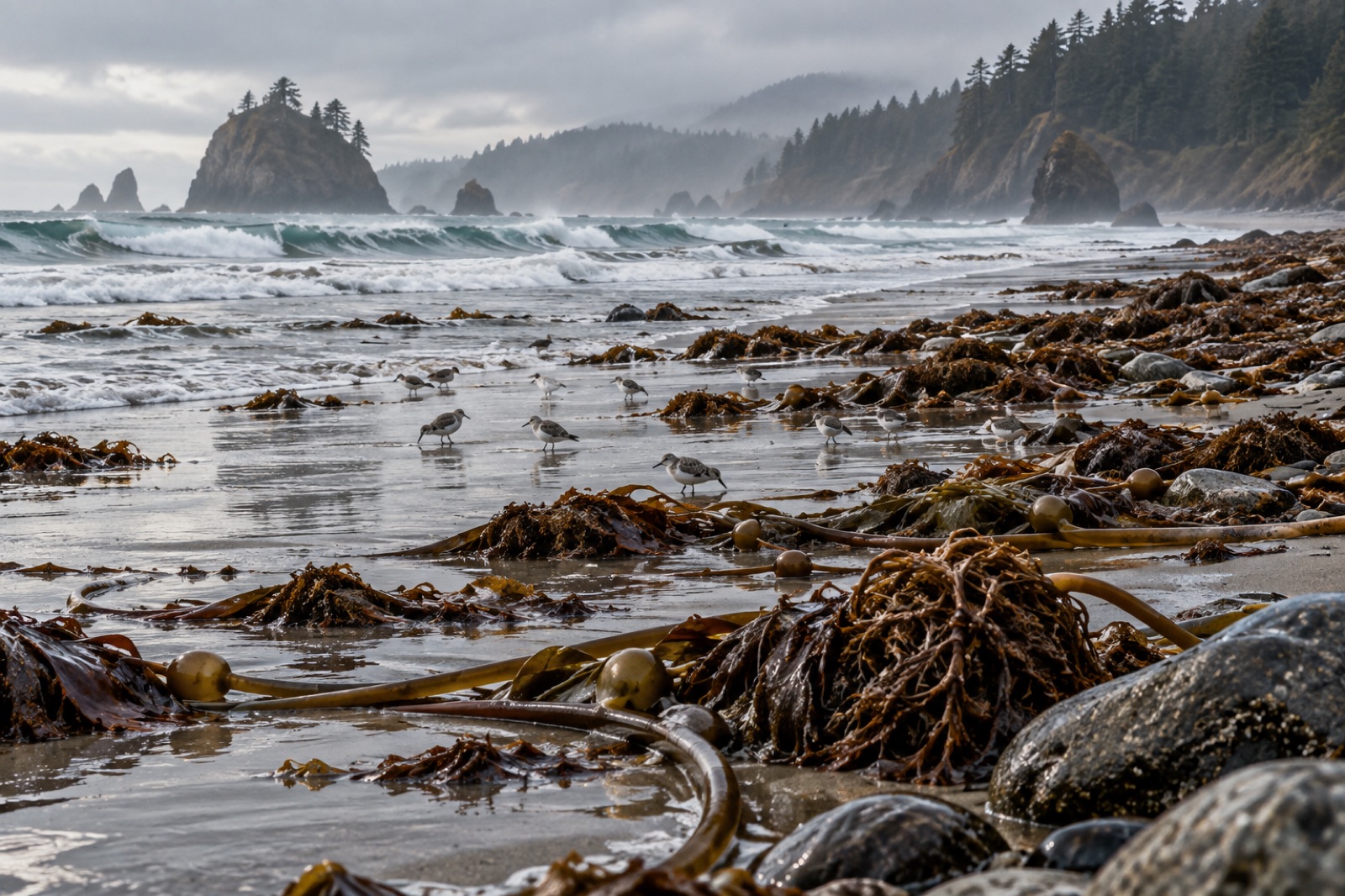
Kelp is the natural vehicle. Where bull kelp holdfasts tear loose in southern storms they float, and giant-kelp rafts from the subantarctic islands have been documented drifting the Southern Ocean for immense distances — some reaching Antarctic shores still carrying encrusting life. Goose barnacles colonise such rafts at sea and ride them. Our exploration of drift kelp and wrack touches the ecology; the barnacle is the rafts' most reliable marking pennant, fixing a departure date to a raft the way a boarding pass fixes a journey.
Humanity has since added a vehicle fleet the ocean never had. Each year a rising tide of durable plastic — bottles, shoes, drums, nets, whole dock sections — puts a permanent surface into the neuston, and the barnacles colonise it on every float. When debris torn from Japan's coast by the 2011 tsunami began arriving on western North American shores years later, it arrived alive: rafts of rope, dock and plastic carried live Asian coastal species across the Pacific on crossings nobody would have believed survivable, the hull-plating heavily made of goose barnacles. The episode was a landmark demonstration of ocean rafting as a serious vector for moving coastal species between continents — and it re-anchored attention on the small, unbeautiful barnacle as one of the drifting ocean's best biographers.
Note, before you fantasise at the wrack line, that the pelagic goose barnacle is a different animal from the goose barnacle gourmets mean. Percebes, the precious barnacle of Galicia and Portugal — boiled a minute and eaten from the tube of the stalk at Christmas-market prices that rival fine shellfish — is Pollicipes pollicipes, an intertidal relative stuck to surf-battered rock. Harvesting it is one of Europe's most dangerous traditional fisheries, with percebeiros roping down bomboras between wave sets. The oceanic Lepas, while eaten in moments of drift-line necessity, is thin-bodied, low-yield and generally left to the gulls. Beach-found clusters are better kept for their story.
The dependable season is after storms. Work the fresh wrack line on the first low tide following a blow — the line of newest material, still rich-smelling, delineated by the exact rubble physics described in our guide to reading the beach wrack — and check every hard floater: flip-flops, fishing floats, dock lines, drum lids, logs, and torn kelp bundles. Colonies appear as dark, beard-like clusters cream-plated at the tips; young colonies, a thumbnail-sized bristle on a bottle.
Handle with curiosity but not hunger: a beached colony is draining of life, the cirri's unfurling slowing hour by hour. Photograph the plates; note the hang of the stalks; smell — the honest seaweed-shop smell of a living colony turning ammoniac as it dies. Anything still aboard after a day on land will be dead; what arrives on heavy kelp rafts far from the sea has no practical rescue. The reward is awareness: the wrack line is a shipping manifest of every voyage the last storm ended, and goose barnacles are its clearest signature.
Yes — they are highly modified relatives of crabs and shrimps. The free-swimming nauplius larva looks classically crustacean; the feathered cirri are modified legs; the adult has jointed limbs under its plates. The barnacle body plan is so far from the crab archetype that early naturalists filed them with molluscs until the larvae gave the game away.
No. Percebes — the expensive, surf-rock barnacle of Spain and Portugal — is the intertidal Pollicipes pollicipes. The pelagic Lepas anatifera is a drifter found on flotsam, is thinner-bodied, and is the species behind the goose legend. Same family, wholly different lives and dinner plates.
As larvae. After weeks of drifting and moulting, the final cyprid stage actively searches for a surface, detects the chemical cues of an existing colony or a promising material, cements its forehead to it, and metamorphoses. Once a few barnacles colonise a float, their scent makes it magnetically attractive to later cyprids.
They foul hulls and buoys like any barnacle, but their ecological importance is as a raft-builder: by colonising debris, they pioneer the floating communities that can transport other coastal species across ocean basins — a natural process that plastic debris has made far more frequent and consequential.
On the fresh wrack line of an exposed ocean beach, just after a storm: check driftwood, plastic floats, ropes and kelp rafts for clusters of dark stalks topped by white-blue plates. Temperate open coasts around the world — the Pacific Northwest, western Europe, southern Australia, New Zealand, southern Chile — all have them.
Kelp forests export a share of everything they grow. Here's how drift kelp feeds open water, beach wrack feeds the shore, and why leaving wrack alone matters.
Dr. Mara Ellison ·
How marine invasive species spread: ballast water, hull fouling, aquaculture escapes and plastic rafting — the vectors, and why some coasts are vulnerable.
Dr. Mara Ellison ·
A field guide to the wrack line — identifying kelp holdfasts, blades and pneumatocysts, finding egg cases and drift treasures, and knowing what you may keep.
Tom Okafor ·