Encyclopedia7 min read
Northern Kelp Crab (Pugettia producta): Species Profile
The northern kelp crab is a colour-changing spider crab that lives its whole life in the kelp canopy. Learn its biology, diet, and role in the forest.
Dr. Theo Nakamura ·
The graceful kelp crab is the smaller, rougher, more widely wandering sibling of the northern kelp crab — as at home in eelgrass as on a kelp frond.
Ask a Pacific coast diver to picture a kelp crab and they will describe the northern kelp crab, Pugettia producta: smooth, shield-shaped, the size of a small hand, bold enough to crop kelp blades in open daylight. But the genus has a second, quieter species working the same coast. The graceful kelp crab, Pugettia gracilis, is smaller, rougher-textured, more secretive and more widely wandering — a crab as likely to turn up on an eelgrass blade or a hydroid tuft as on a kelp frond. Learning to see it means learning to read the whole two-storey habitat — canopy and meadow — where the kelp fringe meets the eelgrass beds.
| Scientific name | Pugettia gracilis |
| Group | Spider crab, family Epialtidae (kelp and decorator crabs) |
| Carapace width | Commonly 2–3 cm; rarely beyond about 4 cm |
| Range | Northeast Pacific: Alaska south to southern California |
| Habitat | Kelp, eelgrass, hydroid turf and low rocky reef, from the shallow subtidal to well below 100 m |
| Diet | Kelp and other algae, diatoms, epiphyte film, small invertebrates |
| Closest relative | The northern kelp crab, Pugettia producta |
The two Pugettia share a body plan — a smooth-edged, pentagon-shaped carapace, long thin legs, and the spider-crab habit of moving with deliberate, placement-careful steps rather than the shore crab's dash. The differences are reliable once learnt:
Where the northern kelp crab is a canopy loyalist, P. gracilis is a generalist of edges. Divers meet it in kelp understory and on kelp holdfasts, but also far from kelp altogether — crawling eelgrass blades in shallow bays, climbing hydroid and bryozoan turf on cobble, working the algae of low rocky reefs. It also ranges deep: records extend well past a hundred metres, far beyond the reach of the light that runs the kelp canopy. This is a crab built to follow food and shelter across the whole coastal shelf, not to hold a single stipe.
That breadth has a seasonal rhythm. Shallower in summer, deeper in winter, it tracks the boom-and-bust of annual algae and eelgrass growth the way a small gardener follows the planting calendar — surfing the same epiphyte-rich blade surfaces whose ecology is the subject of our science piece on life on the kelp blade.
Everything the graceful kelp crab eats is small: diatom films, filamentous epiphytic algae, tender kelp tissue, and the tiny amphipods and worms that live in the same turf. In the language of reef ecology it is a mesograzer — one of the small, numerous grazers standing between the plant and the big herbivores that get all the attention.
Mesograzers of the kelp-and-eelgrass fringe punch well above their weight. By cropping the epiphytes that colonise kelp blades, they keep the leaf surface clear for light and gas exchange — the "cleaning crew" function that our guide to the kelp forest food web shows threading the forest's production through a thousand small mouths. In eelgrass the same service has been shown experimentally to boost blades' growth: a meadow with its small gardeners does measurably better than one stripped of them. A crab this size, in numbers, is infrastructure.
Life at three centimetres runs fast. Females mature at modest size, carry a compact sponge of eggs under the abdomen through spring and summer, and release planktonic larvae that, like those of most shore crustaceans, spend weeks drifting and moulting before settlement. The details differ from the larval journeys mapped for kelp itself in our explainer on spore and larval dispersal only in agency: where a kelp spore can swim mere seconds, a crab larva can steer. Even steering, though, most settlement is local — which is why an eelgrass bed that loses its small crabs in a bad year may stay crab-poor until a good larval year tops it up.
Nobody targets the graceful kelp crab, but it rides the fisheries around it: it turns up in crab and shrimp pots, in trawl bycatch on sandy-mud grounds and in traps set among eelgrass. Managers and scientists alike read such incidental catches as barometers — a small, widely dispersed species tracks the general health of shallow coastal habitat better than any single flagship can. For the diver or tidepooler, the practical version of that barometer is simpler: a bay with kelp, eelgrass and a resident population of P. gracilis stitching the two together is a bay with its two-storey habitat intact.
Shallow, protected Pacific Northwest water is the heartland: the eelgrass edges of Puget Sound, the wilderness coves of the Olympic coast, and comparable kelp-and-meadow shorelines south into California. Look on and around kelp holdfasts in the low subtidal by day; in eelgrass, the crab often sits partway up a blade, clipped flat to it like a badge of mottled shell. Move slowly — a graceful kelp crab that trusts you will keep walking, and one that doesn't will let go and drift. More of the kelp fringe's crustacean cast is catalogued in our invertebrates encyclopedia section.
Check the rostrum between the eyes with a hand lens: the two spines tip apart in P. gracilis and run nearly parallel in P. producta. The rough, bristly carapace and banded legs of the graceful kelp crab are supporting clues.
From Alaska to southern California, in kelp understory and holdfasts, eelgrass beds, hydroid turf and low rocky reef — shallower in summer, deeper in winter, with records extending well beyond 100 m depth.
Mostly small fare: kelp and other algae, diatom and epiphyte films, and tiny invertebrates like amphipods. Their grazing keeps kelp and eelgrass blades cleaner, which benefits both plants.
The name refers to its slender-legged, lighter build compared with P. producta — and to the deliberate, considered way spider crabs place their feet as they climb.
No — it has no specific conservation listing and remains common across its range, though like all shore life it depends on the intact kelp and eelgrass habitats that shelter it.
The northern kelp crab is a colour-changing spider crab that lives its whole life in the kelp canopy. Learn its biology, diet, and role in the forest.
Dr. Theo Nakamura ·
Decorator crabs build living costumes from algae, sponges and anemones using velcro-like hairs. How the disguise works, why it evolved and where to see it.
Dr. Mara Ellison ·
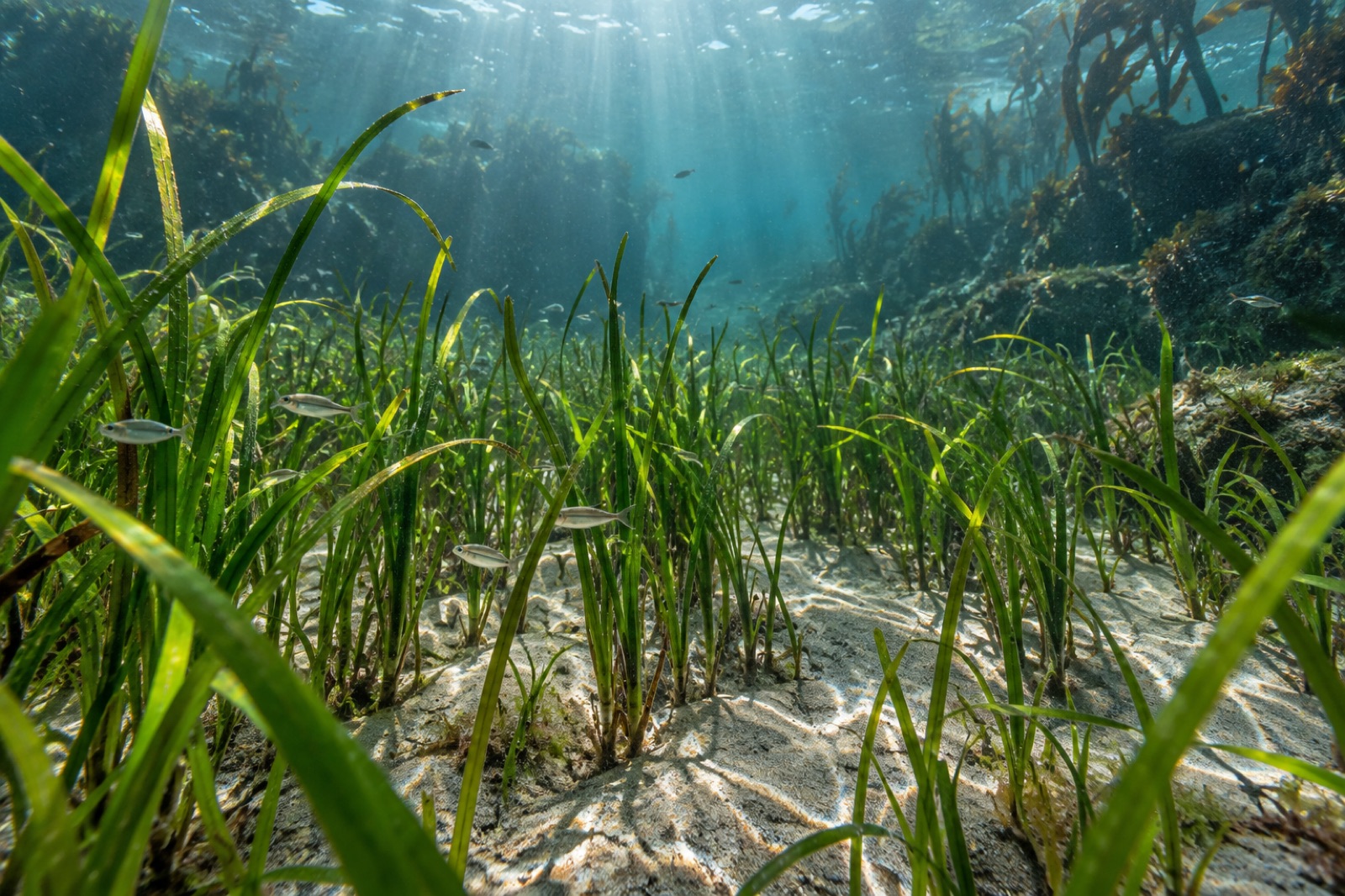
Eelgrass (Zostera marina) is a true flowering plant whose meadows fringe kelp forests worldwide: biology, wildlife, carbon and how meadows are restored.
Dr. Mara Ellison ·