Most seahorses are miniatures — animals you find by searching, one eye-height at a time, through weed and rubble. The pot-bellied seahorse is the exception that stops a dive. Hippocampus abdominalis is one of the largest seahorses on Earth, a thick-waisted, deep-bellied animal that can reach 35 centimetres, and it hangs in plain sight on the kelpy, sponge-strewn piers and reefs of southern Australia and New Zealand as though it has nothing to hide. In a world where seahorses are vanishingly close to invisible, this one behaves like a small horse that wandered onto the reef and decided to stay.
Fast facts
|
|
| Scientific name |
Hippocampus abdominalis |
| Group |
Seahorse, family Syngnathidae (with pipefish, pipehorses and seadragons) |
| Size |
Commonly 20–30 cm; exceptional individuals to ~35 cm — among the world's largest seahorses |
| Lifespan |
Roughly 3–4 years in the wild; longer (up to 8–10 years) reported in captivity |
| Depth range |
Most often under 15 m; known from the shallows down past 100 m on sponge and rubble reef |
| Range |
Southern Australia (Western Australia's southern coast to New South Wales, incl. Tasmania) and New Zealand |
| Status |
Poorly censused; all seahorses are CITES Appendix II, and Australia's aquarium trade in the species is captive-bred |
The big belly, and what it's for
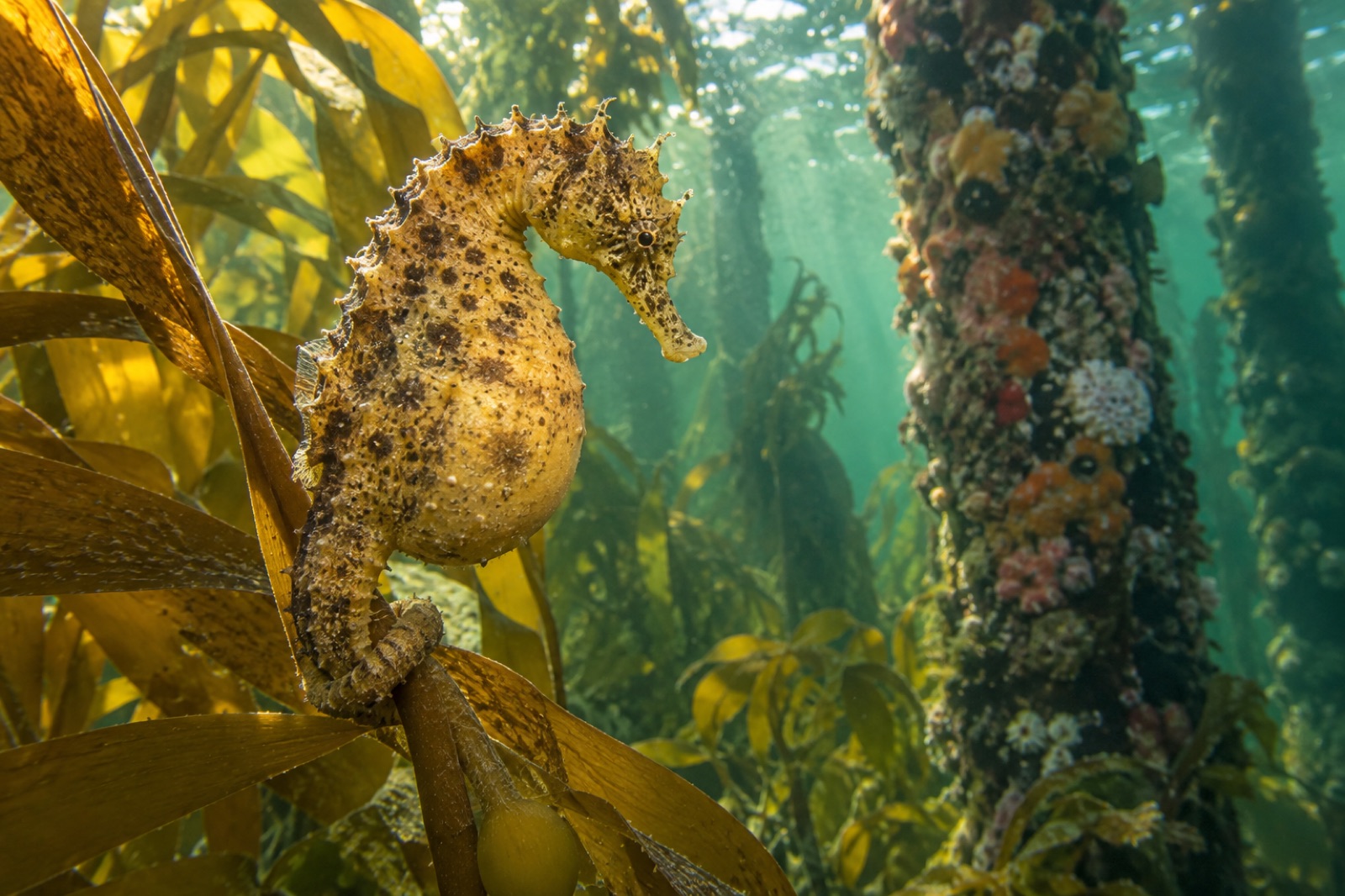
The Latin says it plainly: abdominalis. The pot-bellied seahorse carries a rounded, pouchy belly larger, volume for volume, than almost any of its relatives, and in males that girth is functional art. At the belly's lower seam sits the opening of the brood pouch — the structure that has made seahorses famous. It is here that the male, and only the male, carries the pregnancy.
The outline otherwise is classic seahorse enlarged: an upright posture built on a coiled, prehensile tail; a long tubular snout tipped with a tiny toothless mouth; a single, fast-fluttering dorsal fin that provides what little propulsion the animal can manage; pectoral fins that work like paddlewheels for trimming. The skin is rough, armoured with bony rings instead of scales, and dressed in a variable wash of gold, tan, olive, cream or near-black, often with dark blotches and pale filaments sprouting above the eyes and along the back. Two individuals on the same pier piling may look as unrelated as two autumn leaves.
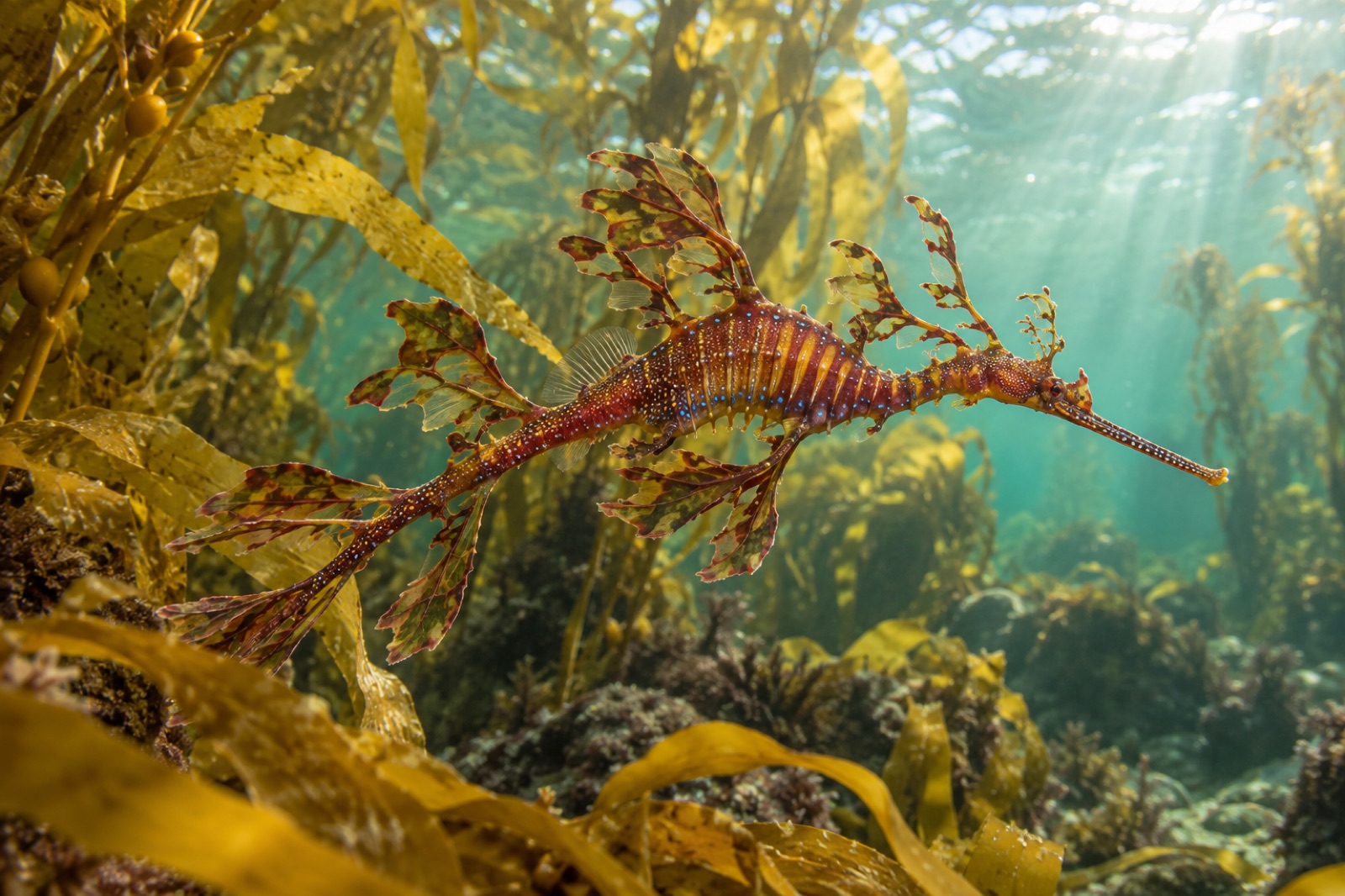
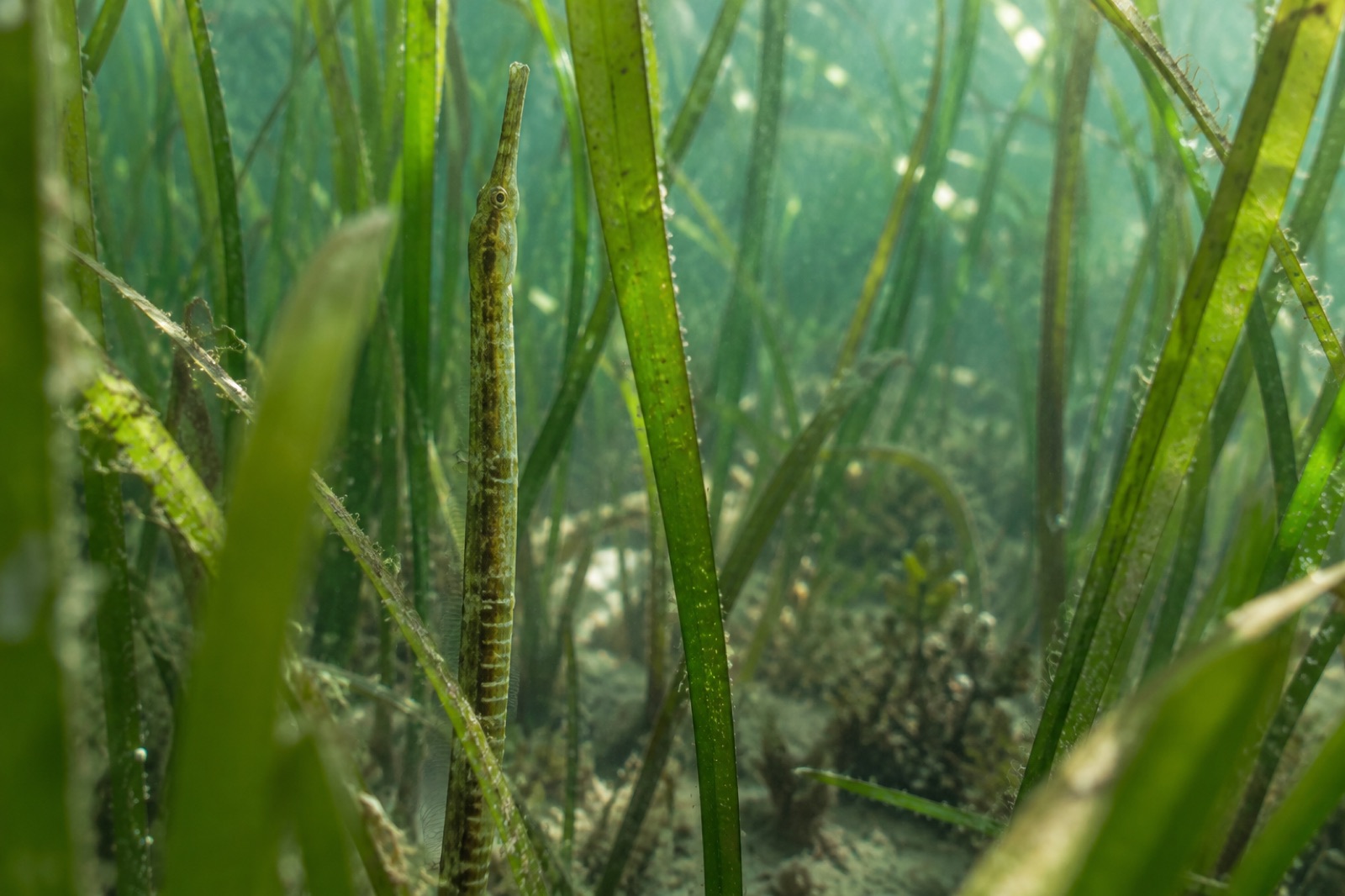
Among the family it shares with the weedy seadragon and the leafy seadragon — those extraordinary, ornament-crowned Australians that have made Southern Australia's temperate reefs a pilgrimage — the pot-bellied seahorse is the working seahorse: less baroque than its finned-alga cousins, but many times larger than the little pipe-shaped bay pipefish and the small seahorses most divers know.
Where it lives
The range sweeps the Great Southern Reef from Western Australia's sheltered southern coast across to New South Wales, plus the whole suggestive geography of New Zealand — harbours, jetty fields, channel mouths, sheltered bays. Its favoured height is surprisingly uniform: it is a shallow-water, structure-loving animal. Piers and jetty pilings, sponge gardens, drifting rafts of weed, mooring lines heavy with growth, sheltered pockets of kelp and seagrass — anywhere the water flows gently past a place to hold a tail.
Look for it where the Mornington Peninsula's famous piers cast their sponges and weed over a bottom, or on any of a hundred unglamorous Hobart, Wellington or Adelaide structures. Depths rarely take it much past 15 metres, though populations are recorded deeper on offshore sponge reefs. What matters is never depth so much as purchase: something to grip, something to graze near, something that doesn't move too fast.
Feeding by suction, never by hurrying
The pot-bellied seahorse is an ambush suction feeder — effectively a stationary vacuum cleaner. The snout acts as a pipette: a sudden expansion of the head creates a brief, violent pressure drop, and everything small alive within a snout's reach — mysid shrimps, amphipods, larval fish, minuscule crabs and copepods — is drawn in whole and unchewed in a time measured in thousandths of a second. With no teeth and no functional stomach, digestion is a quick conveyor-belt that demands a constant supply; a seahorse eats near-continuously, often dozens or hundreds of times per day when food is available.
That engineering explains everything about the body plan. The upright posture and prehensile tail are those of an animal that has traded swimming entirely for anchoring; the camouflage is that of a predator whose prey comes to it; the big belly is a fuel tank for the pouch within. Watch one feeding among its home pilings and the dive-guide cliché turns literal: this is a fish that stands still and grazes.
The famous male pregnancy
Seahorse reproduction has been celebrated for so long that it can be hard to see plainly, so here it is plainly: the female produces eggs and deposits them, through a brief courtship embrace — tail-holding, colour displays, a rising dance — directly into the male's pouch. He fertilises them there, and the pouch seals. For the next weeks he carries them, regulating salinity, bathing the embryos in oxygenated fluid, nurturing them through development while his belly deepens toward full term.
Temperature sets the timetable: something close to a month in cool water, shorter in warmth, and broods in large males can be remarkable — commonly several hundred young, and occasionally over a thousand. At the end, the male pumps and contracts the pouch in visible, dramatic labour, releasing pea-sized, perfectly formed offspring into a current none of them has chosen. The newborns drift for days as plankton, then settle — vastly, efficiently outnumbered by the seas' appetites — and the cycle begins again. Males commonly take up a new brood within days.
It is, from a human vantage, irresistibly symbolic; from a seahorse's vantage, simply the evolutionary deal worked out: seahorses make few of their kind, in a world built on mass spawning, and someone must guard those few. The male volunteered.
Conservation: protected, farmed, and still uncounted
The pot-bellied seahorse is CITES Appendix II like every seahorse, meaning international trade is certified and monitored; Australia protects it from commercial wild harvest; and the species has a proud history in conservation aquaculture — Tasmania's pioneering breeders in the 1990s and 2000s essentially founded commercial seahorse farming to supply the aquarium trade without touching the wild. Most pot-bellied seahorses in aquaria today are captive-bred.
The wild story is stranger: nobody is quite sure how many there are. The species' patchy, pier-and-bay habitat structure, its shallow depth, its sluggish movement and its superb disguise make census work difficult, and the IUCN data for this and many Hippocampus species remain thin. What is solidly established is that shallow, sheltered, sponge-and-weed habitat — exactly the habitat the animal needs — is among the most economically contested coastline on Earth. Rope-protected piers, marine reserves, and artificial structure thoughtfully seeded with sponge all play a role; so does the simple diver's ethic of looking and not removing, which applies to kelp coast wildlife everywhere.
Key takeaways
- The pot-bellied seahorse (Hippocampus abdominalis) is one of the largest seahorses in the world, to around 35 centimetres.
- It ranges across southern Australia and all of New Zealand, favouring shallow piers, sponge beds, jetties and sheltered kelp gardens.
- Its name honours its big belly — the seat, in males, of the famous brood pouch.
- Male pregnancy runs about a month in cool water and can yield several hundred to over a thousand fry per brood.
- It is a suction feeder, drawing whole mysids and small crustaceans into its snout with near-instant drop in pressure, eating nearly all day.
- It is fully protected from Australian wild harvest, all seahorses are CITES-listed, and the aquarium trade is now largely captive-bred — but wild populations remain thinly censused.
FAQ
How big does the pot-bellied seahorse get?
Commonly 20–30 centimetres, with exceptional animals reaching around 35 cm. Among seahorses — most of which measure just a few centimetres — it is a genuine giant.
Where does the pot-bellied seahorse live?
Southern Australia (from Western Australia's southern coasts across to New South Wales, including Tasmania) and throughout New Zealand's coastal waters. It is a shallow-water animal of piers, jetties, sponge gardens, seagrass and kelp-line structure, rarely below 15 metres.
Do male pot-bellied seahorses really get pregnant?
Yes — in the sense that only the male carries the brood. The female places her eggs into his pouch during mating; he fertilises and gestates them (roughly a month, depending on temperature) and gives birth to fully formed, independent young. Brood size in large males can pass a thousand.
Can you keep pot-bellied seahorses in an aquarium?
Captive-bred pot-bellied seahorses are the staple of the legitimate trade and, being among the largest and hardiest seahorses, are commonly kept in specialist display aquaria — with demanding needs: low current, hitching posts, frequent feeding of small live or frozen crustaceans, and meticulous water quality.
Is the pot-bellied seahorse endangered?
It is not classified as globally threatened, but it is poorly censused in the wild. All seahorse species are CITES Appendix II, and Australia prohibits commercial wild harvest; Tasmania's successful aquaculture industry now supplies much of the world's aquarium demand for the species.