Everything you think you know about scallops involves motion: the free-swimming, valve-clapping escape of the commercial scallop, spinning away from a diver like a castanet. The purple-hinged rock scallop (Crassadoma gigantea, formerly Hinnites giganteus) takes the opposite path. It is a scallop that, as a youngster, chooses one patch of rock and cements itself there for the rest of its life, trading mobility for bulk and becoming a reef fixture that can reach the size of a dinner plate. When it opens to feed, a brilliant orange mantle flares around every sheltered edge — a stationary flash of colour that veteran divers of the Pacific kelp forests learn to spot like a signature. Here is what this animal is and what it does on the kelp forest's walls.
Fast facts
|
|
| Scientific name |
Crassadoma gigantea (formerly Hinnites giganteus, Hinnites multirugosus) |
| Group |
A scallop — a bivalve mollusc of family Pectinidae |
| Common names |
Rock scallop, giant rock scallop, purple-hinged rock scallop |
| Size |
Commonly 10–15 cm across; large old shells reach 20–25 cm |
| Depth range |
Low intertidal to 50 m and beyond; commonest on subtidal rock walls and boulders in kelp forest depth |
| Distribution |
Alaska to Baja California; commonest in central and northern Pacific kelp forests |
| Diet |
Filter-feeds phytoplankton and suspended organic matter from the passing current |
| Notable traits |
Permanently cemented to rock as an adult; long purple hinge teeth; conspicuous orange mantle; one of the largest scallops in the world |
An oyster-hearted scallop
The rock scallop's life tells you what kind of animal it is. It begins, like all scallops, as a planktonic larva, settles onto hard surfaces, and passes a normal juvenile phase attached by byssal threads — the fibrous anchor-lines most scallops keep through life. But then Crassadoma does what almost none of its relatives do: as it approaches a few centimetres, the right (lower) valve cements itself permanently to the rock, oyster-style, and the byssal phase ends forever. From that point the shell grows where it sits, thickening and warping into whatever crevice or boss it landed on, often acquiring the sponges, tube-worms and algae of its neighbourhood as camouflage. A big brown lump of encrusted rock that opens to breathe bright orange is the discoverable truth of this animal.
The one motion that remains is the valve itself: the upper shell lifts on the purple hinge, the mantle edges part, and the scallop filters. The eponymous hinge is indeed vivid purple where the two valves articulate — visible the moment a dead or gaping specimen is turned over.
Recognising one on the reef
Identification has two modes:
- Open and feeding. A rosette of vivid orange mantle — the animal's filtering edges, lined with tentacles and a dense row of small dark eyes — expands around the crack between the valves. On a grey kelp reef this orange flash is one of the most striking single colour statements you will see; once you learn it, you see it on every rock face and piling. This is the "stationary flash" of the title: a reef landmark that never moves, only opens and closes.
- Closed, or dead. The shell is heavy, irregular, roughly triangular-fan shaped, white to grey-brown and usually generously encrusted with sponge and worm-tube life; the large flat shell of a dead adult, with its purple hinge, is unmistakable. The rock scallop's near-relative the spiny or kelp scallop, by contrast, is smaller, unattached, and genuinely swims. If the scallop claps energetically away from you: that's not this one.
What it eats, and how it matters
The rock scallop is a suspension feeder on a large scale: it draws water over its gills, filters phytoplankton and suspended detritus, and returns the cleaned water to the reef. An adult moves an extraordinary daily volume, and a wall of them — as you see on good reefs — is one of the kelp forest's principal water-cleaning appliances.
That quiet labour has two important consequences in the bigger web. First, like mussel beds and sponge mats, rock scallop walls help maintain the water clarity on which the kelp forest depends — see water clarity and light for how much hangs on that. Second, they transfer floating planktonic production into reef-bound, visible biomass that others can eat: their own tissues (and the community of small life that shelters on and around their shells) become lunch for sea stars, octopuses and predatory snails. In the ledger of the kelp forest food web, the rock scallop is an unglamorous but consequential middle row.
Senses, eyes and the sudden clamp
A feeding scallop is not insensate. The mantle edge carries a row of tiny eyes — real image-forming eyes, with lenses and retinas, tuned to detect passing shadows and movement — and a battery of chemical and touch sensors. A large shadow crossing the reef, or the touch of a predator's arm, triggers an instant, forceful valve slam with a jet of expelled water: the scallop's only remaining defence, and by all accounts an effective one against many attackers.
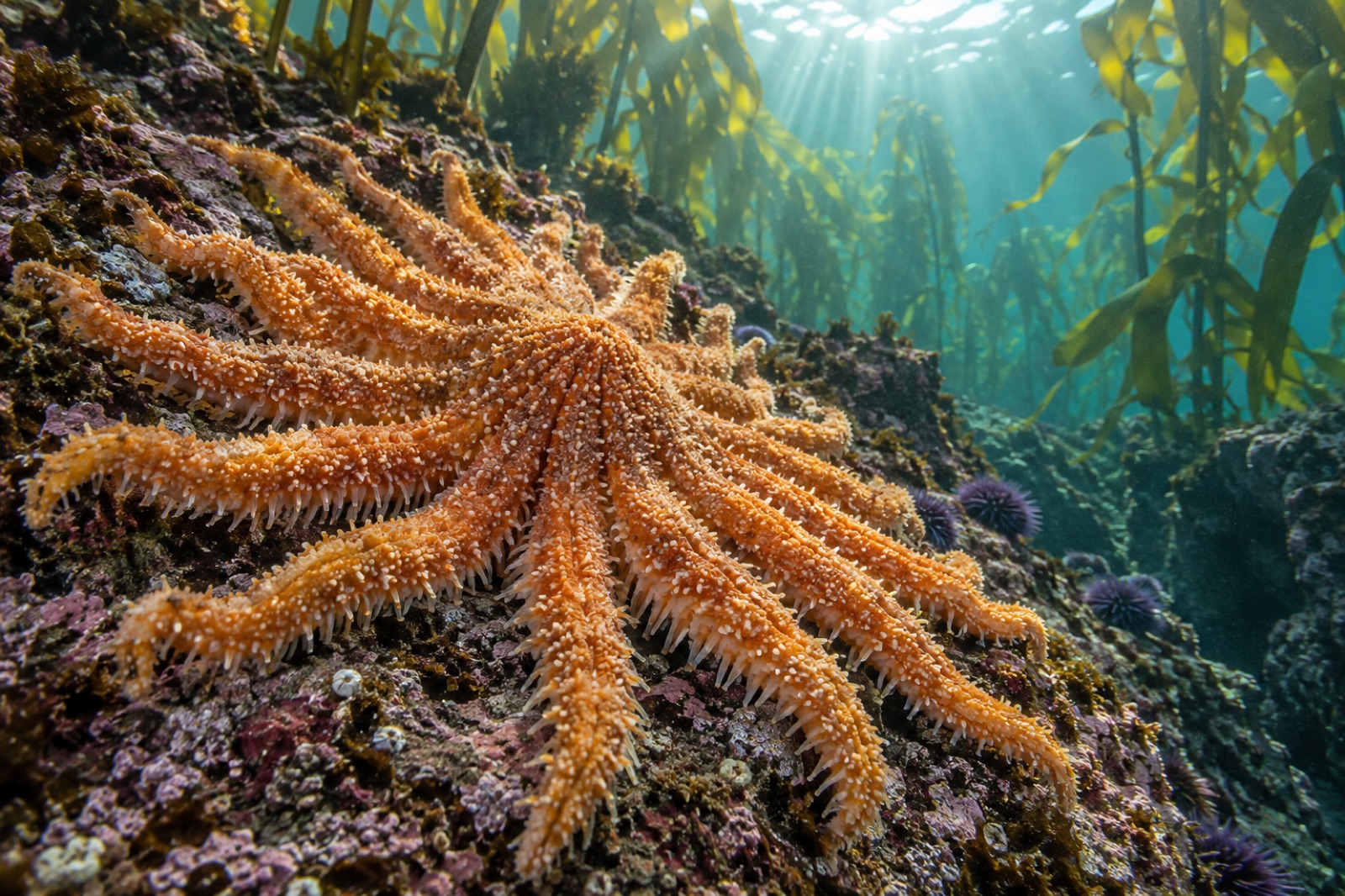
The attackers most committed to the effort are the big sea stars. A sunflower sea star is a documented rock-scallop predator: it pins the valves, exerts patient suction with its tube feet, waits for the scallop to tire, and then everts its stomach into the gap. Divers before the sea-star wasting epidemic described in our sea star wasting explainer remember the grim sign: a big sunflower star draped over a big rock scallop, sometimes for days. Octopuses take smaller animals; boring sponges weaken old shells. But the adult, clamped in place on rock it owns, is a stubborn and long-lived target — rock scallops are thought to live decades, their shells ringed with a visible autobiography of growth.
A fishery, briefly
The rock scallop's combination of size, sedentary habit and excellent, large adductor muscle has made it a target wherever it is common — a prized dive delicacy in British Columbia and Alaska, and the subject of aquaculture trials in the Pacific Northwest. In California it is taken recreationally in modest numbers; its vulnerability is exactly its virtues — it cannot flee — which is why jurisdictions have tended to manage it with size limits and, in some areas, spatial protections. The main advice to any diver considering taking one: know your local regulations, and leave the centenarians on the wall. A 20-centimetre rock scallop is an old animal with no way to be replaced quickly.
Where to see one
Rock scallops favour subtidal rock walls, boulder fields, pilings and surge channels in kelp forest depths, from just below the low-tide line to well past sport-diving depth. They are common on the shaded, current-washed facets of reefs throughout northern and central California, British Columbia and Alaska, and occur south into Baja. Big encrusting mounds on underwater walls, opening to reveal orange: on a good reef you will spot the first within minutes. The kelp forests of Vancouver Island, the Olympic Coast and the Channel Islands are all strong rock-scallop territory. And if you want to see the contrast — a related scallop that actually swims — follow a kelp scallop as it claps off through the understory on the same dive: the two species, one bolted down and one airborne, are a tidy lesson in how differently evolution spends the same body plan.
Key takeaways
- The purple-hinged rock scallop (Crassadoma gigantea) is a giant scallop that cements itself permanently to rock as a young adult and lives out decades in place.
- Two identification modes: a stationary flash of orange, eye-lined mantle when open; a large, encrusted, roughly triangular shell when closed.
- It is a major suspension filter of the kelp reef — a wall of rock scallops is an engine of water clarity and plankton-to-reef biomass transfer.
- It defends itself with mantle eyes that sense shadows and a fast, forceful valve slam; the patient big sea stars are its principal nemesis.
- Juveniles attach by byssus like ordinary scallops; cementation to the rock comes later, and the shell then grows to fit wherever it landed.
- Know your local rules before taking one; the biggest animals are decades old and, on a wall they cannot leave, irreplaceable in practice.
FAQ
Can rock scallops swim at all?
Not as adults once they have cemented — the lower valve is fused to the rock for life. The swimming reflex and adductor muscle remain fully functional, and closed animals clap their valves vigorously when disturbed, expelling a jet of water; but with their base fixed, the clap is a defensive gesture, not a launch. For a scallop that genuinely swims, see the kelp scallop.
What does the purple hinge actually look like?
The region where the two valves articulate carries a pair of strong, interlocking "teeth" — chomphorae — that in Crassadoma are a striking dark purple. On a live animal it is hidden between closed valves, but a gaping specimen, or any turn-of-the-tide empty shell, shows the colour unmistakably and is the surest shell-only identification.
Are rock scallops endangered?
No — the species has no conservation listing and remains common through most of its range. The local concern is subtler: as a long-lived, totally sedentary, easily collected large animal it is slow to recover where heavily picked, and management in several jurisdictions reflects that with size and bag rules. Admire the big ones; they're older than many of the kelp plants above them.
Do rock scallops really have eyes?
Yes — a row of small, sophisticated eyes lines the mantle edge, each with a lens and retina and backed by a reflecting layer. They don't see pictures the way you do, but they detect moving shadows well enough to trigger escape and defence. A torch beam moved suddenly over a feeding rock scallop gets a response; approach gently and it will go on feeding with its eyes on you.
Where is the best place to see rock scallops?
Any current-washed rock wall or piling field through the northeast Pacific kelp forests: Vancouver Island, the Olympic Coast, the Channel Islands, and the rocky shores of British Columbia and Alaska in particular. Look for large encrusted mounds on shaded vertical surfaces between 5 and 30 metres, and watch a few moments for the orange mantle to open.