Turn over a flat cobble on nearly any Pacific rocky shore between Alaska and central California, wait two seconds, and something small and purple will usually make a dash for it. That is the purple shore crab (Hemigrapsus nudus): one of the most abundant crabs on the North American west coast, and one of the most overlooked. It is a scavenger, a grazer, a prey item for everything from sculpins to raccoons, and a quietly important link between the kelp forest and the tide line — much of what the canopy sheds ends up processed, eventually, through small purple mouths on the shore. This profile covers how to identify it, how it lives, and why a crab most people step over is worth a second look.
Fast facts
|
|
| Scientific name |
Hemigrapsus nudus |
| Group |
Brachyuran crab, family Varunidae (shore crabs) |
| Carapace width |
Commonly 3–4 cm; large males up to about 5.5 cm |
| Range |
Aleutian Islands, Alaska, south to central California |
| Habitat |
Mid- to high intertidal rocky shores, cobble beaches, protected bays and estuaries |
| Diet |
Algae, diatoms, drift kelp fragments, carrion, small worms and crustaceans |
| Key predators |
Gulls, crows, raccoons, river otters, sculpins, flatfish, octopuses |
Identifying the purple shore crab
The name does most of the describing. The carapace is a rounded, slightly squared-off dome in shades of purple, reddish brown or olive, often mottled, with three low teeth on each side behind the eye sockets. Two features clinch the identification:
- The claws. The pincers are lighter than the body — typically cream to white at the tips — and crisped with distinct red or purple spots. On a good rock-flip this pattern is unmistakable.
- The legs. The second half of the Latin name, nudus ("naked"), refers to the walking legs: they are essentially smooth and bare. This is the fastest field separation from its neighbour, the yellow or hairy shore crab (Hemigrapsus oregonensis), which is smaller, greener-grey and densely bristled on the legs — a way of life for a crab that often lives on mud and silt, where hairs keep sediment out of joints.
Young purple shore crabs can run pale and stripey, and colour varies across the range, so rely on the spotted white claws and naked legs rather than hue alone.
A life lived under rocks
Purple shore crabs are creatures of the mid- to high intertidal — the band of shore that spends hours out of water in every tidal cycle. Their strategy for surviving that exposure is simple: be somewhere else. During low tide they stay wedged beneath cobbles, inside rock crevices, or buried at the edge of damp gravel, retreating to microhabitats that hold moisture and moderate temperature. The crab's flattened profile is not decorative; it is the shape of an animal that earns its living in the centimetre-high world between a rock and a hard place.
They are also notably tolerant of brackish water, which is why they turn up far up estuaries and inside sheltered inlets where most marine crabs fade out. Physiological work on Hemigrapsus has long made the genus a laboratory favourite for studying how crustaceans regulate their internal salts — a skill set that lets the purple shore crab work terrain from fully marine outer coasts to half-fresh river mouths.
Activity rises with the flood tide. As water returns, the crabs emerge to feed, fight over rock real estate, and court — most of the drama of purple shore crab life happens in the hours when the shore is underwater again.
What a purple shore crab eats (and why it matters to kelp)
The honest answer to "what does it eat" is "a bit of everything slow enough." Gut-content studies find a shifting omnivore's bill of fare:
- Green and red algae scraped from rock surfaces, plus the diatom film that coats every wet stone
- Drift kelp and surfgrass fragments — shredded wrack washed into the high intertidal
- Carrion: dead fish, dead crabs, anything the gulls missed
- Small animal prey: amphipods, worms, young barnacles, tiny snails
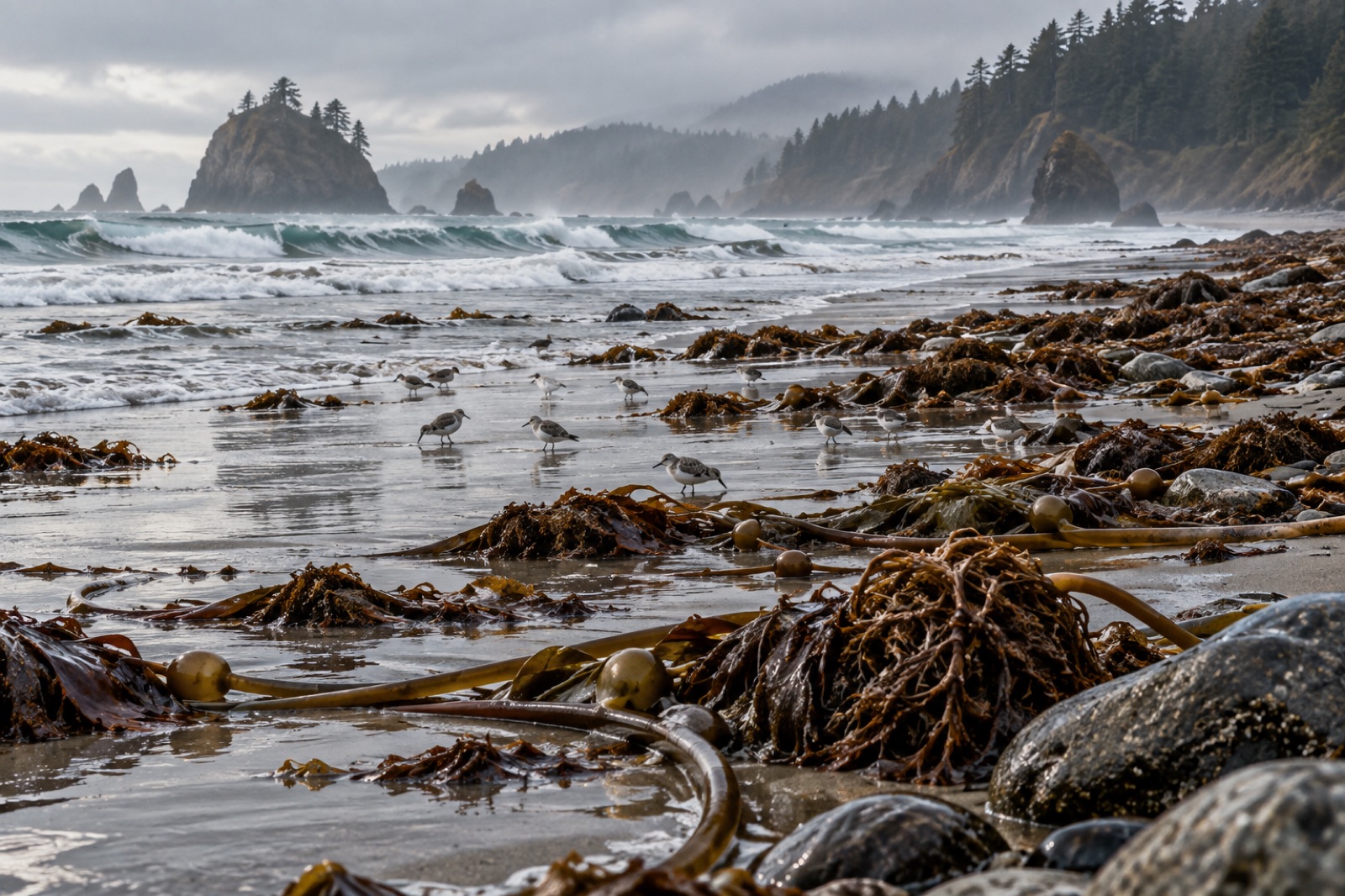
That middle item is where the kelp forest comes in. Kelp forests shed an enormous amount of material — whole fronds torn by storms, blades trimmed by grazers, fragments that drift shoreward and pile up as wrack (see drift kelp and wrack for how that subsidy works). Intertidal scavengers like the purple shore crab are the first processing line for that material on rocky shores: they tear it into smaller pieces, fuel microbes, and convert kelp carbon into crab — and crab, in turn, into gull, sculpin and raccoon. In the larger accounting of the kelp forest food web, shore crabs are a minor species with a major function: they shorten the loop between the forest's waste and the shore's wealth.
Reproduction: a spring belly full of eggs
Purple shore crabs mate in the warmer months, and females carry their fertilised eggs glued to the abdominal pleopods — the orange or grey mass under the tail that fishers call a "berried" crab. A gravid female can carry thousands of eggs for several weeks, tending them by ventilating the mass with her abdomen.
When the embryos are ready, she releases them into the water as zoea larvae, which join the spring plankton bloom. The larvae pass through several zoeal stages and a final megalopa — a half-crab, half-shrimp transitional form — before settling to the shore and metamorphosing. That planktonic window is the population's great equaliser and its great gamble, the same lottery that governs larval dispersal across kelp-coast invertebrates: currents decide where the next generation lands, and a bad plankton year can mean a thin settlement the following summer.
Growth after settlement is by moulting. The crab backs out of its old shell, swells with water before the new shell hardens, and hides until it is armoured again. Each moult is a few hours of extreme vulnerability, which is why soft-shell crabs are almost never seen in the open — and why the undersides of rocks stay crowded.
On the menu: predators and defences
For such a common animal, the purple shore crab has an unusually long predator list, testament to how much protein it packages:
- Birds: gulls flip rocks and patrol low tides; crows learn crab-rich beaches and remember them
- Mammals: raccoons forage the shore at night; river otters take crabs in estuaries
- Fish: sculpins (see the tidepool sculpin profile), flatfish and surfperch take small crabs at high tide
- Cephalopods: octopuses extract crabs from crevices
Against all of this the crab fields three defences: camouflage, the rock itself, and autotomy — the ability to shed a trapped leg at a built-in fracture plane and regrow it over successive moults. Many purple shore crabs you find under rocks are missing a limb or carrying a conspicuously smaller, pale regenerate. It is a sign of a life being lived at the sharp end of the shore.
Why this little crab matters
Ecologists sometimes talk about "sandwich species" — the middle of the food web that passes energy upward. The purple shore crab is a classic: it converts algae and kelp detritus, at densities that can reach many individuals per square metre of suitable cobble, into prey for nearly everything larger. Where cobble beaches lie adjacent to kelp beds, the crab is part of the physical connection between forest and shore.
It is also a useful indicator animal. Because it sits high on the shore, the purple shore crab is among the first marine species exposed to shoreline pollution, freshwater surges and heat extremes during daytime low tides — low tides in hot weather can stress intertidal communities hard, a dynamic explored in rockpools as refugia. Long-term shore monitoring programs consequently count Hemigrapsus as a standard species: changes in its abundance say something about the whole strip of coast between the kelp line and the high-tide mark.
If you flip a rock to look, the etiquette is simple: flip it back. That damp ceiling is somebody's house — usually several somebodies.
Key takeaways
- The purple shore crab (Hemigrapsus nudus) ranges from the Aleutians to central California and is one of the most abundant intertidal crabs on the Pacific coast.
- Identify it by its white-tipped claws with red-purple spots and its smooth, "naked" walking legs — the latter separates it from the hairy shore crab.
- It is an omnivorous scavenger that processes algae, carrion and drift kelp, acting as a first-line recycler between the kelp forest and the rocky shore.
- Females carry thousands of eggs in spring; larvae spend weeks in the plankton before settling, linking distant shorelines.
- As common mid-food-web prey, it feeds birds, mammals and fish — and serves as a sensitive indicator of shoreline stress.
FAQ
Is the purple shore crab the same as the crab sold as "shore crab" in restaurants?
No. It is far too small to be a commercial food species. Edible Pacific crabs like the Dungeness and red rock crab are different, much larger species. Purple shore crabs are sometimes collected alive as fishing bait or for classroom aquaria, which is regulated differently by state.
How can I tell it apart from the yellow shore crab?
Turn the crab gently and look at the legs. The purple shore crab's walking legs are smooth (hence nudus, "naked"), while the yellow shore crab (Hemigrapsus oregonensis) has conspicuously hairy or bristled legs. The purple's claws also carry the tell-tale red spots on white tips.
Where exactly should I look for one?
On protected rocky or cobble beaches, in the mid to upper intertidal. Gently lift flat, hand-sized cobbles that sit in damp gravel — look for movement within a second or two, then replace the rock exactly as you found it.
Does it have anything to do with kelp forests?
Indirectly but genuinely: it lives adjacent to kelp beds, consumes drift kelp and kelp-derived detritus washed onto the shore, and moves that energy up the food web to birds, otters and fish. It is part of the forest's shoreline recycling crew.
Are purple shore crabs dangerous to handle?
Not beyond a small pinch. They are docile crabs that will nip if squeezed. The kinder approach — for you and the crab — is to observe rather than handle, and to leave every rock the way you found it.