Encyclopedia9 min read
Wolf Eel (Anarrhichthys ocellatus): Species Profile
The wolf eel is not an eel and nothing to fear — a devoted, den-dwelling wolffish that crushes sea urchins for a living and guards its eggs for months.
Dr. Mara Ellison ·
Meet the California moray eel — a nocturnal, crevice-dwelling ambush predator of Pacific kelp reefs, with pharyngeal jaws and a reputation it doesn't deserve.
The California moray (Gymnothorax mordax) is the only moray eel that regularly shares the cool kelp forests of southern and Baja California. It is a nocturnal ambush predator: by day you see little more than a mottled brown head resting in a crevice, jaws rhythmically opening and closing as it pumps water over its gills; by night it becomes one of the reef's most effective hunters, sliding through the kelp understory after octopus, fish and crustaceans. Despite the old sailor's tales, it is shy, rarely aggressive, and an important working member of the reef community.
| Scientific name | Gymnothorax mordax |
| Group | True eels (Anguilliformes), moray family Muraenidae |
| Maximum length | About 1.5 metres (5 feet) |
| Typical depth | Shallow rocky reefs, roughly 1–20 m; recorded to about 40 m |
| Range | Point Conception, California, south along Baja California; often sighted around the Channel Islands and Gulf of California |
| Habitat | Rocky reef crevices within and beneath kelp forests |
| Conservation status | Listed as Least Concern by the IUCN; lightly exploited |
Morays are eels engineered around one design goal: occupying tight holes in broken rock.
The California moray has no paired pectoral or pelvic fins and no scales. Instead, a continuous ribbon of dorsal and anal fin runs around its muscular body and tail, and its skin is protected by a thick layer of mucus. That streamlined, finless profile lets it back into a den far narrower than any predator that might come looking, and reverse out just as fast.
The moray's signature behaviour — mouth gaping open and shut — is mostly not a threat display. It is breathing. Water is pumped across the gills by rhythmic jaw movement, which is why a resting moray looks as if it is silently rehearsing an argument it will never have.
Like all morays, G. mordax has a second set of jaws deep in its throat — pharyngeal jaws — that shoot forward into the mouth, grip seized prey and walk it down into the gullet. The arrangement, first fully described in morays, remains one of the most extraordinary feeding mechanisms in fishes: the front jaws catch and secure, the throat jaws deliver. It solves the problem of swallowing large, struggling animals without gills, tongue or hands.
Morays have weak eyesight by daylight standards, but an excellent sense of smell. As dusk falls over reefs such as those around Catalina Island, the California moray leaves its den to hunt, reading scent trails along the rock the way a hound reads the ground.
Its diet is broad: small reef fish, crabs, shrimp and other crustaceans, and — famously — octopus. A moray is one of the few predators that can follow an octopus into its own hole, and encounters between morays and kelp-forest octopuses such as the East Pacific red octopus are nightly dramas played out mostly where no diver will see them. Large prey is handled with a deeply un-elegant trick: the eel ties its own body into a knot and runs the knot forward to generate the leverage needed to tear off manageable pieces.
By day the moray retreats to its den, often one it may use for years. Some individuals tolerate cleaner fish working around their heads and mouths, holding uncharacteristically still while small gobies or shrimp pick at parasites — a local echo of the cleaner-station behaviour better known from tropical reefs.
The California moray is a mesopredator: big enough to suppress numbers of small fish and crustaceans, small enough to be prey itself for large sharks and, occasionally, toothed predators working the reef edge. In a healthy kelp forest it is part of the web of checks and balances that keeps any single prey species from running away with the reef.
That web is exactly what worries ecologists when kelp is lost. Rocky structure survives an urchin barren, but the prey base and the cover that ambush predators depend on thin out fast. Morays are creatures of complex reef: the more holes, ledges and understory, the more hunting and hiding the reef supports. It is one reason Tidewright's Drifter vessels log not just kelp canopy but reef structural complexity on every restoration survey.
A resting California moray is a gift to a careful diver: large, dramatic and almost entirely indifferent. The safety rules are simple and amount to good manners.
If you are new to after-dark reefs, our guide to night diving among kelp covers planning, lights and etiquette in detail.
Not unless provoked. They have sharp, backward-curving teeth and a powerful bite, but no interest in humans. Respect dens, never feed them, and encounters are uneventful and often beautiful.
Large adults reach roughly 1.5 metres. Most animals divers meet on southern California reefs are a metre or less, which makes them modest compared with big tropical morays.
Scan the shadowed mouths of crevices in rocky reef below the kelp, especially under ledges and among boulder piles. Look for the rhythmic opening of the mouth and the mottled, finless head. Night dives greatly increase your chances of seeing one fully out and hunting.
Large sharks are the main threat, and big morays are occasionally taken when moving exposed over open bottom. A moray's first defence is always its den.
It is a working predator of the reef's middle tier. A reef complex enough to hold morays, wolf eels and cabezon is a reef approaching the structural maturity restoration aims for — which is why crevice habitat features in reef health assessments.
The wolf eel is not an eel and nothing to fear — a devoted, den-dwelling wolffish that crushes sea urchins for a living and guards its eggs for months.
Dr. Mara Ellison ·
The cabezon Scorpaenichthys marmoratus is the largest sculpin on the Pacific coast — an egg-guarding ambush predator of kelp reefs with famously toxic roe.
Dr. Mara Ellison ·
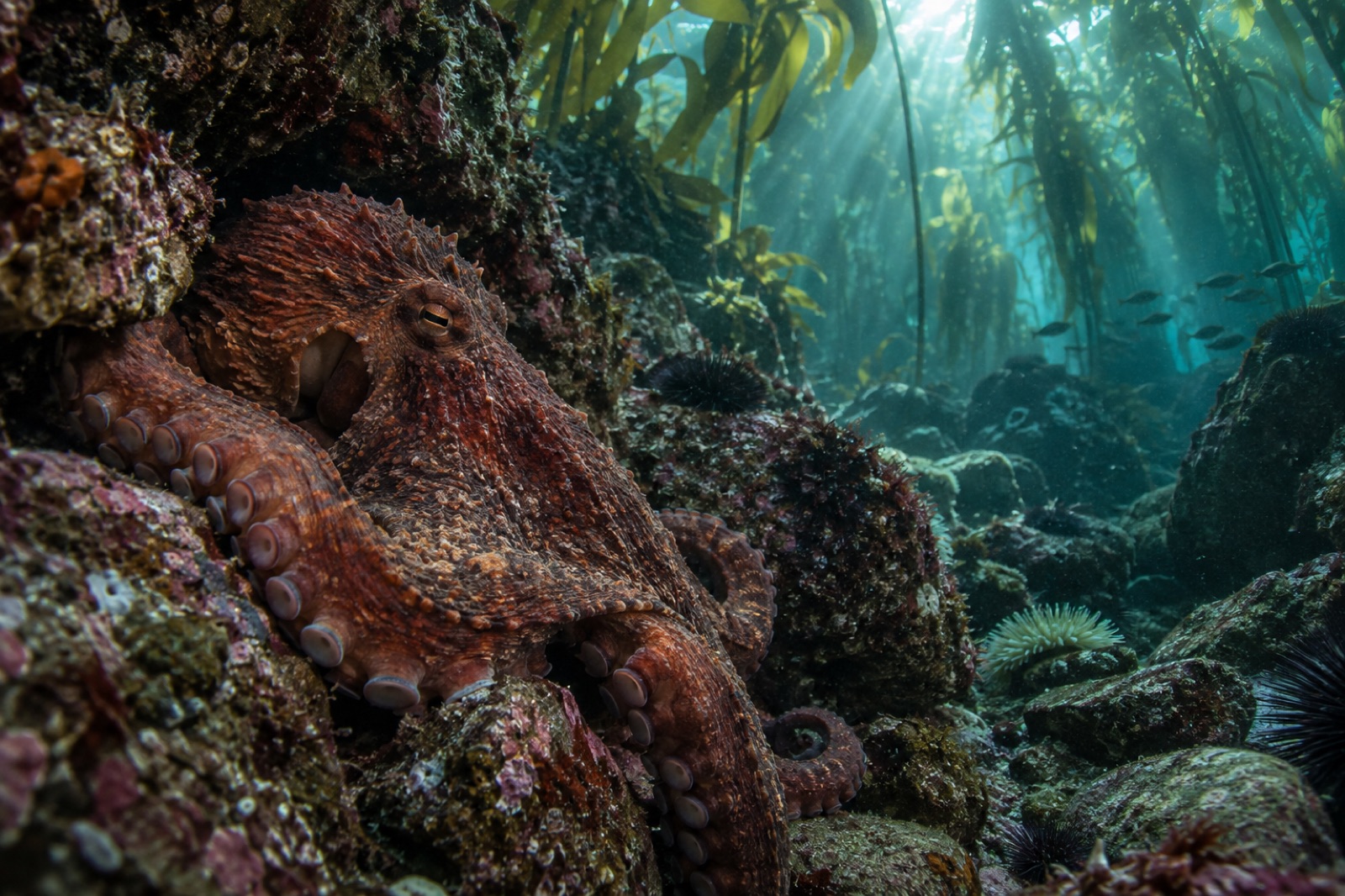
Meet the giant Pacific octopus: the world's largest octopus, a kelp-forest den-dweller with three hearts, blue blood and one shot at motherhood.
Dr. Theo Nakamura ·