Encyclopedia9 min read
A Field Guide to Kelp Forest Nudibranchs
Nudibranchs are the jewels of the kelp forest: shell-less sea slugs in startling colours. Learn the key groups, the star species and how to find them.
Tom Okafor ·
Clown dorid (Triopha catalinae) species profile: identifying the polka-dotted nudibranch, its bryozoan diet, rhinophores and where to find it on kelp reefs.
Some animals are named by committee; the clown nudibranch was named by somebody who had clearly seen one. Triopha catalinae — the clown dorid — looks like a joke the ocean is telling: a crawling slug of glossy white or cream, beaded all over with orange-tipped projections, wearing a pair of feathery orange antennae and carrying a tuft of equally orange gills on its back like a feather duster. It is common, charismatic and camera-friendly, which makes it both a gateway species for new nudibranch watchers and a genuine indicator of healthy encrusting life on kelp-forest rock. Everything it eats grows in crusts on the reef; where the reef's crusts are rich, the clowns are out.
| Scientific name | Triopha catalinae |
| Group | Nudibranch (sea slug), order Nudibranchia, class Gastropoda |
| Size | Commonly 2–7 cm; large animals to about 10 cm |
| Lifespan | Around a year or less, in the fast lane typical of nudibranchs |
| Depth range | Intertidal pools to subtidal reef, roughly 30 m |
| Range | Eastern Pacific: Alaska to Baja California; first described from Santa Catalina Island |
| Status | Common and widespread; no fishery, no formal listing |
The clown dorid belongs to the dorid nudibranchs — the sea slugs that breathe through a ring of feathery, retractile gills arranged in a circle partway down the back. Two features name it instantly. First, the rhinophores: paired, club-shaped, feather-textured chemical sensors on the head, bright orange, used to read dissolved scent in the water the way a dog reads air. Second, the tubercles: the body is studded with low, finger-like projections, each tipped orange, as if the animal had been dotted with a marker. The ground colour varies from white through cream to pale yellow; the tips stay reliably orange, and both the gill tuft and the foot margin echo the scheme.
Confusions do happen. It can be mistaken at a glance for other pale, orange-tipped dorids, but the combination — smooth, unarmed back (no cerata, the stinging-cell fingers of the aeolid slugs), orange-rimmed rhinophores, orange-tipped tubercular polka dots — is diagnostic. Our field guide to kelp forest nudibranchs walks a wider key; and if the animal is violet and orange flame rather than cream and polka dot, you have found the Spanish shawl, this coast's other celebrity slug.
Every nudibranch is a specialist, and the clown dorid's specialty is bryozoans — the colonial "moss animals" that encrust kelp blades, shells and rock in films so thin most divers never notice them. A colony of bryozoans is a city of thousands of microscopic zooids, each a complete filter-feeder with a lophophore crown of tentacles, all sealed into a shared skeleton. To the clown dorid, a bryozoan crust is a pasture: the slug's radula — the molluscan file-tongue — rasps zooids from the crust as it travels, leaving a faintly browsed track where the colony has gone pale.
This is why the species matters more than its charisma. Bryozoan crusts are themselves sensitive structures, and the kelp-blade crèche of bryozoans, hydroids and other encrusters — the micro-forest described in life on the blade — is one of the first systems to shift when water quality or temperature changes. Clown dorids are its conspicuous quality-control: grazers fine-tuned to a small, telling food web, and about as sensitive a "reef is functioning" indicator as a diver can spot without a microscope.
Nudibranchs abandoned the shell their snail ancestors carried, and replaced armour with chemistry and advertising. Rough handling or attack triggers clown dorids to release distasteful, mildly toxic compounds from skin glands — compounds, as with other dorids, thought to be derived or modified from their prey. The clown's bright scheme is honest warning: aposematism, the universal colour language of "do not eat me," worn also by the toxic opalescent nudibranch's more electric relatives. Healthy clown dorids crawl in the open at midday in full view of fish; fish leave them alone. The system works because the warning is true, and because both signal and chemistry are cheap for an animal whose entire being is already soft and slow.
Like most nudibranchs, the clown dorid is a simultaneous hermaphrodite — every individual is both male and female — which means any two clowns that meet on the reef can mate, each donating and receiving sperm. Neither can fertilise itself; the arrangement simply guarantees that every encounter between two adults is potentially reproductive. Weeks later, paired animals each lay an egg ribbon: a delicate, ruffled rosette of tiny capsules, usually white or pale pink, glued to rock or shell. Each capsule holds a handful of embryos that hatch, depending on temperature and species pattern, into shelled planktonic larvae — veligers — which join the drifting plankton lottery described in larval dispersal, feed, metamorphose, drop out of the plankton and settle onto rock as shell-less juveniles a millimetre long.
Then the clock runs hard. Nudibranchs live fast: growth is rapid on good bryozoan pasture, maturity comes in months, and the whole arc from hatch to egg-ribbon to senescence usually fits within a year. Every big, confident clown you photograph is a young animal going at full pace. Tidewright's monitoring teams, logging slug diversity on Canopy Ledger reef transects, use dorid abundance exactly this way — a fast-responding census of the encrusting community's condition, complementing the slow signals from anemones and corallines like the crustose coralline algae that recruit everything else.
Clown dorids range the whole Pacific coast of North America — our Monterey Bay atlas entry and the Channel Islands guide are good starting regions — and they turn up from low-tide pools to 30 m down. Search slowly, close to the rock, over surfaces dusted with pale bryozoan crust; midday on a sunny reef you will often find them in the open, unhurried, doing nothing at all defensively. For photography, they are the perfect patient subject: stationary, vividly patterned and at thumb size — the macro techniques in our kelp photography guide apply exactly. Move nothing, pinch nothing, and let the gill-tuft go into sharp focus.
No — its defences are distasteful, mildly toxic skin compounds aimed at predators, not venom aimed at hands. Brief, gentle observation is harmless to you. The rule that it is harmful to the slug still applies: never pick one up or move it, because the soft body is easy to injure, and some individuals may irritate sensitive skin if handled at length.
Almost entirely bryozoans — the "moss animals," colonial filter-feeders that encrust kelp, shell and rock. Different clown dorid populations seem to use different bryozoan species, which is one reason their abundance tracks the local encrusting community so closely.
Two functions, probably. The tubercles themselves may stiffen or texture the back against small predators; the orange tips, with the orange rhinophores and gills, are classic aposematism — the bright warning pattern that advertises the distasteful chemistry underneath. Fish learn the pattern once.
"catalinae" honours Santa Catalina Island off Southern California, where the species was first scientifically described; "clown" is universal diction for anything in cream, white and orange polka dots. It is one of those rare cases where the common name and the scientific name both point at the same good joke.
Both are dorids, but the sea lemon is lemon-yellow, more deep-bodied, feeds on sponges, and carries a rough, sandpaper mantle instead of the clown's tubercles. If you can smell citrus and touch sandpaper, it's the sea lemon; if it's beaded and orange-tipped, it's the clown.
Nudibranchs are the jewels of the kelp forest: shell-less sea slugs in startling colours. Learn the key groups, the star species and how to find them.
Tom Okafor ·
The opalescent nudibranch steals stinging cells from its anemone prey and wields them as weapons. Learn to identify Hermissenda crassicornis and its world.
Dr. Theo Nakamura ·
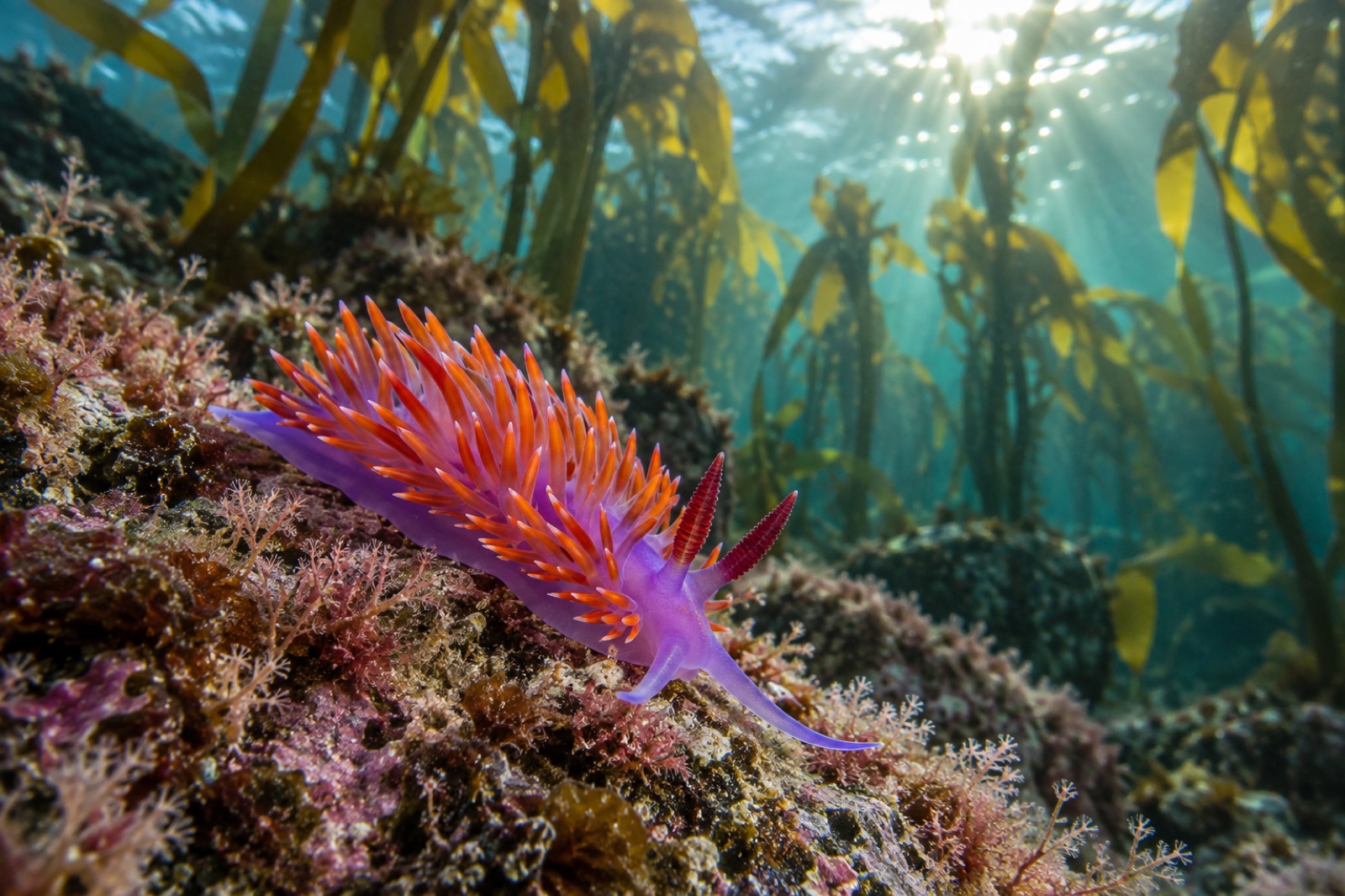
The Spanish shawl Flabellinopsis iodinea is a purple-and-orange aeolid nudibranch that steals stinging cells from hydroids. Identification, diet, habitat.
Dr. Mara Ellison ·