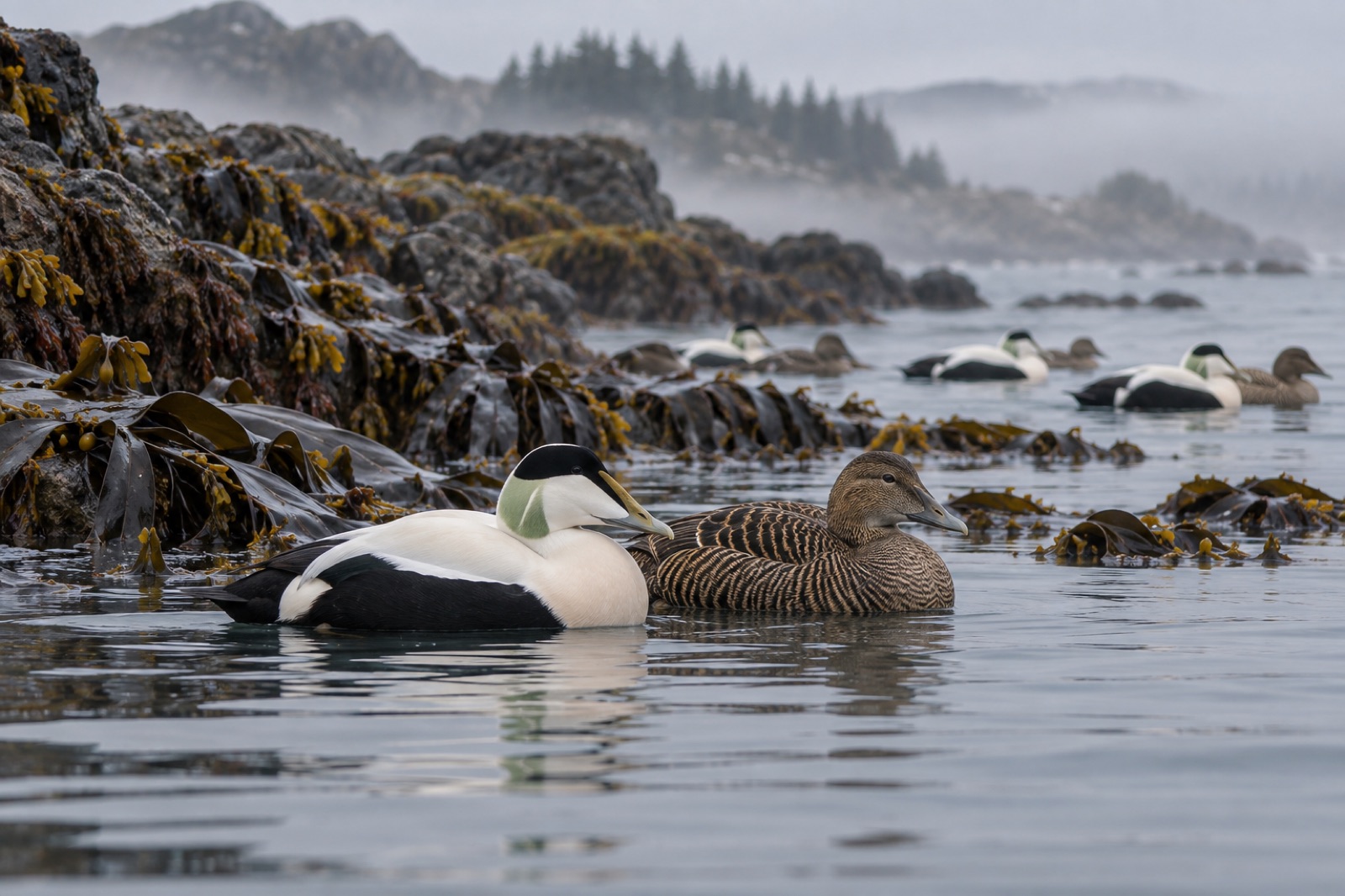
The common eider (Somateria mollissima) is the largest duck in the Northern Hemisphere, and it never really leaves the sea. Other ducks migrate between rivers and marshes; the eider's year is one long coastline — nesting on low Arctic islands in summer, living on shallow kelp-fringed bays the rest of the year, diving to the bottom of the same kelp beds a snorkeller loves. If you want one bird to stand for the North Atlantic's kelp coast, from Maine to Svalbard, this is it: a duck built like a freighter, whistling as it flies, that eats wildlife most people can't even crush in their hand.
Quick facts
|
|
| Scientific name |
Somateria mollissima |
| Common names |
Common eider, eider duck, "Cuddy's duck" (older Northumberland name, after St. Cuthbert) |
| Range |
Circumpolar: coastal northern North America and Atlantic Canada, Iceland, the British Isles, Scandinavia, the Barents Sea, Arctic Russia, western Alaska; several recognised subspecies |
| Marine habitat |
Shallow, sheltered, rocky coastlines, kelp beds, mussel beds and reefs usually less than 20 m deep |
| Breeding habitat |
Low coastal islands and spits, often in dense colonies near gull and tern colonies |
| Size |
50–70 cm long; females around 1.5–2.2 kg, drakes heavier — heavy and powerful by duck standards |
| Diet |
Blue mussels and other bivalves, periwinkles, crabs, small sea urchins — swallowed whole, crushed in the gizzard |
| Diving |
Typical feeding dives of 10–20 m, with deeper dives recorded; usually down for roughly a minute |
| Lifespan |
Commonly into the teens; banded birds have exceeded two decades |
Identification: the freighter duck
Pick a male eider out of a winter raft by shape first. He is big and sits low, with a long, sloping forehead-and-bill profile that birdwatchers describe as a "wedge" or "boat hull" — nothing like the pert round head of a harlequin duck. His plumage is party dress on that industrial frame: white back and breast, black cap and belly, and a wash of pale green on the nape, like sea-light. In eclipse plumage after breeding he goes mostly sooty brown-black, still unmistakable by profile.
The hen is the subtler masterpiece: warm barred brown from crown to tail, camouflage so good she can vanish in plain sight on a nest among rockweed. Her long, sloping head and heavy body give her away at any distance her plumage won't.
On the wing, eiders are unmistakable: low over the water in strung-out lines, wingbeats deep and slow for their size, drakes calling a soft, almost courteous ah-ooo — one of the loveliest sounds on a grey morning over a kelp bed.
A duck of the kelp shallows
Eiders and kelp share the same water for a simple physical reason: both live where it's shallow, clear and moving. Eiders feed almost exclusively on the seafloor, and their quarry — mussels, whelks, urchins, crabs — lives in the same sunlit rocky shallows that build kelp forests. Where a bed of giant or sugar kelp grows over a mussel reef, an eider has a two-storey supermarket: blades overhead hosting periwinkles and small crustaceans, bedrock below paved with shellfish.
The feeding method is singular. An eider doesn't nibble a mussel open; it dives, wrenches the whole animal off the rock by its byssal threads, and swallows it shell and all. The shells go to the gizzard, a muscular mill that grinds through centimetres-thick valve like a garbage disposal. Gull and raven looting of broken mussel shells is, for an eider, a solved problem — it simply takes the packaging along.
This diet makes eiders minor but real players in kelp ecology. They take small sea urchins among the bivalves — one of many mouths keeping urchin numbers honest on a healthy coast, part of the same web of checks whose failure creates urchin barrens. On Iceland's south and west coasts you can watch rafts of eiders working kelp beds where divers knowing the Westfjords coastline report the same pairing: rich kelp, rich eiders.
Breeding, crèches and the ancient commons
In late spring, eiders come ashore — briefly, and reluctantly, like sailors on leave. Hens nest in scrapes on open ground, often shoulder to shoulder in colonies of hundreds or thousands on predator-free islands, frequently tucked under the protective umbrella of aggressive gull or Arctic tern neighbours. The hen lines the nest with the famous down: grey-brown breast feathers she pulls from her own body, the most effective insulating material any animal has evolved, engineered to keep eggs at incubation temperature through an Arctic gale while she fasts for the better part of a month.
This is where the eider's most remarkable relationship begins — with people. In Iceland and parts of Norway, farmers have protected and harvested eider colonies for centuries in what is one of Europe's oldest continuous examples of wildlife stewardship: the colony is guarded all season, and when the brood departs, a portion of the abandoned down is gathered, cleaned and sold as eiderdown — a harvest that takes nothing the bird still needs and gives the colony armed protection in return. The arrangement long predates the modern word "conservation," and it still works.
At hatching, ducklings are walked to the sea within days and merge into crèches supervised by several females. Pipit-sized divers headfirst into wavelets, learning the bottom of their bay — the same coastlines featured in our North Atlantic and Arctic atlas.
Range and seasonal rhythm
The common eider is circumpolar, with recognised subspecies spanning the Canadian Arctic, the Atlantic coasts of North America, Iceland, Britain, Scandinavia and Russia, and the foggy coasts of western Alaska and the Bering Sea on the Pacific side. It winters wherever ice-free shallows hold shellfish — in the north that can mean polynyas and tidal leads in the pack ice, far from any shore a person would willingly stand on.
Autumn and winter put eiders in view: big rafts in bays, kelp fringes and river mouths, thick along the Maine coast, Atlantic Canada, Iceland, Norway's mid-coast (see our guide to Norway's mid-coast kelp country) and around Scotland's western isles. Spring returns the hens to their natal colony — eider site fidelity is legendary — and the drakes go back to sea.
Pressures: a coast-dweller in a changing sea
Eiders hug the coast, so their problems are the coast's problems. Oil spills hit eider rafts hardest because they spend their lives in the surface slick's way. Getting tangled in fishing nets has long been a quiet drain where gillnet fisheries overlap wintering flocks. Avian influenza has taken a serious toll on North Atlantic eider colonies in recent breeding seasons — one of those events that turns a dense, social colony into a field epidemiology case study in the worst way.
Longer term, warming seas reorder the shellfish beds the species depends on, and sea-level rise will flood low nesting islands — slow-motion pressures that arrive bird by bird, bay by bay.
Where to look
Any sheltered, kelp-fringed northern bay with mussel beds is eider water. Walk a rocky point at first light, glass the kelp fringe, and learn the shapes: low freighters among the bobbing gulls, heads like ploughshares. Our guide to birdwatching on kelp coasts covers hides, seasons and etiquette. If you hear a gentle ah-ooo drifting over grey water while the rest of the sea is silent, stop. You are already there.
Key takeaways
- The common eider is the Northern Hemisphere's largest duck and a committed year-round sea duck of shallow, kelp-fringed coastlines across the Arctic and sub-Arctic.
- It eats shellfish whole, crushing them in its gizzard, and feeds almost entirely by diving in water shallower than about 20 m — the same shallows that grow kelp.
- Eiders take crabs and small urchins as well as mussels, making them one of many natural checks on the herbivores that can strip a kelp forest.
- The hen's down is the finest natural insulation known; the centuries-old protected harvest of eiderdown in Iceland and Norway is a landmark example of conservation through stewardship.
- The species' close tie to the coast makes it vulnerable to oil spills, gillnet bycatch, avian disease and long shifts in prey and nesting habitat.
FAQ
How deep can a common eider dive?
Routine feeding dives run to roughly 10–20 metres, and deeper dives are on record. What sets eiders apart is less the record depth than the work rate: dive after dive, in near-freezing water, all daylight long.
Do eiders really swallow mussels whole?
They do. The whole mussel — shell, threads and all — goes straight to the gizzard, which mechanically crushes it. The shell shards pass through. It is an extraordinary piece of digestive engineering, and it means the bird loses no time at the surface among thieves and waves.
Where does eiderdown come from?
From the nest, not the bird's back. Hens pull down from their own breast to line the nest cup, then abandon it when the brood goes to sea. In Iceland and parts of Norway, stewards protect the colony all season and collect a portion of the used down afterward — the birds keep what they need, and the trade keeps the guardians employed.
Are common eiders endangered?
Globally the species is not considered threatened, but several regional populations have declined, and recent avian influenza outbreaks have hit colonies hard. Like most sea ducks, the eider's fortunes track the health of the shallow coastal seas — the same kelp coast this site is about.
What is the difference between a common eider and a king eider?
The king eider is smaller, more colourful on the head and built for deeper, more Arctic water. The common eider is the heavy coastal freighter; the king, its deep-diving, high-Arctic cousin. Where they overlap in winter, the common eider's long wedge profile and enormous build set it apart.