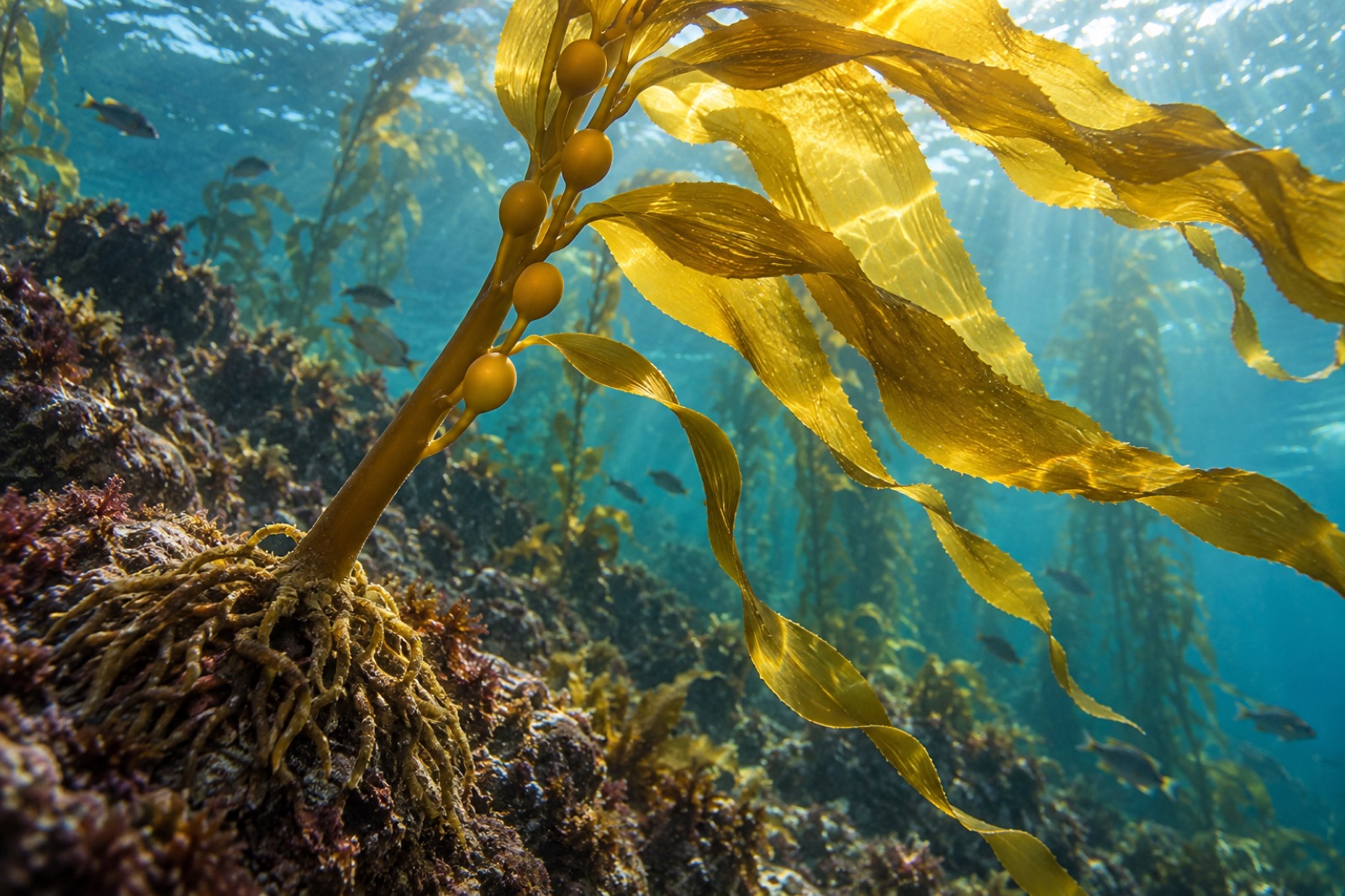
Spend a night dive on a temperate reef in the northeast Pacific and, if you shine your light low, you will find the lawn-mowing crew at work: hundreds of dark, whorled shells, each a few centimetres across, creeping over the rock on broad grey feet, each trailing a faintly polished groove through the algal film. These are red turban snails (Chlorostoma funebralis, formerly placed in Tegula) — among the most abundant mobile grazers on rocky shores from British Columbia to Baja California, and a species whose collective appetite quietly shapes what a reef becomes. Take them away, and the turf thickens. Pack them onto a reef stripped of predators, and they can strip it bare. Ecologists call this kind of species a "keystone in waiting": unremarkable at normal densities, decisive when the balance swings.
Fast facts
|
|
| Scientific name |
Chlorostoma funebralis (formerly Tegula funebralis) |
| Group |
Marine gastropod mollusc, family Tegulidae |
| Shell |
Top-shaped (turban), 2–4 cm, dark purple-brown to near-black; columella often reddish |
| Habitat |
Rocky intertidal and shallow subtidal; kelp forest floors and ledges, usually to ~15 m |
| Diet |
Microalgal film, turf algae, drift kelp fragments, occasional detritus |
| Lifespan |
Long for its size — estimates of decades; annual shell growth bands used in ageing |
| Range |
Eastern Pacific, roughly Vancouver Island to central Baja California |
| Status |
Locally common; commercially harvested in Baja California, where depletion has been documented |
Identification: the dark turban
Turban snails are named for the shell's silhouette: a blunt cone, like a small dark spinning top. The red turban is the intertidal specialist of the group — dark, often eroded white at the apex in older animals, with a pearly interior and a reddish tinge around the columella that gives the species its common name. Its subtidal cousin, the wavy turban snail, is far larger and bulkier, a kelp-bed heavyweight, while the red turban works the shallows in aggregations that can reach stunning densities — hundreds per square metre in the right crevices.
Field marks: the foot is grey and mottled, the head bears two long sensory tentacles with eyes at their bases, and the animal seals itself in with a smooth, round, calcareous operculum — a trapdoor that fits the aperture exactly. Juveniles shelter under adults and in crustose coralline turf, which is one reason healthy coralline crust matters well beyond its own pink prettiness.
A grazer's working life
The radula — the mollusc's rasping, tooth-ribbon tongue — is the tool everything else is built around. A red turban snail drags it across the rock and removes the thin film of diatoms, sporelings and young turf that would otherwise thicken into felt. This sounds minor. It is not. Algal turf is the substrate on which kelp spores and many reef invertebrates must settle, and the film-and-turf layer is also prime habitat for juvenile purple sea urchins and abalone. By continuously resetting this surface, grazing snails influence what can recruit — which species get a foothold, and which get scraped away at the size of a pinhead.
They also eat drift kelp. Fragments torn off the giant kelp canopy by storms wash into the shallows, and turban snails swarm them, converting kelp carbon into snail tissue that fish, octopus, sea stars and lobsters can later convert into themselves. In the ledger of the kelp forest food web, turban snails are a transfer account between detritus and the higher trophic levels.
Activity is strongly nocturnal and tide-timed: intertidal animals forage on immersed night tides and retreat to crevices and shaded pools by day, a rhythm that trims their exposure to heat and to visually hunting predators. Growth is slow, and the shell's annual bands suggest these small snails may live for many decades — meaning a large, gnarled individual under your light might be older than the diver looking at it.
Reproduction: broadcast and hope
Sexes are separate, and fertilisation is external: adults release eggs and sperm into the water, mostly in the cooler months, and the embryos develop into planktonic veliger larvae that ride the currents before settling onto coralline-crusted rock. This lottery-ticket reproductive strategy — many tiny propagules, few survivors — ties local populations to the same current systems and larval dispersal pathways that shape everything else on the reef. A depleted bed does not necessarily restock from the next cove over; connectivity depends on coastline geometry, currents and how long the larvae swim.
When the balance swings
The red turban snail earns its place in conservation discussions because of what happens when its numbers move sharply in either direction.
Depletion. In Baja California, turban snails support a commercial hand-collection fishery — the snails are sold as caracol — and research on those fished beds has documented a repeatable pattern: where grazer densities are stripped down, algal turf grows heavier and the composition of the whole benthic community shifts. Grazers are not interchangeable with urchins. Urchins are indiscriminate bulldozers that crop everything to bare rock when they overgraze; snails are selective, mobile mowers that keep the film cropped short while leaving crusts intact. A reef can have "enough" total grazing on paper and still tilt if the kind of grazing changes. This is one of the subtler lessons behind urchin barrens: reefs flip not just on how much is eaten, but on who is doing the eating.
Aggregation. The flip side appears when predators are stripped out. Like other mid-sized grazers, turban snails are prey for sea stars, octopus, lobsters, rockfishes and — where they survive — sea otters. Remove that predator guild, and grazer densities can build to levels where the grazing itself becomes a disturbance, holding young kelp and foliose algae in a permanently cropped state. It is the same trophic cascade logic as the otter–urchin story, told at a smaller, quieter scale.
The honest scientific summary is this: turban snails are not a keystone species in the classic, always-decisive sense. They are part of a guild — snails, urchins, abalone, fishes — whose combined and complementary grazing keeps a temperate reef in the narrow band between overgrown and overgrazed. Lose diversity within that guild and the band narrows further. Reefs with a full grazer cast bend with heatwaves and storms; reefs running on one grazer species are a single bad season away from flipping.
Collection, management and warming
Where the fishery operates, it is managed through permits, size limits and seasonal rules, and there is growing interest in co-management with the fishing cooperatives that actually walk these shores. The lessons transfer broadly: hand-harvested intertidal invertebrates are deceptively easy to overfish, because they are visible, slow, aggregated and long-lived — a combination that recovers from cropping far more slowly than it succumbs to it. Warming adds a second pressure from below: intertidal grazers already live near their thermal limits, and hotter low tides compress the foraging windows that heaviest summer days allow.
For divers and snorkellers, the red turban snail needs no protection more complicated than attention and restraint: look, photograph, leave the shells in place — occupied or not, since hermit crabs queue for the empties.
Key takeaways
- The red turban snail (Chlorostoma funebralis) is an abundant turban-shelled grazer of northeast Pacific rocky shores, Vancouver Island to Baja California.
- Its rasping radula crops the algal film and turf layer — work that shapes which species, including kelp, can settle on the rock.
- Snails and urchins graze differently: selective mowing versus indiscriminate bulldozing. A reef needs the mix, not just the tonnage.
- Commercial collection in Baja California has depleted beds locally; slow growth, aggregation and long life make recovery slow.
- The species is a "keystone in waiting": background player at normal densities, decisive when predators or harvesters skew the grazer guild.
FAQ
Are red turban snails endangered?
No — the species remains locally common across much of its range. The concern is local depletion where hand-collection fisheries work accessible beds, and the broader vulnerability that comes with being slow-moving, aggregated and long-lived. Assessments of abundance are regional, so a healthy cove can sit next to a fished-out one.
What is the difference between red and wavy turban snails?
Size and address. The red turban is small (2–4 cm), dark and intertidal — the turban of crevices and pools. The wavy turban (Megastraea undosa) is a subtidal heavyweight that can exceed 10 cm, favouring kelp-bed depths. Both are grazers, but they divide the reef between them by depth.
Do turban snails eat live kelp?
Mostly no. Their diet is microalgal film, young turf and drift-kelp fragments washed in by storms — they clean the reef's surface and recycle the forest's litter rather than attacking standing kelp. At unnaturally high densities, heavy grazing of sporelings can slow kelp recruitment, which is a predator-removal problem, not a snail problem.
Why does grazing matter for kelp forests?
Because settlement is the bottleneck. Kelp zoospores need clean-ish rock and crustose coralline surfaces to attach and grow through their microscopic gametophyte stage. Grazers keep the film cropped; without them turf can blanket the rock, while too little turf and crust can also mean nothing good to settle on. The forest's future is decided in a layer only millimetres thick.
Can I collect turban snails from tidepools?
In many places, recreational take is regulated with licences, size and bag limits — check local rules before touching anything, and default to leaving them. Beyond legality, empty shells are housing for hermit crabs, and occupied ones may be older than you are. Photograph, note the spot, and let the mowing continue.