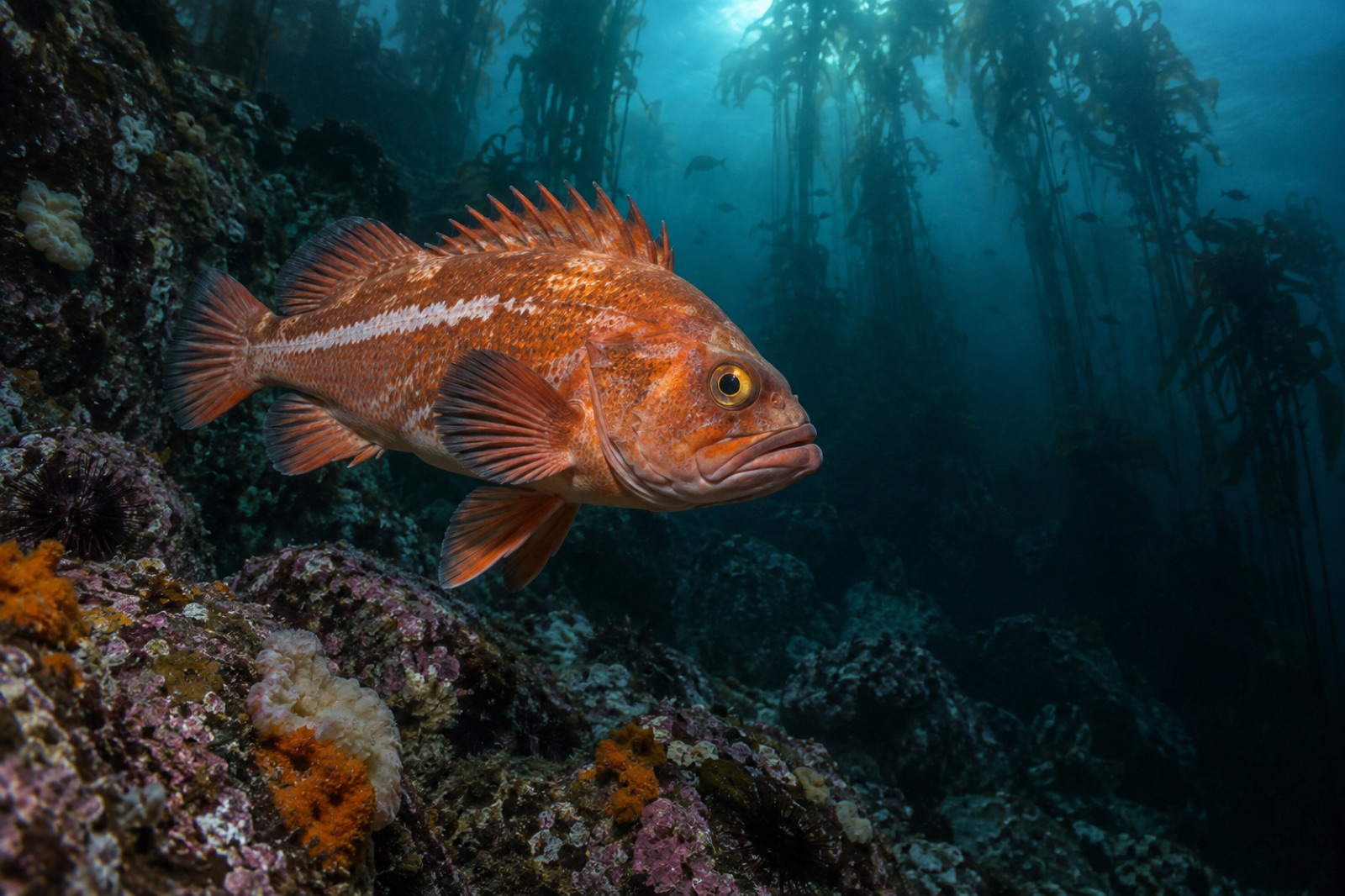
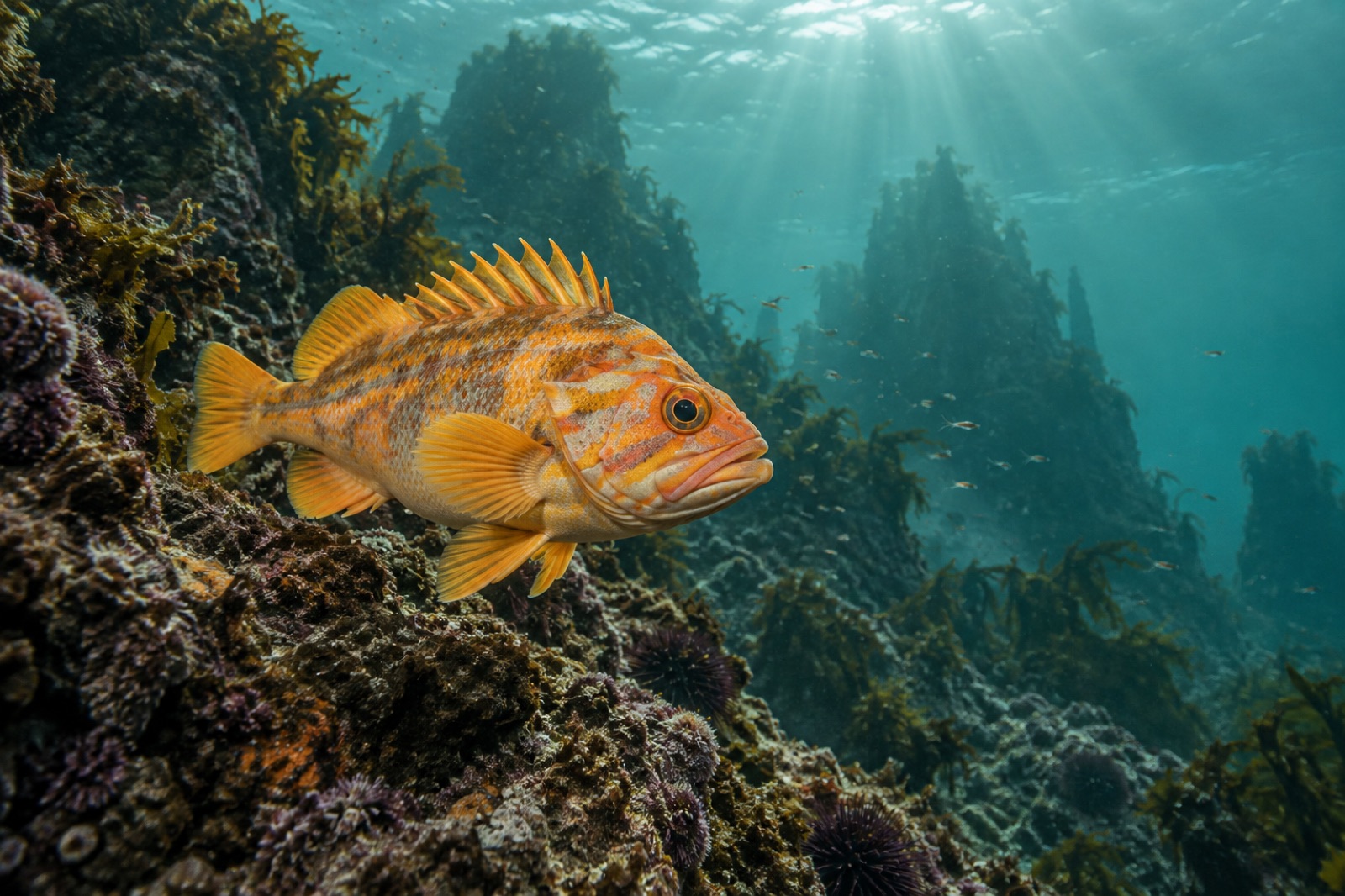
There is a fish cruising a canyon edge off British Columbia right now that may have been released, as a larva smaller than an eyelash, before the First World War. The yelloweye rockfish (Sebastes ruberrimus) is the elder statesman of Pacific coast reefs: a flame-orange perch-shaped fish with a staring yellow eye, a life measured in overlapping human generations, and a fondness for one address so strong that fishery scientists speak of yelloweye 'grounds' the way farmers speak of family orchards. It is also, per pound hauled up, one of the most easily ruined fish populations on the coast — and the species behind the rules, from Puget Sound to the Aleutians, requiring anglers to send every rockfish back down alive. This is its profile: identification, the kelp connection, and the century-long arithmetic of catching a fish older than your grandmother.
Fast facts
|
|
| Scientific name |
Sebastes ruberrimus |
| Group |
Rockfish, family Scorpaenidae — live-bearing scorpionfishes |
| Common names |
Yelloweye; "red snapper" (a misnomer), red rock cod, rasphead, turkey-red |
| Size |
Commonly 50–70 cm; exceptional fish reach about 90 cm and 10 kg |
| Range |
Aleutian Islands and Gulf of Alaska to northern Baja California; most abundant from Southeast Alaska through British Columbia |
| Habitat |
High-relief rocky reef, boulder fields and canyon edges, roughly 50–250 m as an adult; juveniles much shallower, including kelp beds |
| Diet |
Fishes and large crustaceans above the reef — herring, sand lance, smaller rockfish, crabs, shrimp |
| Lifespan |
Validated past 100 years; the oldest aged individuals approached 120 — among the longest-lived fishes on Earth |
Identification: the red fish with the yellow lantern
An adult yelloweye is close to unmissable. Body and head are a clean, vivid orange-red — tomato more than fire-engine — with a paler wash along the belly and an often-visible pale line tracing the lateral line. The fins are rimmed dark to black. Scattered spine-tipped ridges roughen the top of the head (hence "rasphead"). And above it all: the eye, an unambiguous, almost brassy yellow surrounding the pupil — no common coast rockfish shows that particular light.
The confusion set:
- Vermilion rockfish: red, but with dark cross-mottling, a dark eye, and a preference for deeper, softer-edged habitat. Vermilions lack both the yellow eye and the clean pale lateral stripe.
- Canary rockfish: brilliant orange and a genuine lookalike, but canaries carry grey along the lateral line and a mottled grey-green patch on the spinous dorsal; their eyes are dark. In BC and Washington waters, telling yelloweye from canary matters because the rules around them differ by species.
- Juveniles are a different design entirely: young yelloweye are deeper-bodied, almost scarlet, with two crisp white stripes along the flank, and they live shallow enough to be a regular sight for divers — one of the reef's genuine small jewels, especially along Haida Gwaii and the fjords of the BC mainland.
- "Red snapper": a market name that has dogged the species for a century. The true red snapper is a Gulf-and-Atlantic fish; any "Pacific red snapper" on a menu or in a fish market story is, almost always, a yelloweye or one of its red relatives. Names matter here — the fish's reputation was spent down partly by chefs and diners who never knew its true name.
The kelp connection nobody expected from the deep-reef elder
Yelloweye are usually filed under "deep rockfish" — the adults patrol structure from fifty metres down. But the species' life begins, and passes its most dangerous years, in the shallows of the kelp zone. Females release their live larvae in spring; the larvae drift for weeks or months; and when settlement comes, juvenile yelloweye recruit into shallow, high-relief rocky reef draped in kelp, often in water no deeper than 20 metres. The two-striped red juveniles share that nursery acreage with juvenile coppers and quillbacks, sheltering under the canopy's architecture, feeding on small crustaceans at the algae-encrusted rock, and deepening only gradually as they grow toward adult size over a decade or more.
So the ancient fish on the deep pinnacle begins as a kelp forest fish — and that is not trivia. It means the state of the shallow forest gates the state of the deep population. A coast that loses its kelp stands to lose, in slow motion, the next century's worth of yelloweye. Restoration programs that bring canopy back (Tidewright's own illustrative monitoring includes juvenile rockfish occupancy) are, on this evidence, also stocking the deep reefs — a decade early.
One reef, one lifetime, the arithmetic
Now the arithmetic, because everything about conserving this fish follows from it. Yelloweye grow slowly, reach sexual maturity late — males around a dozen years, females often nearer twenty — and are, as adults, profoundly site-attached. Sonic tagging has found individual yelloweye holding home ranges of a few hundred metres around single pinnacles and canyon ledges, year after year, decade after decade. The adult stock of a rocky bank is not a flowing population; it is a membership, recruited at a trickle.
Vintage otolith studies have validated ages past a hundred years. Picture what that means. A 70-centimetre yelloweye that struck a jig off the west coast of Vancouver Island in 1985 might have settled onto that reef as a striped juvenile in 1910, in water over which schooners, not seiners, were running. When it was removed, the reef did not simply lose biomass; it lost an appointment. The vacancy can only be refilled by a larva that has not yet been born, at a rate measured in decades.
This is why the mid-twentieth-century era of hook-and-line and longline "red snapper" fishing, plus trawl bycatch, did so much quiet damage — in Puget Sound and the Georgia Basin, yelloweye were run down to a small fraction of their former abundance, and the distinct population there is listed as threatened under the U.S. Endangered Species Act. Canadian managers ring the best yelloweye grounds with Rockfish Conservation Areas, and many US and Canadian jurisdictions prohibit retaining yelloweye at all in recreational fisheries. Recovery is measured not in seasons but in decades — which the fish, uniquely, has in stock. The marine protected areas that work best for this species work precisely because the fish does not leave: protection a pinnacle receives, a pinnacle keeps.
The barotrauma problem, and the fix that finally worked
For decades the conservation math had a grim skip in it: even where anglers released yelloweye, the fish died anyway. Rockfish carry a closed, gas-filled swim bladder, and hauled up through fifty or a hundred metres of dropping pressure, that gas expands — the bladder balloons, the stomach can be forced into the mouth, the eyes bulge, and the fish arrives at the surface floating on its side, most often destined for a gull. Released rockfish observed at the surface were functionally "fish thrown away slowly."
The fix turned out to be embarrassingly simple: send them back down. Descending devices — weighted clips, grips or cages that return the fish to depth, where the gases recompress and the fish rights itself and swims off — have been repeatedly shown to transform survival for yelloweye and other deep rockfish. Washington made descending devices mandatory aboard saltwater recreational boats; Oregon and Alaska followed; Canadian recreational rule books carry the same instruction. What had been waste became a functioning catch-and-release fishery. If you boat-fish anywhere in the yelloweye's range, a descender is now as basic a piece of kit as a net, and knowing how to use it is part of participating — as we discuss with our fisheries partners designing low-impact harvests around restoration reefs.
Watching for one as a diver
Recreational scuba divers meet yelloweye mostly at the species' shallow edge — the striped juveniles in kelp, and, at dive sites with deeper access off Vancouver Island or the San Juan Islands, an occasional adult hanging like a red aircraft over a wall at sport-diving limits. They are calm, habituated slowly to careful divers, and one of the most photographed rockfish in the Pacific Northwest. The dive etiquette is the standard for slow, site-holding fish: keep your distance, resist handling, and treat the neighbourhood as the fish's home — because for a yelloweye, it is exactly that, possibly for the next fifty years.
Key takeaways
- The yelloweye rockfish is an orange-red, yellow-eyed rockfish of Aleutian-to-Baja reefs, distinguished from vermilions and canaries by the yellow eye, clean flanks, pale lateral line and black-edged fins; juveniles are scarlet with two white stripes.
- It is among the longest-lived fishes known — ages past 100 years — with females maturing near age twenty and adults holding tiny home ranges for decades.
- Juveniles recruit into shallow kelp-covered reefs, making the nearshore forest the nursery of the deep-reef population.
- Twentieth-century fishing, aided by the "red snapper" market and barotrauma-killed discards, collapsed local populations; the Puget Sound/Georgia Basin population is listed as Threatened.
- Descending devices transformed the release problem, and protected pinnacles work unusually well for a fish this site-faithful. The recovery will be measured in decades — which the species, given peace, has.
FAQ
Is the "Pacific red snapper" at the fish market a yelloweye?
Frequently, yes — or another red rockfish. True red snapper is a warm-water, Gulf-and-Atlantic species; on the Pacific coast, "red snapper" historically meant yelloweye and its kin. The misnaming matters because it hid from diners how singular, and how slow-growing, the fish on the plate really was.
How old was the oldest yelloweye ever aged?
Ages validated from otolith growth rings have exceeded one hundred years, with the oldest individuals at the time of their studies approaching roughly 120. Very few other fishes on Earth have documented ages at that scale — yelloweye belong to a small club of century fish.
Why are the rules about releasing them so strict?
Because of barotrauma. Pulled rapidly from depth, a yelloweye's swim bladder expands and the fish cannot submerge; surface releases historically died. Mandatory descending devices solve most of this problem — the fish is returned to depth, the gas recompresses, and survival rates climb dramatically. The rules exist because the fix demonstrably works.
If it's protected in Puget Sound, why is it still caught legally in Alaska?
Status differs by region. The Puget Sound/Georgia Basin distinct population segment was assessed as deeply depleted and federally listed; northern stocks, though watched closely, remain substantially more abundant and are managed under conservative quotas with closed areas. Same fish, very different local pasts.
What would help yelloweye most?
Three things, all underway: keep mandatory descending-device rules and use them well; keep the Rockfish Conservation Areas and no-retention zones on known yelloweye pinnacles; and protect the shallow, kelp-covered nursery reefs where each century-long story begins. Give the reef the time — the fish brings its own.