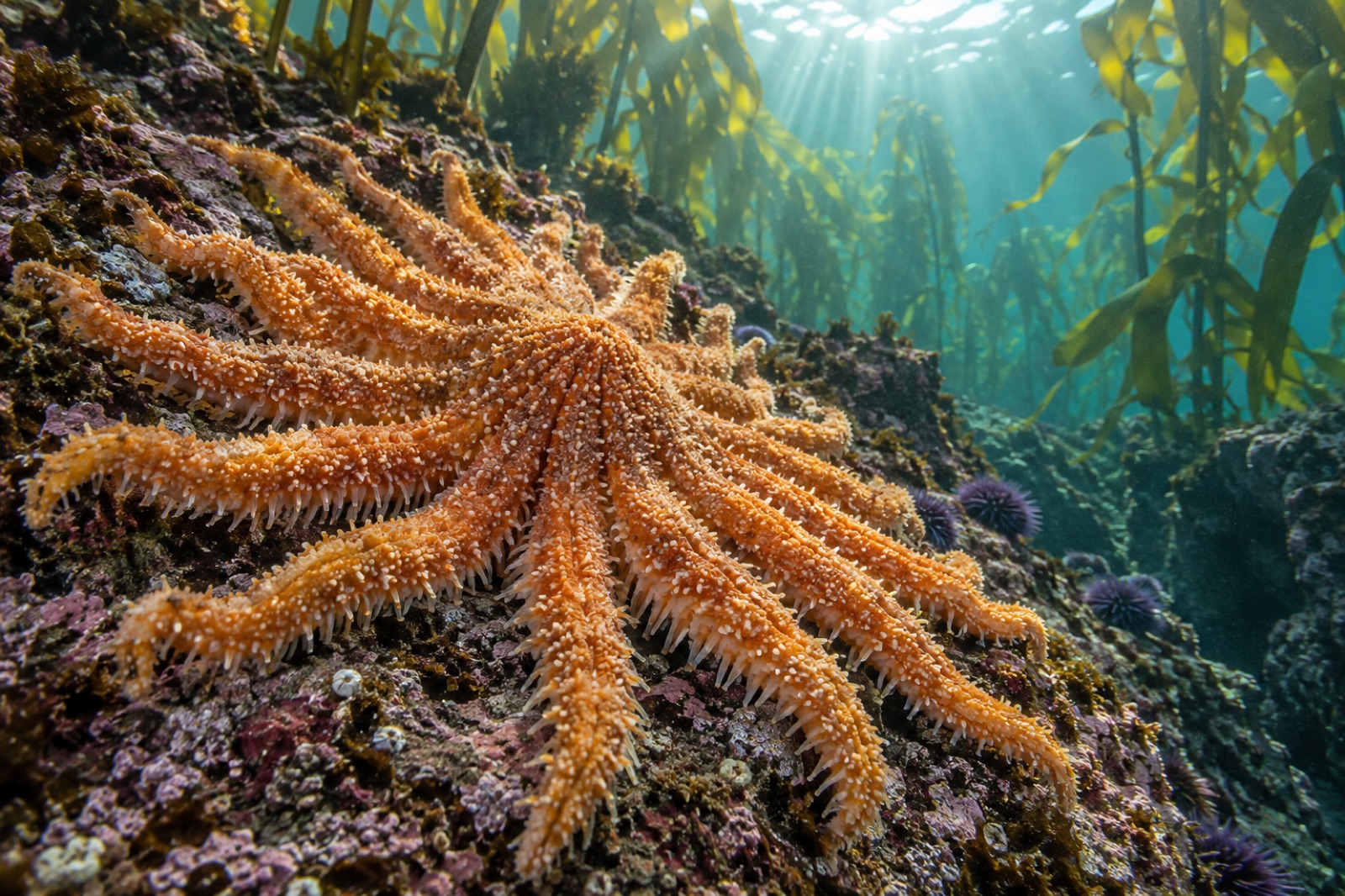
The spiny sun star (Crossaster papposus) is what you get when the ocean takes the plan of a sunflower star and shrinks it into something tougher, rougher and far more widely travelled. It carries eight to sixteen arms — usually around a dozen — a spiny, blunt-textured disc, and a blush of red, coral or rose-pink that has earned it the alternate name "rose star" on Pacific Northwest dive charters. It lives on two oceans at once, from Arctic fjords to the kelp coasts of Alaska and the North Atlantic, and it will eat almost any slow animal it can climb onto, including other sun stars. If you dive cold water anywhere in the Northern Hemisphere, this is one of the sea stars you should know by sight.
How to recognise a spiny sun star
Start with silhouette. A common five-armed starfish has a generous disc with long, tapered arms; Crossaster papposus inverts that. Its disc is broad and low, and its arms are short and stubby — more like the points of a child's drawing of a sun than spokes of a wheel. Most adults span 10 to 25 centimetres, with exceptional animals wider.
Run your eye over the upper surface and the name makes sense: the whole animal is armoured in short, blunt spines and pincer-like pedicellariae, arranged in rough rings that give the surface a shaggy, velvet-over-concrete texture. Colour varies from brick red to salmon pink to cream-blushed rose, often mottled with white.
Confusion species are easy to separate once you know what to check:
- Sunflower star (Pycnopodia helianthoides) — the famous giant of the Pacific coast, with up to two dozen soft, almost floppy arms on an animal that can exceed a metre. The sunflower sea star is bigger, softer and far more famous; the spiny sun star is its stout boreal cousin.
- Blood star and leather star — both five-armed, both smooth enough to look poured rather than built. If it has five arms, it is not a sun star at all.
- Ochre stars and their relatives — chunky, rough-textured and often purple or orange, but always five-armed and lumpier, with a sharply rough surface of white ossicles.
Juvenile sun stars start five-armed and add arms as they grow, so a very small "five-rayed" pink star with a stubby build on an Alaskan or Scandinavian reef may be a Crossaster foundling.
Two oceans, one star
The headline fact about this species is biogeographic: the spiny sun star is amphiboreal — native to both the North Pacific and the North Atlantic, and continuous through the high Arctic between them.
On the Pacific side it runs from the Sea of Japan and the Sea of Okhotsk, through the Bering Sea and Aleutian arc, down the Alaskan coast into British Columbia and Washington, with deep-water records reaching toward California. On the Atlantic side it carpets the same boreal latitudes: the White Sea and the coasts of Norway and Iceland, around Britain and into the North Sea, and on the western side from Greenland and Labrador down into the Gulf of Maine. Northerly populations creep up into the intertidal; further south it drops deeper, and it has been recorded down around a thousand metres — one of the more depth-flexible sea stars known.
A distribution like that is a fossil made of living tissue. Boreal species that now ring the Arctic almost certainly funnelled back and forth through the Bering Strait across the ice ages, diverging in isolated refuges whenever ice closed the door. Our explainer on ice ages and kelp refugia tells the ocean-forest side of that same story: today's cold-temperate communities, from kelp to Crossaster, are ecosystems an ice age sorted.
Life in a cold hurry
Sea stars are not fast, but the spiny sun star is fast by sea-star standards. It drives itself across rock and sediment on hundreds of hydraulic tube feet and can shift visibly during a single dive — several centimetres a minute when it is committed. That pace matters, because its prey list is built on animals that can, in principle, retreat: brittle stars, small urchins, other sea stars, bivalves, barnacles, whelks and anything recently dead. Field observers have watched it chase down smaller Crossaster individuals, making it as close to cannibalistic as sea stars get.
Like all asteroids it feeds with an eversible stomach, pressing the folded sac through its mouth and over its prey to digest externally. A sun star that has engulfed a mussel or a younger urchin can soften and consume animals far too big to swallow.
Two more cold-water talents round out the toolkit:
- Regeneration. Arms lost to crabs and trawl nets regrow over months, and discarded arms may trace a pale comet-tail of regrown disc if the fragment carried part of the central ring.
- Reproduction by broadcast. Gonads colour the arms in season, and males and females release gametes into open water. Larvae spend weeks to months in the plankton — which is one way this species gets between fjords, islands and entire seas.
Where the sun star sits in a kelp forest
The spiny sun star is not a keystone in the classic sense — that honour on temperate reefs belongs to the five-armed ochre sea star, whose mussel-hunting defined the whole concept. Crossaster is better understood as a mesopredator: a middleweight that thins smaller grazers and other echinoderms, scavenges the reef's losses and passes scraps up the line to fish, crabs and octopuses.
Its indirect relevance to kelp is real. The species takes small sea urchins among its prey, and on northern kelp coasts the difference between a grazed-down barren and a standing forest is often the difference between urchins hidden and urchins exposed. Divers on Kodiak's coast describe spiny sun stars working the same rocky margins where young kelps are trying to resettle — one member of a whole cold guild of urchin enemies that includes otter, sheephead analogues, wolf eels and large crabs. No single one of them runs the system. All of them, together, keep the reef's many outcomes possible.
Carcasses also cycle. After storms, sun stars work wrack lines and storm-tossed reefs, cleaning up what the waves loosened. In a kelp forest, nutrients arrived by the blade tend to leave by the stomach of someone scavenging.
Standing in a warming sea
The spiny sun star is not listed as threatened and remains common across much of its vast range. Its deep-water refuge and amphipolar spread are buffers most sea stars do not have. But "broadly safe" is a description that has shifted under cold-water animals before, and two pressures deserve honest attention.
Sea star wasting disease hit Pacific coasts in 2014–2015 and remains episodic. The devastation of the sunflower star was the worst hit, from a global-scale die-off to local absence in years. Crossaster individuals were reported with wasting symptoms in Alaskan and British Columbian surveys, but populations appear to have weathered the epidemic far better than their many-armed cousins — cold tolerance and depth flexibility likely helped. "Less affected" is not "unaffected," and the disease's seasonal returns are watched closely in sun stars now because they are among the few large predators left on some wasting-thinned reefs.
Ocean warming is the slower pressure. A boreal specialist is, by definition, a species at the mercy of its cold ceiling; its southern edges sit between its thermal limits and the warm water moving poleward. Norwegian and Atlantic populations now share fjords with species from further south that did not used to go there, and monitoring programs tracking marine heatwaves treat the fate of boreal asteroids as one of the system's cleanest signals.
Key takeaways
- The spiny sun star (Crossaster papposus) is a boreal, many-armed sea star: stubby 8–13 armed body, spiny mottled-red surface, commonly 10–25 cm across.
- It is amphiboreal — native to both the North Pacific and North Atlantic, linked through the Arctic, from intertidal Arctic rock to depths near a kilometre.
- It is a mid-size opportunistic predator of urchins, brittle stars, other sea stars and molluscs, and a capable scavenger after storms.
- It weathers sea star wasting disease better than the sunflower star but is not immune; warming seas are its widest long-term pressure.
- It contributes to kelp forests indirectly, as one of several urchin predators that keep grazers from running a reef bare.
FAQ
Is the spiny sun star the same as the rose star?
Yes — "rose star" is a common Pacific Northwest and Alaska dive-guide name for Crossaster papposus, referring to its rose-pink colouring. You may also encounter it under its older scientific name, Solaster papposus, in older texts; Crossaster papposus is the accepted name.
How many arms does a spiny sun star have?
Usually eight to thirteen, occasionally up to sixteen. Juveniles start at five and add arms as they grow, so arm count alone is not always reliable — look for the stubby-armed, broad-disc outline plus the spiny texture.
Does the spiny sun star eat kelp?
No. It is a carnivore and scavenger. Its connection to kelp forests is indirect: by eating small sea urchins it is one of many predators that, together, limit grazing pressure on young kelps.
Is the spiny sun star endangered?
It is not listed as threatened and is widespread across both northern oceans. It showed symptoms of sea star wasting disease in some Pacific surveys but declined far less than the sunflower star. The main long-term pressure is ocean warming, which erodes the southern edge of its cold-water range.
Where can divers most reliably see one?
Cold-water reefs from southern Alaska and British Columbia down rarely into Washington in the Pacific, and Norway, Iceland, Scotland and Atlantic Canada in the Atlantic. Look on rocky reef faces, ledges and shell-strewn gravel, generally from just below the intertidal to 30 metres in diving depths.