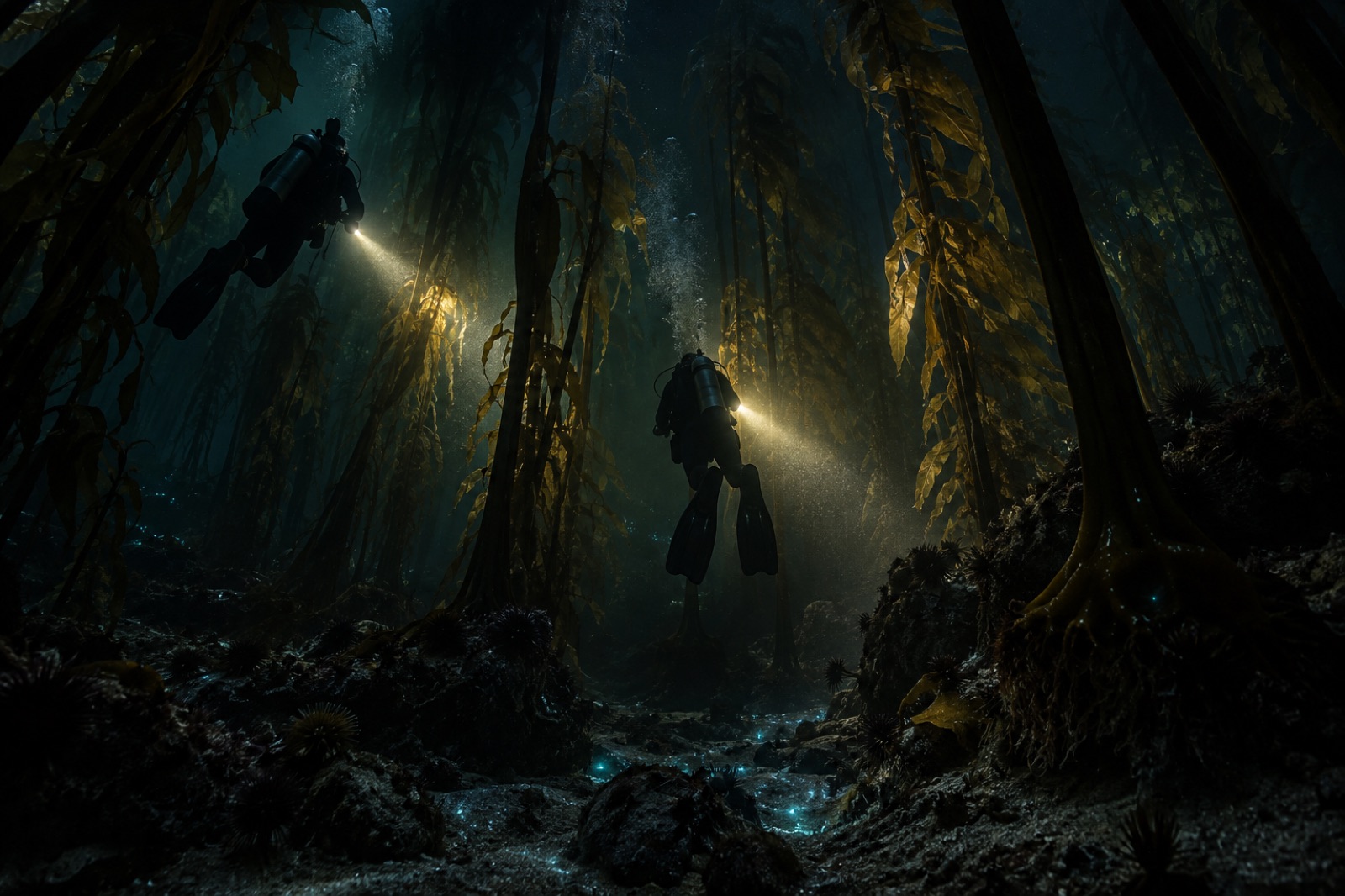
Night divers in the kelp beds of Southern California sometimes hear it before they see anything: a low, resonant thrumming, almost a subwoofer hum, rolling out of the dark reef in pulses. Follow it and you may find its source hovering head-down over a cave mouth — a deep-bodied, charcoal-dark fish with a bass's profile and a faint brassy sheen. You have found the black croaker (Cheilotrema saturnum), the kelp bed's resident drummer and one of the most characterful — and least known — fish of the California nearshore.
Fast facts
|
|
| Scientific name |
Cheilotrema saturnum (Girard, 1858) |
| Group |
Croakers and drums, family Sciaenidae; the genus Cheilotrema holds this one species |
| Maximum length |
About 40 cm; most adults 20–30 cm |
| Habitat |
Rocky reefs, caves and kelp beds; roughly 3–45 m |
| Diet |
Crustaceans, worms and other small benthic invertebrates; small fishes |
| Range |
Monterey Bay (rarely) to central Baja California; common in the Southern California Bight |
| Behaviour |
Daytime cave-loiterer, night-time hunter; produces loud drumming sounds with its swim bladder |
Identification: a bass silhouette in charcoal and brass
The black croaker is unmistakable once you have seen one, and unfindable before you know what to look for. The body is deep and compressed, like an overbuilt surfperch, rising steeply from the snout to a high arch behind the head. The colour is a uniform dark grey-brown to near-black, the scales edged darker still, catching a reddish- or yellowish-brass glow in a dive light. The mouth is small, low-slung and slightly downturned — a bottom-picker's mouth, not a hunter's — and the fins are dusky, with the spiny front dorsal giving the classic perch-like profile.
Two cousins are worth separating it from. The kelp bass is longer-bodied, barred in cream and brown, and owns the kelp midwater by daylight; the giant amongst croaker relatives, the white sea bass, is silver, elongated and pelagic. The black croaker's squat depth, small terminal mouth and sooty, coppery cast set it apart from both — and from every rockfish, whose large eyes and motley patterning look nothing like a croaker's sober uniform.
A behavioural tell is nearly as reliable as colour: black croakers hold position oddly, hanging at an incline or near-vertical near shelter, fins working gently, unhurried. Nothing else in the bed holds its body quite that way.
Range and habitat: a Southern California specialist
This is a fish of one coastline. Its entire world lies between Monterey and the middle of the Baja peninsula, and its heartland is the Southern California Bight and the Channel Islands — the same golden rectangle of kelp beds covered in our Channel Islands and Point Loma guides. Rocky structure is non-negotiable: caves, undercut ledges, boulder fields and man-made relief, all ideally under or beside kelp. Depth is usually shallow — most encounters happen between five and twenty-five metres — but they are recorded to roughly 45.
By day the species is a recluse. Individuals and small loose groups station themselves in cave mouths, beneath ledges and inside recesses, often in communal dark pockets shared with other cave-dwellers. It is among the most reliably "findable in the dark places" fishes on the reef — which is why divers torch-lit into a crevice meet them so often, and why snorkellers over open rock rarely do.
The drummer fish: sound under the kelp
The croaker family takes its name from the noise its members make, and the black croaker honours the family tradition. Like other sciaenids — our acoustic ecologists have written about reef soundscapes in detail — it generates sound by vibrating its swim bladder with specialised sonic muscles, producing the drumming, thrumming chorus that gives these fish their name. Croaker drumming is functional: the sounds are bound up with courtship and spawning aggregation, and with disturbance — a handled black croaker will audibly thump its displeasure.
What makes the species remarkable for divers is that you can experience it. On a night dive, kill your light against your chest, hang neutrally over the reef, and listen. The low pulses carrying through the water are part of the bed's nocturnal soundscape — the same soundscape we profile in Listening to a Kelp Forest — and with a little local knowledge you can home in on a drumming cave. It is one of the very few fish whose voice you can use, like a birder's ear, to find the animal itself.
Night work: what a croaker does after dark
Sunset restructures the kelp forest, and the black croaker is a creature of the second shift — the same dark forest our night-diving guide describes encountering. As light fails, the fish leave their daytime recesses and spread across the reef and its sandy margins to feed. That small, underslung mouth is built for picking: amphipods, shrimps, small crabs, polychaete worms and other invertebrates were taken from the sediment surface and from the algal turf. Occasional small fishes round out the menu.
The day-night choreography matters to the reef. By spending daylight parked in shelters and darkness foraging wide, black croakers shuttle energy between the open feeding grounds and the reef's recesses — and by turning bottom invertebrates into fish flesh they feed the bigger hunters of the kelp forest food web, from large rockfish to sea lions.
The quiet life cycle
Surprisingly little is solidly published about the black croaker's private life, a humbling reminder of how many nearshore species remain unstudied. What is known fits the sciaenid template: they mature over their first few years, spawn across the warmer months — summer into early autumn — and release pelagic eggs and drifting larvae that ride the currents for weeks before the young fish recruit to shallow reef. The drumming that defines the family presumably orchestrates those warm-month aggregations, as it does in better-studied drums and croakers elsewhere.
Lifespan is modest for a reef fish — the species does not appear to be an extreme liver of life on the decades-long rockfish pattern — and the population is local, the whole species pinned to a few hundred kilometres of one coast.
Fisheries standing and conservation notes
Black croakers are not a target of any major fishery. They are taken incidentally in nearshore gillnet, trap and hook-and-line fisheries, and speared occasionally; their day-sheltering habits make them easy marks for a spearfisher who has checked the caves. California's nearshore regulations and the marine protected area network around the Channel Islands and the Bight now shelter portions of their habitat. In short, this is a species whose greatest protection has historically been its obscurity — and obscurity is a weak shield. A fish that comes out only at night on a single coastline is exactly the kind of animal that can slip quietly without anyone holding a number.
That is why we count them. In ecological monitoring on restoration reefs — within our Canopy Ledger biodiversity surveys — croaker presence and night-time activity are useful signals: a bed that hums after dark is a bed with its full cast of characters at work.
Key takeaways
- The black croaker is a deep-bodied, charcoal-and-brass sciaenid found only from about Monterey to central Baja California, centred on the Southern California Bight and Channel Islands.
- It shelters in caves and ledges by day — often hanging oddly, head-down — and spreads over reef and sand to pick invertebrates by night.
- It drums: specialised muscles vibrate the swim bladder, producing the low pulses divers can hear and even use to find the fish.
- It is unfished as a target but taken incidentally; no robust public stock numbers exist, and the species' whole world is one coast.
- Hearing the drumming on a night dive is one of the Southern California kelp bed's signature experiences.
FAQ
Why is it called a croaker?
The whole family Sciaenidae — croakers and drums — is named for the sounds its members make. Specialised muscles vibrate the swim bladder like a drum skin, producing pulses used in courtship, aggregation and alarm. Black croakers drum loudly enough that night divers can hear them from metres away.
Are black croakers dangerous or aggressive?
Neither. They are placid, slow fish with tiny mouths. Divers regularly share cave space with them at close range; the fish's response is generally mild curiosity followed by a slow retreat deeper into shadow.
Where is the best place to see one?
Rocky reefs with caves and ledges in the Southern California Bight — the Channel Islands, Palos Verdes, La Jolla and Point Loma are classic water. Go where kelp meets structure, look into the shade by day, or drift quietly over the bed on a guided night dive.
Can you catch or eat black croaker?
They are occasionally taken incidentally or by anglers and spearfishers, and croakers are a good-eating family generally. But the black croaker is uncommon, slow and poorly studied — there is no directed fishery and we suggest treating it as a look-don't-take species wherever you meet one.
How is it different from a white sea bass?
They are family relations — both sciaenids — but opposites in build and habit. The white sea bass is a big, silver, open-water predator that looms out of the blue beyond the kelp; the black croaker is a small, dark, vertical-hanging cave-dweller of the reef itself. Same family name, two different forests.