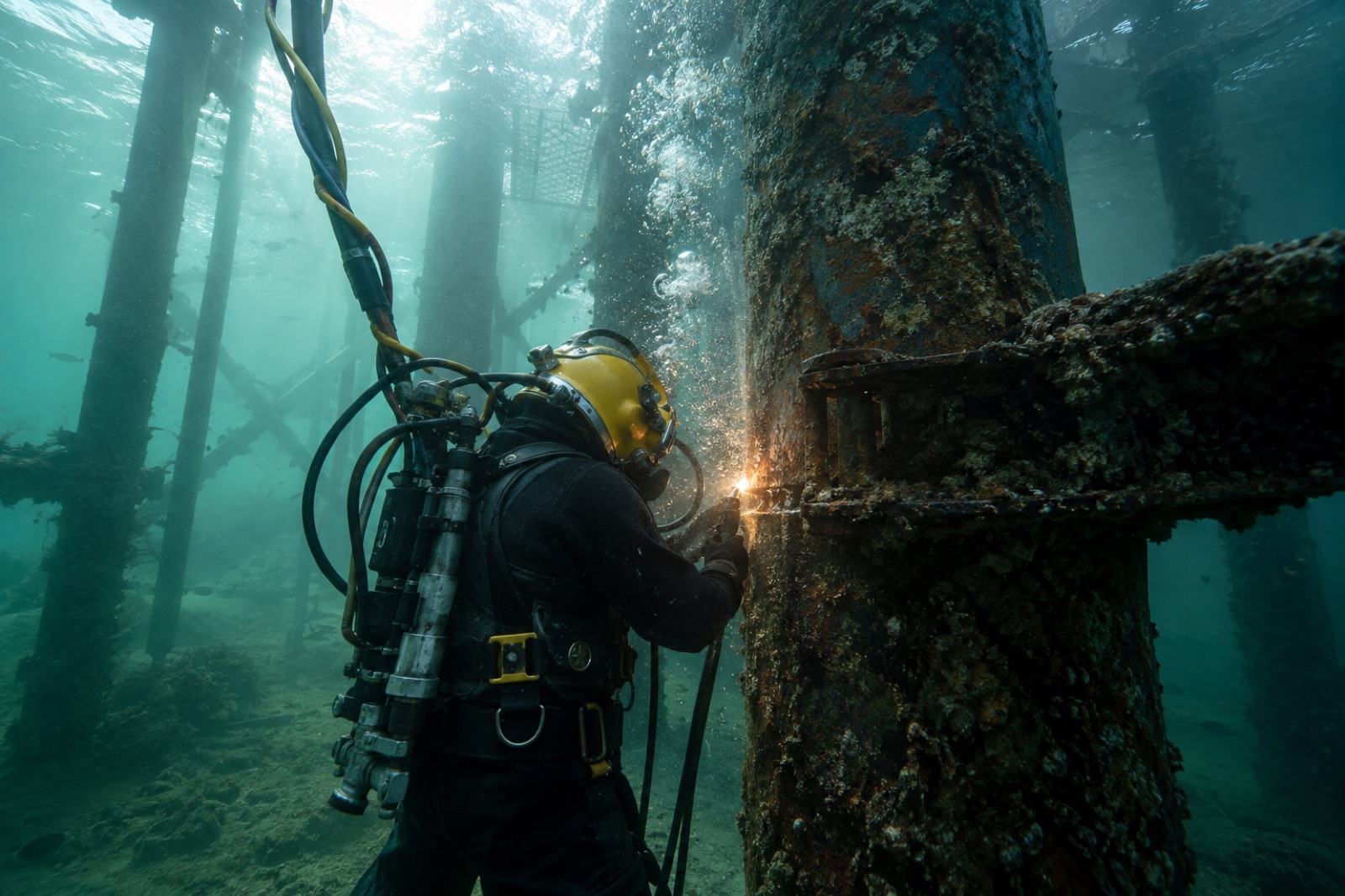
Commercial diving is one of the few ocean careers where a trade ticket, not a university degree, is the price of entry — and where demonstrable skill underwater matters more than credentials on paper. It is also one of the most misunderstood. Recreational divers imagine it as scuba with a salary; in reality it is industrial work performed in a hostile environment, closer in spirit to welding or rigging than to anything you did on holiday in the tropics. Done well, it pays accordingly. This guide lays out the real path: which certifications exist, what the work involves, what it costs to qualify, and where ocean restoration fits into the picture.
What commercial divers actually do
The single biggest adjustment for recreational divers is understanding that commercial diving is work first, diving second. The dive is simply how you get to the job site. Common sectors include:
- Civil construction and marine infrastructure — inspecting, repairing and building wharves, bridge footings, dams, outfalls and intake pipes. Much of this work is in harbours and rivers with near-zero visibility.
- Offshore energy — inspection, repair and maintenance (IRM) of oil, gas and increasingly offshore wind structures. This is the highest-paid end of the industry and where saturation diving lives.
- Salvage — recovering sunken vessels and cargo, often under time pressure and in degraded conditions.
- Aquaculture — mooring installation, net inspection and repair, mortalities removal, and site husbandry for finfish and shellfish farms. This sector employs a large share of working divers in countries like Norway, Scotland, Chile and Australia.
- Seafood harvest diving — abalone, sea urchin and scallop diving under licence, which is its own regulated trade in places like Tasmania and California.
- Scientific and environmental work — a smaller crossover zone, covered in our guide to becoming a scientific diver.
If you love being underwater for its own sake, be honest with yourself: a day of black-water pier inspection is a long way from a kelp forest. The people who thrive are those who enjoy the craft — rigging, burning, concreting, tensioning — with diving as the delivery system.
The tickets: how certification actually works
Unlike recreational diving, where a card from any major agency opens dive shops worldwide, commercial diving is regulated like other hazardous occupations, and the rules differ by country. The main schemes:
- ADAS (Australia) — the Australian Diver Accreditation Scheme issues progressive parts, from Part 1 (restricted occupational scuba) through Part 2 and 3 (surface-supplied diving, diving to 30 and 50 metres) into closed-bell qualifications. ADAS tickets are well regarded internationally.
- DCBC (Canada) — the Diver Certification Board of Canada certifies unrestricted surface-supplied divers, the standard for Canadian waters.
- HSE (United Kingdom) — the Health and Safety Executive approves commercial diving qualifications in categories (scuba, surface-supplied, offshore air, closed bell) tied to the UK Diving at Work Regulations.
- IMCA recognition — the International Marine Contractors Association does not certify divers, but many offshore employers worldwide require training from schools whose courses align with IMCA guidelines. Coming out of an IMCA-recognised school widens where your ticket will be accepted.
A typical entry-level surface-supplied course runs three to five months full-time and costs in the range of a new car — oft-cited ballparks are USD $15,000–$30,000 depending on country and school, plus living expenses. Chambers, compressors, dive stations and offshore-medic instructors are expensive to run; there are no cheap shortcuts, and you should treat discount providers with suspicion. Many schools also require you to already hold (or earn alongside) first-aid, oxygen-administration and in some cases commercial boat-handling certificates.
Career progression continues on the job: air diver to offshore air diver, then, for those who want the deep end of the industry, closed-bell or saturation training — living under pressure in a chamber complex for weeks at a time, transferred to depth in a diving bell. Saturation diving is a small, intensely selective world with commensurate pay.
Does recreational experience count?
Less than you hope, more than nothing. Commercial schools generally do not require advanced recreational certifications — many accept students with an open-water card, and some don't require one at all. The skills that transfer are comfort in the water, breath and buoyancy discipline, and calm under stress. The skills that don't transfer are almost everything else: surface-supplied equipment, umbilical management, communications discipline, task loading, and working to a supervisor's orders through a comms cable.
What genuinely helps: hands-on trade skills (welding, construction, engine maintenance, rope access), small-boat experience, and physical robustness. A recreational rescue diver who can weld is far more employable than a divemaster who can't use a grinder. If you're weighing routes, our overview of blue-economy skills employers actually need shows how employability stacks across ocean sectors.
Pay, conditions and honest expectations
Pay varies enormously by sector and seniority. Inshore construction and aquaculture divers work regular hours for solid trades-level wages. Offshore and saturation divers work rotational rosters — weeks on, weeks off — with daily rates plus depth and saturation bonuses that push experienced hands well into six figures in strong years. The trade-off is time away from home, a physically punishing job, and an industry tied to commodity and infrastructure cycles.
The honest caveats:
- It is hazardous work. Decompression illness, barotrauma, differential-pressure hazards and entanglement are managed risks, not eliminated ones. Safety culture has improved dramatically; it remains a job where complacency is fatal.
- Careers are finite. Many divers transition in their forties into supervision, dive-systems technician roles (maintaining the chambers and panels), hyperbaric medicine support, or training.
- The industry is small. Reputation travels fast. Turning up fit, prepared and humble is a career strategy.
Where restoration fits
Ocean restoration is a growing niche employer of commercial diving skills. Reef construction, mooring installation, marine-debris removal and nursery maintenance all need surface-supplied capability. At Tidewright, for example, our field operations teams (illustrative — Tidewright is a fictional company) use qualified commercial divers for hatchery intake maintenance and Holdfast line deployment checks at restoration sites, working alongside the autonomous survey vessels in our Drifter program. Restoration work rarely pays offshore rates, but divers consistently describe it as the most meaningful work of their careers — building habitat rather than inspecting rust. It's also a sector growing on the back of government coastal programs, as outlined on our solutions for governments page, which is itself funded by exactly the carbon and biodiversity finance that needs divers on the ground.
A realistic 24-month plan
- Get a trade or hands-on skill first — welding, electrical, construction, deck work. This is your employability floor.
- Build water time — recreational diving, club diving, boat handling. You don't need hundreds of logged dives, but you need to know you love cold, dark water.
- Pass a commercial dive medical before spending a cent on training; conditions that end careers are screened out here.
- Pick an accredited school aligned with the scheme of the country you want to work in (ADAS, DCBC, HSE-approved or IMCA-aligned).
- Take the first inshore job you're offered. Aquaculture and civil work build logged hours and professional references faster than waiting for an offshore break. Our jobs board at Tidewright careers is one example of how restoration employers advertise field roles.
Key takeaways
- Commercial diving is industrial work underwater; the dive is transport, not the point.
- Certification is country-specific: ADAS (Australia), DCBC (Canada), HSE-approved (UK), with IMCA-aligned schools giving the best offshore mobility.
- Entry training takes months and costs roughly USD $15,000–$30,000; pass the dive medical first.
- Trade skills (welding, construction, deck work) matter as much as dive hours for employability.
- Offshore and saturation pay is high but rotational and finite; inshore and aquaculture offer steadier lives.
- Restoration and environmental diving is a smaller but growing niche with outsized job satisfaction.
FAQ
Do I need to be an advanced recreational diver before commercial dive school?
Not usually. Most schools require only basic open-water certification, if that, because commercial diving uses different equipment and procedures from recreational scuba. What matters more is demonstrated comfort in the water, physical fitness and — increasingly — trade skills such as welding or construction.
How long are commercial divers' careers?
Physically demanding inshore and offshore careers commonly run fifteen to twenty-five years. Most senior divers transition into supervision, dive-systems maintenance, hyperbaric work or training. Planning your second act early is standard practice, not pessimism.
What's the difference between a commercial diver and a saturation diver?
A commercial (air) diver is deployed from the surface for each dive and decompresses after it. A saturation diver lives under pressure in a chamber complex for rotations of weeks, is transferred to depth daily in a closed bell, and decompresses once at the end. Saturation is used for deep offshore construction and inspection, requires closed-bell training and years of air-diving experience, and pays a substantial premium.
Can I work overseas with my ticket?
Often yes, but check before you train. ADAS, DCBC and HSE qualifications have differing recognition by country and employer, and IMCA-aligned training provides the broadest offshore acceptance. If you already know where you want to work, train under that country's scheme.
Is commercial diving in decline because of ROVs?
Remotely operated vehicles have taken over much routine visual inspection, especially deep offshore. They have not replaced divers for hands-on construction, welding, rigging and complex repair — and they have created adjacent careers (we cover them in ocean-tech careers). The realistic read is: fewer pure-inspection jobs, steady demand for divers who can do things underwater.