Careers11 min read
Becoming a Fisheries Observer: The Hard Job That Keeps Fisheries Honest
Fisheries observers collect the data that quotas, closures and stock science stand on. What the job involves, how to get in, and who it suits.
Jack Callum ·
Marine mammal observers and PAM operators keep industrial noise and whales apart. What the job is, which certifications matter, and how to land contracts.
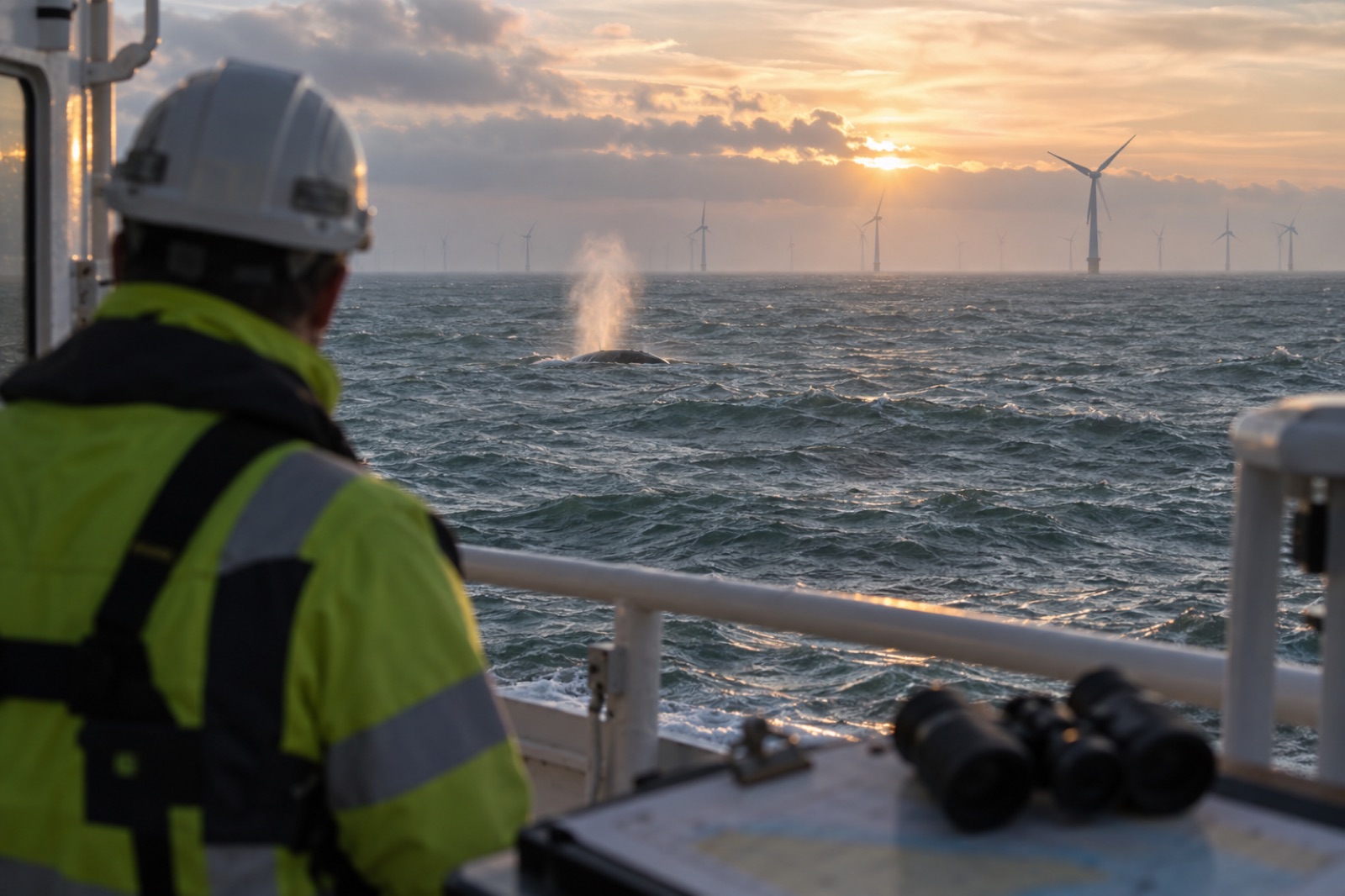
Somewhere off a windy coastline right now, a seismic survey vessel is towing an array of airguns, or a pile-driver is hammering a wind-farm foundation into the seabed. Both make extraordinary underwater noise — and underwater noise is how whales navigate, feed and find each other. Standing on that vessel's bridge wing, binoculars up, is a marine mammal observer (MMO): an independent wildlife professional whose job is to watch the water and, when an animal strays into the danger zone, call the shutdown. It is one of the few jobs where a whale sighting can stop a multi-million-dollar operation in seconds — and where your whole purpose is to keep the ocean's soundscape survivable for its biggest listeners. Here is what the work really involves and how to get onto those decks.
Industrial offshore operations — seismic surveys for oil, gas and carbon-storage geology; pile-driving for offshore wind; some dredging, blasting and naval activities — typically carry permit conditions requiring marine mammal mitigation. MMOs are the people who deliver it:
The job is 95% disciplined watching in conditions ranging from sublime to miserable, and 5% moments of genuine authority. Both parts matter: regulators read your logs, and crews remember whether you were fair, consistent and unshakeable when it counted.
Whales are mostly underwater, and half of every day is dark — so mitigation increasingly relies on passive acoustic monitoring (PAM). PAM operators deploy hydrophone arrays towed behind vessels or moored nearby, and listen (and watch spectrograms) for vocalising animals in real time. Baleen whale calls carry for many kilometres; sperm whale clicks announce a diving animal long after it leaves the surface.
PAM work is more technical than visual observing: you will operate detection software and hardware, distinguish delphinid whistles from propeller cavitation, classify sperm whale click trains, and combine acoustic bearings with visual reports into a single mitigation picture. Many professionals qualify in both MMO and PAM work — the combination roughly doubles your employability, since night-time and poor-visibility operations often legally require acoustic coverage.
MMO and PAM contracts attach to vessels and platforms, which means the lifestyle is maritime: rotations of four to twelve weeks at sea, twelve-hour watches (formal limits usually cap mitigation watching to prevent fatigue), shared cabins, excellent food on good boats and education in patience on bad ones. Projects cluster seasonally — seismic and construction campaigns prefer calmer months — so most observers are freelancers stitching contracts together, with winter often spent on reports, training or other work.
The settings are more varied than the industry image suggests. Beyond seismic and wind construction: naval exercises, harbour developments, controlled decommissioning of old structures, scientific studies using loud sources, and increasingly, environmental baseline monitoring around operations. The people you'll work beside are crews, clients, engineers and occasionally fisheries observers — a related but distinct profession; our guide to fisheries observer careers explains that sibling job.
MMO work is a certification-gated profession, and the requirements depend on jurisdiction:
Beyond tickets, what agencies actually screen for is field credibility: demonstrable wildlife survey experience, species-identification skill (cetaceans by dorsal fin and blow, at distance, in swell), and evidence you can sustain concentration for hours of empty horizon. People arrive from whale-watch guiding, seabird surveying, research vessel work (see working on a research vessel) and graduate research on marine mammals.
The market runs on specialist staffing agencies that supply observers to operators under framework agreements. The honest sequence looks like this:
The work is weather-beaten, the watching can be hypnotically quiet, and you live on other people's schedules. Pay is decent day-rate work rather than wealth; careers plateau unless you move into project management, environmental consulting or senior client-representative roles. Why do it, then? Because it is one of very few jobs where marine mammal protection is not aspirational but operational — where a licence condition, a good observer and a professional crew genuinely keep animals and industry apart, day after day, in real time. If you want closer contact with the ocean's megafauna than any office affords, and you can hold professional standards on day 40 of a grey rotation, few entries into marine conservation are more direct.
No — a degree helps and many observers have one, but regulators require accredited training and offshore tickets, not a specific qualification. Documented wildlife survey experience and strong species-identification skill carry at least as much weight with the agencies who hire you.
Pay is typically a day rate that varies significantly by country, sector and qualification — PAM-qualified observers and those in oil-and-gas settings generally command higher rates than visual-only observers on coastal works. Because work is freelance and seasonal, annual income depends heavily on how many rotations you stitch together.
Both are independent on-board professionals, but different mandates: MMOs watch for marine mammals around specific industrial activities and can trigger mitigation shutdowns; fisheries observers sample catch and bycatch to support stock science and quota compliance. Different certifications, different employers — though the sea legs and independence transfer, and some people do both.
Recruitment peaks ahead of the main construction and survey season for your region — typically spring for summer campaigns. The practical move is to complete training and register with agencies in winter or early spring so your file is compliance-complete when project calls start landing.
Yes. Common progressions include senior observer and client-representative roles, environmental compliance management for operators, consultancy work on marine mammal impact assessment, and research or policy positions where offshore mitigation experience is prized. It is a credible foundation for any career touching marine mammals, acoustics or offshore regulation.
Fisheries observers collect the data that quotas, closures and stock science stand on. What the job involves, how to get in, and who it suits.
Jack Callum ·
Three crews keep an oceanographic ship alive — deck, engine and science. Here's what each actually does, the tickets to get aboard, and the life at sea.
Jack Callum ·
Underwater, sound is the only sense that travels. How sound speed works in seawater, what the SOFAR channel is, and why the ocean is far noisier than it seems.
Dr. Mara Ellison ·