Blue Carbon6 min read
Blue Carbon Policy: NDCs, Article 6 and the Global Framework
How blue carbon fits into the Paris Agreement — NDCs, Article 6 trading, national inventories and coastal-wetland accounting — and where kelp stands.
Priya Raman ·
Which countries actually count, credit and trade blue carbon? A comparative tour of national frameworks, from Australia to Japan, Kenya and beyond.
Blue carbon sounds global — the ocean is, after all — but carbon policy is relentlessly national. Whether a hectare of mangrove, marsh or seagrass can be counted toward a climate target, credited by a government scheme, or traded across a border depends entirely on where the tide meets which flag. Countries diverge on three practical questions: Do they count coastal wetlands in their national greenhouse gas inventory? Is there a domestic route to generate tradable credits? And who actually owns coastal carbon?
This article is a comparative snapshot of where key countries and regions stand, written for councils, developers and buyers who need the lay of the land fast. The global scaffolding — NDCs, Article 6, the IPCC's 2013 Wetlands Supplement — is covered in Blue Carbon Policy: The Global Framework and in our piece on blue carbon in national climate plans; here we tour the regimes themselves. A caveat that matters: policy in this space moves quickly, so treat this as a map of the terrain as of 2026, not legal advice.
Australia is the closest thing the blue carbon world has to a compliance-grade template. Its national crediting scheme (which issues Australian Carbon Credit Units, or ACCUs) includes a government-approved method for tidal restoration of blue carbon ecosystems — introducing tidal flow back to drained or impounded coastal land. That means an eligible coastal project can, in principle, earn government-recognised credits on the same footing as land-sector abatement, rather than floating purely in the voluntary market.
Australia has also invested in the science base — national mapping of coastal wetland carbon and dedicated research programs — and has signalled interest in incorporating coastal wetlands formally into its inventory accounting. The gaps are familiar, though: the method targets tidal wetlands, not kelp; project uptake has been modest relative to the coastline's potential; and coastal tenure involves both states and First Nations agreements, so project pathways vary by jurisdiction.
Verdict: the world's most developed national crediting route, for a specific intervention type, on marsh and mangrove — not yet a full-ecosystem framework.
Japan's approach looks nothing like Australia's, and that is the point. Rather than a compliance market, the Japan Blue Economy Association operates J Blue Credit, a cooperative certification scheme that issues credits for carbon taken up by eelgrass beds, tidal flats — and notably seaweed beds. First issued in the early 2020s, the credits are bought largely by Japanese companies and local governments for voluntary offsetting of events and activities.
J Blue Credit matters disproportionately: it is one of the only functioning schemes in the world that credits seaweed systems at all, and it embeds blue carbon in fisheries-cooperative institutions rather than in a carbon-market bureaucracy. Volumes are small and the accounting is designed for domestic voluntary claims, not export-grade Article 6 trade. But for anyone watching kelp's policy future, Japan is the proof of concept that seaweed crediting can operate at all.
Verdict: small but genuinely pioneering, and the most kelp-inclusive national framework in existence — which highlights how empty that category still is (the kelp policy gap).
The US presents a split personality. On the inventory side it is a leader: the national greenhouse gas inventory has included coastal wetlands using the IPCC wetlands supplement for years, making the US one of relatively few countries that report wetland gains and losses to the UN process — a prerequisite for any future NDC-scale accounting.
On the crediting side there is no federal blue carbon scheme. Cooperating via some compliance markets is limited; practically, American blue carbon activity lives in the voluntary market and in a thicket of state-level experiments, restoration programs and resilience funding that rarely monetise carbon directly. States with large wetland estates — Louisiana most prominently, with its vast land-loss problem — have explored carbon finance for coastal restoration, but the durable model has been public resilience funding with carbon as a bonus, not the engine.
Verdict: strong inventory science and immense physical potential, constrained by the absence of a national crediting pathway and famously tangled coastal property rights. (The tenure tangle is generic, not American — see Who Owns Blue Carbon?.)
Indonesia holds roughly a fifth of the world's mangroves and has made them a centrepiece of national policy: a multi-year mangrove rehabilitation program, a standing moratorium policy on converting mangrove forests, and a national carbon-pricing regulation that creates the legal skeleton for domestic and international trading, including nature-based credits. Blue carbon ecosystems feature in national climate planning, and international partners have queued up accordingly.
The gulf between framework and issuance remains real. Questions that decide projects — how carbon rights attach to customary coastal tenure, how revenue flows to village governments, how national accounting interacts with project-level credits — are being worked through in practice, project by project, including via bilateral arrangements under the Paris Agreement's cooperative mechanisms. The world's largest potential blue carbon supplier is also, unavoidably, the most complicated place to do it.
Verdict: unmatched resource and genuine national commitment; execution and tenure clarity are the frontier.
If you want to see blue carbon crediting that worked, look to the smallest projects. In Colombia, the Vida Manglar initiative in the Ciénaga Grande de Santa Marta region became one of the first mangrove projects credited under a major voluntary standard, developed with local communities and anchored in a river delta that had suffered decades of hypersalinity and mangrove die-off. In Kenya, Mikoko Pamoja at Gazi Bay has sold mangrove carbon credits as a community-run project since the early 2010s — small volumes, but an existence proof that village institutions can run MRV, sell credits and govern the revenue, and a template cited worldwide in community benefit-sharing design.
Neither country built a national blue carbon crediting scheme; rather, their projects succeeded through international voluntary standards. The lesson runs in both directions: national policy helps, but functioning community governance can precede it.
Verdict: proof that community-scale projects can pioneer ahead of national frameworks — in both good ways (working models) and hard ones (no state scaffolding when things go wrong).
The boldest blue carbon promises have come from small island states, whose coastal estates dwarf their land area. Seychelles, in its 2021 NDC, committed to protect half of its seagrass and mangrove ecosystems by 2025 and all of them by 2030 — targets backed by a landmark debt-for-nature swap and marine spatial planning that put large ocean areas under protection. Belize similarly folded mangrove and coastal-marine protection into its updated NDC, pairing it with its own debt conversion for ocean conservation.
These are protection commitments rather than crediting schemes — the credits, where they exist, still flow through voluntary standards. But politically they moved blue carbon from the wings of climate policy to its centre: when a country's headline climate pledge is its seagrass, ministries of finance start paying attention.
Verdict: the world's clearest examples of blue carbon as flagship national climate policy, powered by conservation finance rather than credit markets.
Across every jurisdiction, three absences recur:
Depends on the axis: Australia leads on national crediting infrastructure; the US and Australia on inventory science; Seychelles and Belize on NDC ambition; Japan on seaweed inclusion; Indonesia on sheer resource significance. There is no complete national package yet — a useful warning against any claim that "the policy problem is solved."
In practice, almost nowhere at national scale. Japan's J Blue Credit includes seaweed beds at small volumes; elsewhere, kelp projects work through voluntary project approaches, research partnerships, or credit only the sediment pools around restored reefs — conservatively, as described in Kelp Carbon Baselines.
Yes, under conditions defined by the Paris Agreement's Article 6 — notably "corresponding adjustments" so both countries don't count the same tonne. The design and authorisation machinery is still being built in most countries, which is why most blue carbon trade today happens in the voluntary market regardless of flag.
Usually not. Restoration advances on grants, resilience budgets and voluntary buyers long before compliance frameworks arrive — and projects instrumented properly from day one can retrofit into future schemes. Councils weighing their options can start from our solutions overview for governments, bearing in mind that Tidewright is a fictional company and this site is a design demonstration.
Fast enough that any country summary should be timestamped. Standards bodies revise methodologies, Article 6 operationalisation continues, and kelp science is actively closing the gaps that keep it out of inventories. A snapshot taken in 2026 will need new borders within a few years — which is, for a field this young, entirely good news.
How blue carbon fits into the Paris Agreement — NDCs, Article 6 trading, national inventories and coastal-wetland accounting — and where kelp stands.
Priya Raman ·
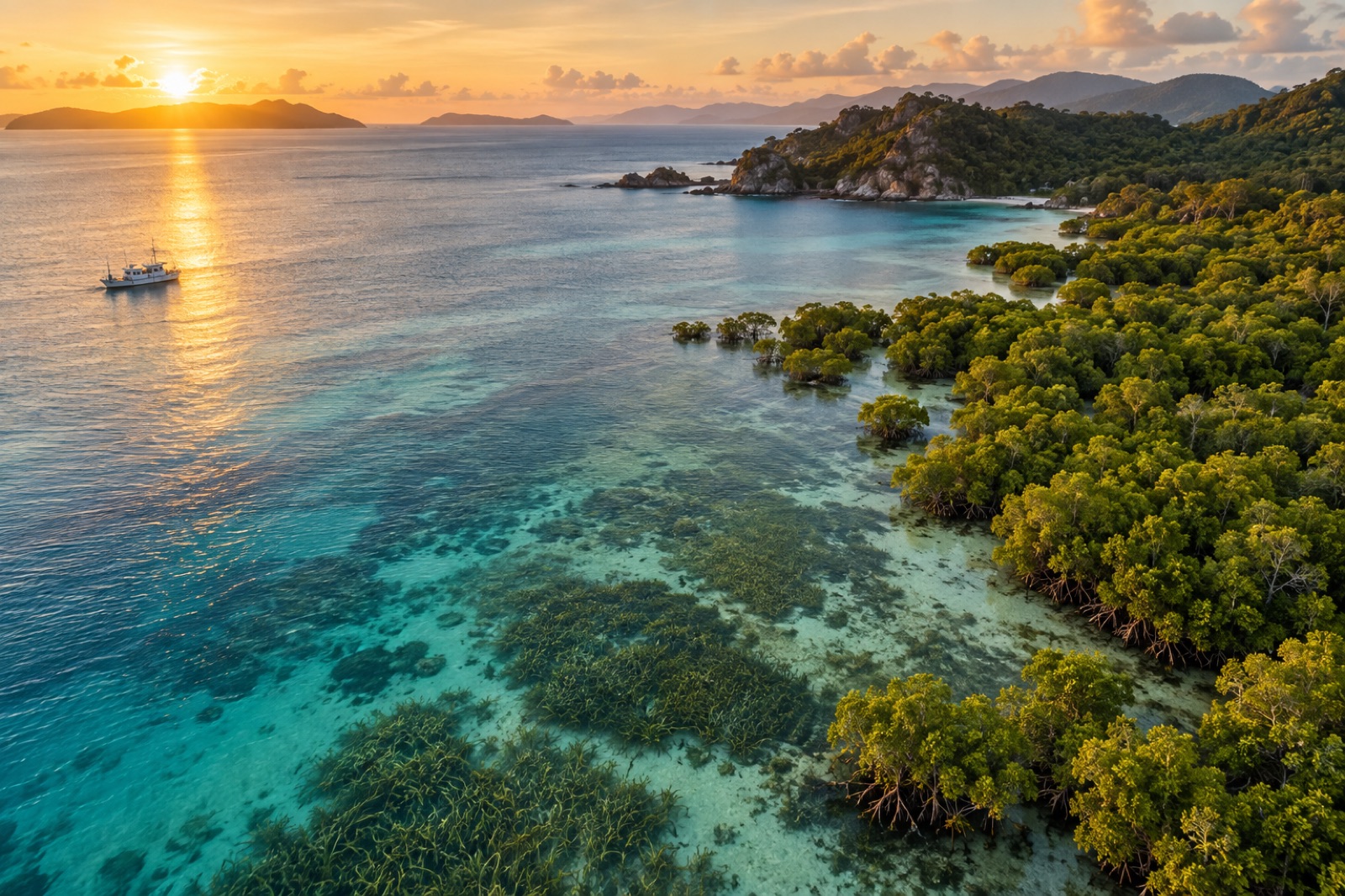
How mangroves, seagrasses, salt marshes — and eventually kelp — enter countries' NDCs, climate targets and national inventories, and why it matters.
Priya Raman ·
Kelp forests fix carbon at extraordinary rates, yet sit outside IPCC inventories and most crediting standards. Here's why — and what would close the gap.
Priya Raman ·