Blue Carbon6 min read
Blue Carbon Policy: NDCs, Article 6 and the Global Framework
How blue carbon fits into the Paris Agreement — NDCs, Article 6 trading, national inventories and coastal-wetland accounting — and where kelp stands.
Priya Raman ·
How mangroves, seagrasses, salt marshes — and eventually kelp — enter countries' NDCs, climate targets and national inventories, and why it matters.
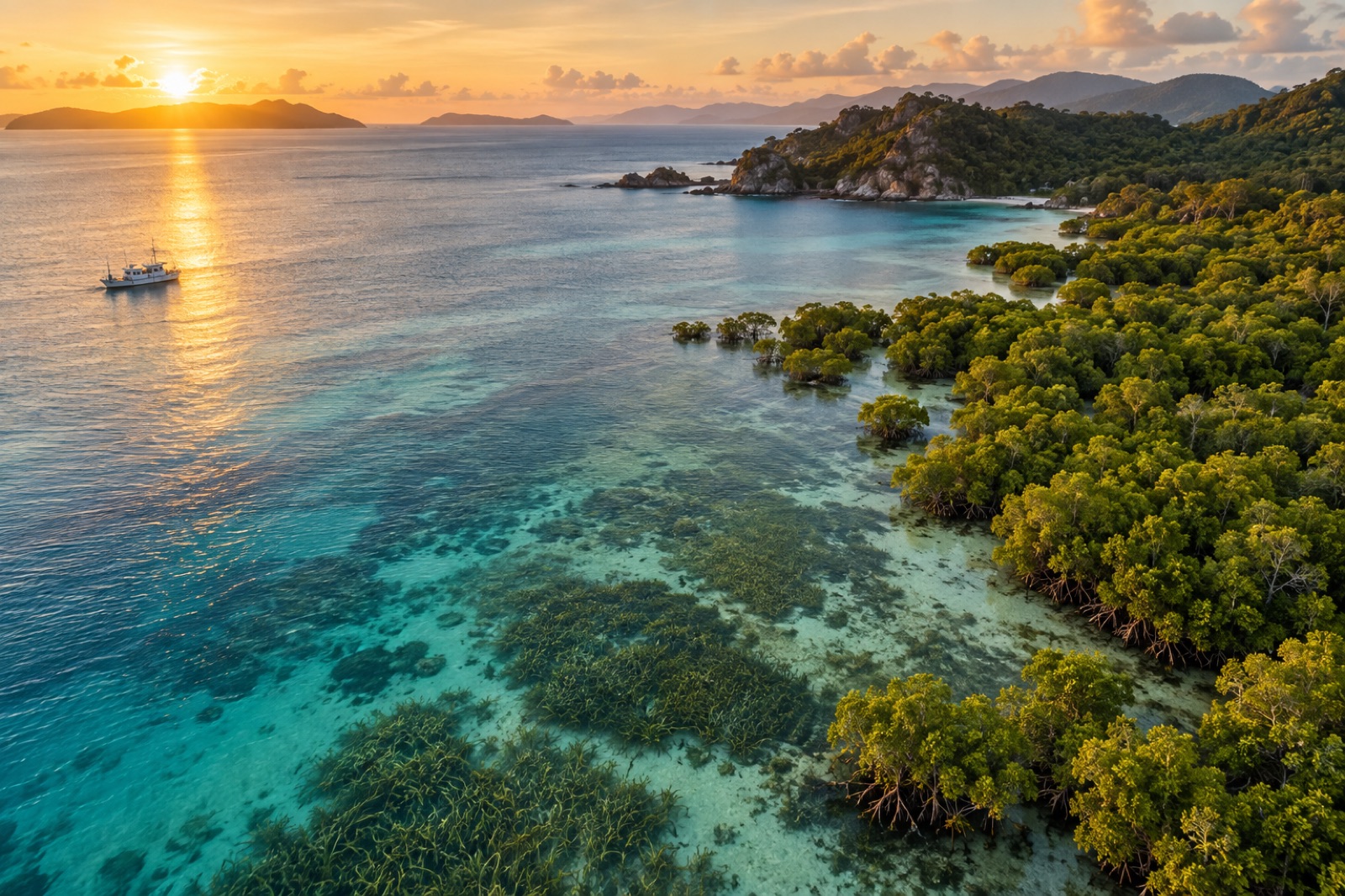
When a government promises the world it will cut emissions, that promise takes the form of a nationally determined contribution (NDC) under the Paris Agreement — a plan stating what the country will do, by how much, and using which levers. For most of the agreement's first decade, the ocean appeared in those plans mainly as a victim. That is changing: coastal blue carbon ecosystems — mangroves, tidal marshes, seagrasses — are steadily moving from the margins of NDCs into their mitigation and adaptation text, backed by new accounting rules and a growing body of national experiments. This article explains how blue carbon enters NDCs, what the 2013 IPCC Wetlands Supplement made possible, which countries are leading, and why kelp remains outside the frame — for now. For background, see our broader explainers on blue carbon policy and Article 6 and the ocean.
Under the Paris Agreement, each of the 190-plus Parties must submit an NDC roughly every five years, with each successive plan expected to be more ambitious than the last. An NDC typically contains a headline target (usually expressed against a reference year or a business-as-usual scenario), a set of mitigation policies and measures, and — increasingly — adaptation commitments. Unlike the Kyoto Protocol's top-down national targets, NDCs are bottom-up: countries choose their own contributions, and international pressure operates through transparency and the "global stocktake" rather than legal enforcement.
Two properties of NDCs matter for blue carbon:
Before 2014, national greenhouse gas inventories could handle forests, croplands and settlements, but coastal wetlands sat in a methodological grey zone. The IPCC's 2013 Supplement to the 2006 IPCC Guidelines for National Greenhouse Gas Inventories: Wetlands changed that. For the first time, it provided standardized accounting methods for mangroves, tidal marshes and seagrasses — covering emissions from drainage and conversion, removals from revegetation and creation, and the all-important sediment carbon pools where most blue carbon actually lives.
Its significance is hard to overstate. Before the Wetlands Supplement, a country restoring mangroves could mention the activity in its NDC as a policy measure but couldn't rigorously count the carbon benefit toward its target. After the supplement, the carbon could enter the inventory, flow through to the mitigation achievements sections of NDCs and biennial transparency reports, and become a formal, comparable contribution.
An important nuance: adoption is voluntary. The supplements are guidance, not mandates, and countries must choose to incorporate wetland accounting into their inventories. As of the mid-2020s, a growing but still modest number of countries had done so. That choice has become a meaningful signal of blue carbon policy seriousness — a country that adopts the Wetlands Supplement is telling markets, scientists and investors that it intends to count coastal carbon properly.
Three tiers of availability echo through the accounting: Tier 1 approaches use global default emission factors; Tier 2 uses country-specific data; Tier 3 uses detailed modelling and direct measurement. A country's journey from Tier 1 toward Tier 3 for coastal wetlands is, in effect, a journey toward making blue carbon investable — because Tier 3 data is what project developers and carbon markets need to design credible creditable projects within a national accounting frame.
Analyses of the second generation of NDCs (submitted around 2020–2025) show a marked rise in ocean and coastal references. Typical patterns include:
A handful of countries have gone further and made quantitative mitigation commitments explicitly tied to coastal wetlands — putting a number, in tonnes CO₂e, on the contribution these ecosystems will make toward the headline target. This is blue carbon's highest level of policy integration yet: not a footnote, a line item.
Several enabling agreements sit alongside NDCs and reinforce these trends: the Global Mangrove Alliance targets, national blue carbon strategies in countries like Australia and Seychelles, marine spatial planning frameworks that tie conservation to climate commitments, and the various "blue carbon partnerships" that pair donor countries with host countries. None of these create carbon credits on their own, but they build the policy scaffolding within which both compliance and voluntary markets can operate — including Article 6 transactions, which require host-country authorization and corresponding adjustments tied directly to NDC targets.
Kelp forests are conspicuously absent from nearly all NDCs, for a straightforward reason: the IPCC Wetlands Supplement — and national inventory methodologies generally — don't cover them. There is no approved Tier method for accounting for kelp carbon at the national scale, so no country can cleanly include kelp restoration gains in its inventory, and no NDC can formally count them toward its target.
This is the policy gap in its purest form. Kelp forests are among the largest and most productive coastal vegetated habitats on Earth — the Great Southern Reef alone spans more than 8,000 kilometres of Australian coastline — yet from the standpoint of national carbon accounting, they might as well not exist. The exclusion isn't a dismissal of kelp's carbon relevance; it's a reflection of methodological immaturity and unresolved scientific questions, particularly around how much kelp carbon is durably sequestered versus simply recycled in the food web.
Closing this gap requires three things, all in motion:
Until these align, kelp operates in the voluntary carbon market's pilot zone rather than the compliance world's inventory system — which is why platforms like Tidewright's fictional, illustrative Canopy Ledger focus on voluntary market MRV-grade monitoring rather than national accounting integration in the near term. For the broader picture of how blue carbon meets markets, see blue carbon markets explained.
A sceptical reader might ask: if the voluntary market already exists, and blue carbon projects can already sell credits, why does NDC inclusion matter so much? Three reasons:
Scale. National commitments move capital, regulation and public institutions in ways voluntary market demand alone never will. When a coastline's carbon is in the inventory, coastal zoning law, infrastructure planning and budgets begin to notice it.
Legitimacy. Inventory inclusion imposes the discipline of national accounting — conservativeness, transparency, third-party review — on blue carbon numbers, which filters out hype and inflated claims.
Durability. A project backed by a private buyer is exposed to market cycles; a project embedded in a country's NDC adaptation and mitigation strategy has a longer policy half-life, particularly where loss-and-damage and climate finance flows are tied to NDC implementation.
For coastal communities and Indigenous sea-country custodians, NDC inclusion is also a leverage point: it creates a formal forum in which tenure, benefit-sharing and consent — the issues explored in who owns blue carbon and consent before credits — must be negotiated rather than assumed.
Three fronts are worth tracking over the next NDC cycle (2028–2030 submissions):
The pattern of climate policy history suggests these processes feel glacial until they're suddenly fast. Kelp's journey from policy gap to policy inclusion will likely be no different — and the monitoring infrastructure being built today is, in effect, the preparatory work for that moment.
Mentioning blue carbon in an NDC (e.g., "we will restore 10,000 hectares of mangroves") is a policy commitment that signals intent. Counting it means the carbon benefit is included in the national greenhouse gas inventory, formally contributing to measurable progress toward the NDC target. Both matter, but counting is the harder, more consequential step — it requires IPCC-method inventory work and annual reporting, not just aspiration.
Capacity and cost. Implementing wetland accounting requires baseline mapping, monitoring systems and skilled personnel — a burden for smaller nations. Some countries also strategically prioritize sectors where they can more easily demonstrate reductions. International technical and financial support, increasingly available, is steadily lowering these barriers.
Not without a corresponding adjustment. Under Article 6, any credit transferred internationally (including to voluntary buyers, under evolving guidance) must be authorized by the host country and matched by a corresponding adjustment to the host's inventory, so the tonne isn't double-counted. This is the mechanism that makes international blue carbon trade and national accounting compatible rather than conflicting; see double counting explained.
Not yet at the inventory level. Australia, Chile, Norway and the United States have active kelp research programs and strong scientific communities pushing for methodological development, and several voluntary-market pilots operate in these jurisdictions. But as of 2026, no country has incorporated kelp into its national inventory or NDC mitigation accounting — the methodological foundation doesn't yet exist.
For formal inventory counting, effectively yes — it's the IPCC's recognized methodology for coastal wetlands. However, countries can still make policy commitments to protect or restore blue carbon ecosystems without adopting the supplement; the carbon benefits just wouldn't be formally tallied toward the NDC target. Think of the supplement as the bridge between policy intent and accountable numbers.
How blue carbon fits into the Paris Agreement — NDCs, Article 6 trading, national inventories and coastal-wetland accounting — and where kelp stands.
Priya Raman ·
How Article 6 actually works for ocean carbon — ITMO trades, corresponding adjustments, the 6.4 mechanism — and what it changes for blue carbon buyers and coastal nations.
Priya Raman ·
Kelp forests fix carbon at extraordinary rates, yet sit outside IPCC inventories and most crediting standards. Here's why — and what would close the gap.
Priya Raman ·