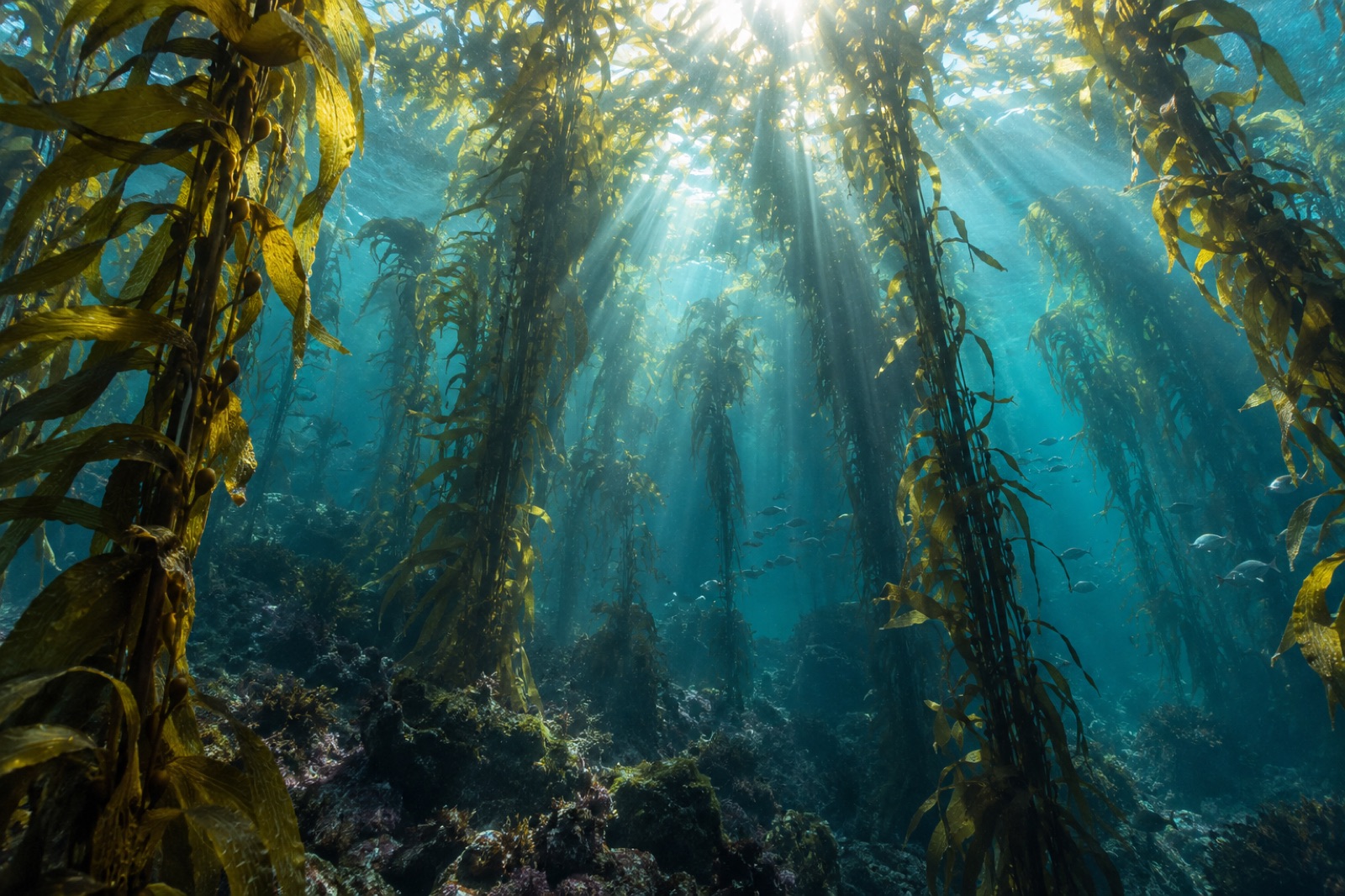
When a marine heatwave strips a kelp forest or a hurricane tears through a mangrove fringe, the ecological loss is immediate and visible. The financial loss arrives later and more quietly: carbon credits sold against that ecosystem's stored carbon suddenly describe a sink that no longer exists. Someone — the project, the registry, the buyer — has to make good the difference.
For years, the carbon market's answer to this problem was almost entirely internal: conservative accounting and shared buffer pools of credits. That machinery still does most of the work, and our explainer on permanence and buffer pools covers it in detail. But a second layer is now emerging from outside the carbon market entirely: the insurance industry. Products that treat stored nature as an insurable asset are young, small and uneven — and they may turn out to be one of the most consequential developments in blue carbon finance. Here is what exists, how it works, and what to watch.
The problem insurers are being asked to solve
Carbon reversal risk has a shape that should interest any underwriter. Most of the time, coastal ecosystems store carbon steadily and boringly. Occasionally, a correlated event — a single marine heatwave, one hurricane season — hits dozens of projects at once. Add the fact that these events are becoming more frequent and more intense as ocean heat content rises (our decade review of marine heatwaves walks through the records), and you have a classic insurance problem with a twist: the underlying risk is well-enough observed to price, but it is trending upward in ways historical data alone will understate.
Buffer pools absorb routine, project-level losses well. What they struggle with is the catastrophic, correlated tail — the scenario where the pool itself is drawn down by many simultaneous claims. That is precisely the slice of risk commercial insurance exists to carry.
The product landscape
Four product families now sit between a blue carbon project and its worst year.
Credit-replacement insurance
The most direct product: a policy that pays out in carbon credits, or in cash equal to their replacement cost, when a verified reversal occurs. If a storm releases credited sediment carbon from a salt marsh, the insurer's obligation is to make the buyer's claim whole — effectively outsourcing the buffer pool's job, or supplementing it, to a balance-sheet-strong third party.
The appeal is that risk evaluation moves to an institution whose entire business is pricing rare, costly events. A small cohort of specialist insurers and managing general agents now write this kind of cover for nature-based projects, usually layered on top of rather than instead of registry buffer pools. The limitation is scale: capacity is thin, deductibles can be high, and most policies cover only defined perils (fire, storm, named events) rather than slow ecological decline.
Parametric insurance for ecosystems
Traditional indemnity insurance pays after a loss is measured and agreed — a slow process poorly suited to an ecosystem that needs intervention within days. Parametric insurance pays out automatically when a pre-agreed physical trigger is crossed: wind speed at a location, wave height at a buoy, sea-surface temperature anomaly over a reef, regardless of the final damage assessment.
The landmark real-world example comes from the Mexican Caribbean. In 2019, the state of Quintana Roo established a parametric insurance policy covering a stretch of the Mesoamerican Reef and its beaches, funded through a coastal tourism trust. When Hurricane Delta passed over the reef in October 2020 and crossed the agreed wind-speed trigger, the policy paid out — and the money funded trained "reef brigades" who reattached broken coral fragments and cleared debris in the days after the storm. The logic transfers directly to kelp and seagrass: a payout triggered by a heatwave threshold could fund urchin culls, spore reseeding or canopy survey work while recovery is still possible.
Catastrophe bonds and insurance-linked securities
At the largest scale, catastrophe ("cat") bonds transfer defined natural-disaster risk to capital-market investors, who earn a yield and lose some or all of their principal if the trigger event occurs. Long used for hurricane and earthquake cover, reef- and coast-linked cat bonds have been discussed and piloted in conservation finance. Their relevance to carbon is indirect but real: a project whose physical asset is protected by a cat bond can credibly promise faster post-storm restoration, which strengthens every durability claim it makes.
Mutual risk pools and resilience trusts
Not all insurance is commercial. Coastal nations, trust funds and project coalitions have begun pooling premium dollars and conservation levies into mutual funds that self-insure against defined events — the Quintana Roo trust is partly this. The structure matters because the fund outlives any single policy year and can also pay for the monitoring that both ecology and underwriting depend on.
How insurers actually price nature
Pricing is where the whole edifice stands or falls, and it is far more data-hungry than traditional property insurance. Underwriters entering this space typically need, at minimum:
- A hazard record. Decades of sea-surface temperature, storm tracks, wave height and heatwave frequency at the site — the raw material for return-period estimates of each peril.
- An exposure map. Exactly where the credited carbon sits: canopy extent, sediment depth, geomorphology with elevation relative to sea level. Satellite and drone canopy mapping — the machinery described in our guide to measuring kelp carbon at sea — is the difference between an insurable asset and an unquantifiable hope.
- A vulnerability model. What a given event does to the carbon: how much standing biomass a category-3 storm typically strips, how much sediment carbon erosion mobilizes, how fast a restored forest regrows.
- A monitoring commitment. Payouts on measured losses require trusted, continuing measurement — which makes insurance one more reason that rigorous MRV is not overhead but the product.
This is the quiet synergy worth noticing: every sensor, survey and canopy map a serious project buys for verification is also the actuarial foundation of its insurability. Monitoring is the premium-discount mechanism.
For buyers and project developers: the questions that matter
Insurance can be substance or theatre, and the difference lives in the policy schedule. Five questions separate the two:
- What exactly triggers a payout? Measured loss, named perils, or a physical trigger — and who measures, against what baseline?
- What does the payout consist of? Replacement credits of what quality and vintage, or cash — and is cash capped below replacement cost?
- What sits on top of the buffer pool? Cover that duplicates registry buffers adds little; cover for correlated catastrophe risk adds a lot.
- What is excluded? Slow decline from warming, pollution events, management failure — the exclusions list is where the real risk allocation hides.
- Who pays if the insurer's model is wrong? Climate trends make historical loss data a floor, not a ceiling.
Key takeaways
- Buffer pools handle routine project-level reversals; commercial insurance is emerging to carry the correlated, catastrophic tail risk they cannot.
- Four product families exist today: credit-replacement cover, parametric ecosystem insurance, catastrophe bonds, and mutual risk pools — each covering a different slice of the risk spectrum.
- The Quintana Roo reef policy showed parametric nature insurance working end to end: pre-agreed trigger, automatic payout after Hurricane Delta, reef repair funded within days.
- Insurability is built from the same data as credible carbon accounting — hazard records, exposure maps, monitoring — so rigorous MRV lowers both verification risk and premiums.
- Policies must be read at the schedule level: triggers, payout form, caps and exclusions determine whether insurance is genuine risk transfer or a marketing layer.
FAQ
Is carbon credit insurance regulated like normal insurance?
Generally yes when written by licensed insurers — the policy is a standard (if novel) insurance contract under the jurisdiction's insurance law. But products sold by non-insurance intermediaries, or embedded in credit contracts without a licensed carrier, may carry no regulatory protection. Buyers should ask who the risk-bearing entity actually is.
Does insurance replace buffer pools?
No — current products complement them. Registry buffer pools remain the default mechanism for crediting programs; commercial cover typically layers catastrophe protection or buyer-side guarantees on top. Any project claiming insurance makes its buffer pool unnecessary deserves close scrutiny of the exclusions.
Can slow decline from ocean warming be insured?
Barely, and this is the hardest honest answer in the field. Insurance is designed for sudden, definable events. Gradual loss of kelp canopy to chronic warming is more often handled through conservative crediting, shorter crediting periods and adaptive management than through insurance, because a foreseeable trend is not an insurable "accident."
What does a parametric trigger look like for a kelp forest?
No product is yet standard, but the candidates are physical: sustained sea-surface temperature anomalies above a thermal threshold at the site, significant wave height exceeding a storm benchmark, or satellite-observed canopy loss beyond an agreed percentage. The kelp-specific version of the reef model would pay out to fund rapid reseeding and grazer management.
Who pays the premium?
Structures vary. Project developers often pay from the credit margin; buyers of premium credits may indirectly fund cover through higher prices; and conservation trusts or public agencies sometimes pay premiums as a stewardship cost, as in the Quintana Roo model where tourism levies funded the policy.