Kitchen7 min read
Preparing Fresh Kelp: From Slippery Blade to Dinner-Ready
Fresh kelp is easier than it looks. How to clean, blanch, cut and store fresh kelp — plus the trick that turns it emerald green and tender.
Sofia Andersson ·
Fresh sugar kelp loves live fire. How to marinate kelp blades and stipes, control grill heat, and get charred edges without rubber — three marinades, one method.
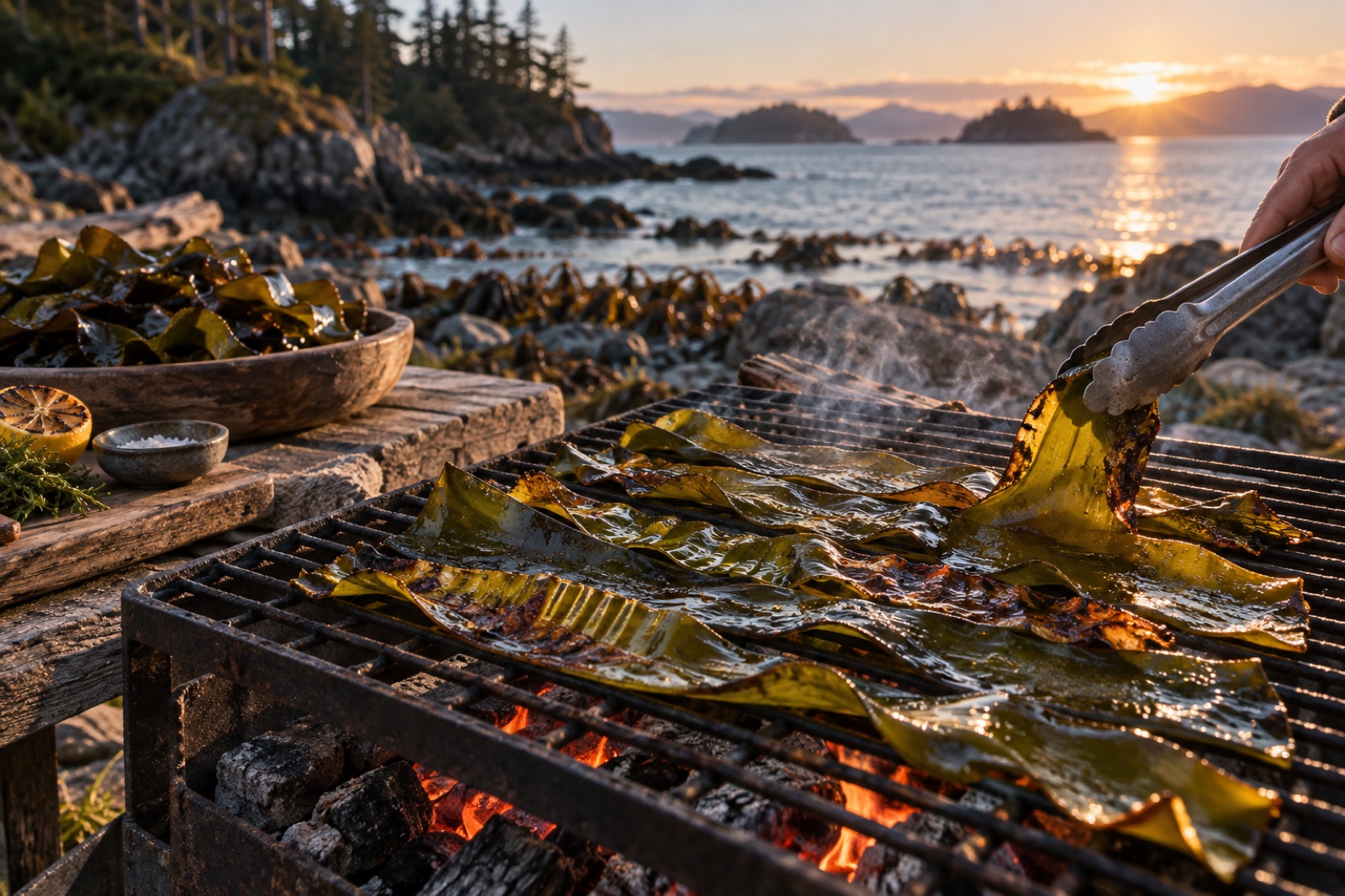
Somewhere between the second and third summer of cooking with fresh kelp, most cooks discover that it grills. Really grills — chars at the edges, keeps a green snap in the middle, takes smoke like it was designed for it, and emerges from ninety seconds over coals tasting like the ocean's answer to grilled asparagus. Sugar kelp especially: its long, thin blades sit flat on a grill grate, and its natural mannitol sweetness literally caramelises.
Grilled kelp is also the easiest impressive thing you will cook all summer, once you absorb three facts: fresh kelp loves a short marinade but hates a long one, it cooks in seconds rather than minutes, and the blade and the stipe want different heat. This guide gives you the prep, three marinades that each do a different job, and the grill choreography that puts char on the edges without rubber in the middle. If you're starting from a whole fresh plant, do your cleaning and trimming first with preparing fresh kelp — this article begins at the cutting board.
Two bits of kelp chemistry do the work. First, sugar kelp (Saccharina latissima) is thin — the blade runs one to a few millimetres thick — so heat passes through before waterlogging can set in, and the surface dries fast enough to char rather than steam. Second, its flavour compounds are largely heat-stable glutamates and sugars, so live fire adds smoke and caramel notes without cooking the marine character away. What you get off the grill is recognisably kelp, intensified.
The species note matters: sugar kelp is the grilling kelp. Bull kelp blades are too thick and blister-prone; alaria (winged kelp) grills well but is tougher and wants a blanch first; dulse is better in a hot dry pan. If your fishmonger or farmers' market has "fresh kelp" without a species name in midsummer, it's almost always sugar kelp — the season and source guide is in buying fresh kelp seasonally. Restoration-adjacent farms like Tidewright Harvest grow it on lines through winter specifically for this early-summer window.
Choose your cuts. From one sugar kelp plant you get three grilling cuts: the wide middle blade (the prime cut — flat, even, tender), the ruffled blade edges (crispest, chars fastest), and the stipe (the stem — meaty, dense, a different ingredient entirely). Split the plant accordingly. Nothing on a kelp plant is waste, but don't force the stipe to cook on the blade's schedule.
Rinse briefly and dry thoroughly. A fast cold rinse to clear surface grit, then a serious towel-dry. Wet kelp steams on the grill; dry kelp chars. This single step separates the people who say "grilled kelp is amazing" from the people who say "it went floppy."
Score thick blades. Any blade section noticeably thicker than a coin gets a shallow crosshatch, three millimetres deep, on both sides. It speeds marinade penetration and, more importantly, keeps the blade flat on the grate instead of curling into itself.
Pre-blanch the stipe. The stipe needs a 60-second blanch in boiling water plus an ice shock before it ever sees marinade. That softens its structure from crunchy-woody to al dente, and it will pick up a little colour on the grill for finish rather than needing the grill to actually cook it.
Kelp carries a light surface marine salinity and a firm coating of glutamates; a marinade's job is not to mask anything but to layer. All three recipes below marinate 500 g of prepped kelp and follow one timing rule — 15 to 30 minutes, never overnight. Kelp's surface is already seasoned; long marinades in acid or salt turn the outer millimetre mushy while the interior stays plain. Short and frequent beats long and once.
Whisk: 3 tbsp white miso, 2 tbsp maple syrup, 1 tbsp rice vinegar, 1 tbsp neutral oil, 1 tsp grated ginger, 1 small grated garlic clove. This is the marinade that turns kelp into a centrepiece — the sugars char into a dark, glossy lacquer and the miso doubles down on kelp's own umami. Grill hot and fast; the sugars scorch if you wander off. Serve over rice, or slice onto grilled bread.
Whisk: 3 tbsp light soy sauce, zest and juice of one lemon, 1 tbsp toasted sesame oil, 1 tsp honey, chilli flakes to courage. The acid stays largely on the surface in a short marinade, so you get brightness without the mush risk — this is the one for a mixed grill platter, where the kelp will sit next to fish and vegetables and needs to lift them. Scatter with toasted sesame off the grill.
Melt 60 g butter, cook to nut-brown, cool slightly, and whisk in 1 tbsp sherry vinegar and a crushed garlic clove; finish with a handful of chopped soft herbs (parsley, chives, a little dill). The least expected of the three and the one that converts kelp sceptics — brown butter's hazelnut warmth wraps the marine flavour in something familiar. Because butter firms as it cools, brush on a second coat in the last thirty seconds of grilling.
Heat: hot, clean, oiled. You want the grill at the temperature where you can hold your hand above it for two seconds, not three. Clean the grate and oil it twice (folded towel, tongs, patience); kelp's surface proteins stick hard to a dirty grate.
Blades go down flat, and they go fast. Lay blades perpendicular to the bars so thin ruffled edges can't slip through. Thirty to forty-five seconds per side is the honest range — you're looking for dark charring at the edges, slight translucence in the middle, and a blade that just begins to firm. Two minutes is overcooked; three is rubber. This is the fastest-cooking thing you will ever grill.
Stipes take the medium zone. Blanched stipe sections, cut into finger lengths, want three to four minutes over medium heat, rolled a quarter-turn at a time, until they pick up even colour. They're done when a skewer slides in with the resistance of a cooked carrot.
Season after, not before. A finish of flaky salt (or seaweed salt, for full circle), the fresh acid of a lemon wedge, and the herb garnish all belong off the heat. Salt ahead of the grill pulls moisture to the surface and fights the char.
Rubbery blades. Overcooking, always in the too-long rather than too-hot direction. Kelp firms as collagen-analogues in its cell walls set; firmer is not tenderer here. Cook to the translucence cue, not to a timer you set and forgot.
Pale, steamed kelp. The blade went on wet, the grill wasn't hot enough, or — the third cause — you marinated in something watery and didn't re-dry the surface. After a wet marinade, pat the kelp almost-dry; the marinade's flavour is already on it, and dry surface is what chars.
Bitter edges. Burnt sugars, usually from the miso-maple. Marinate shorter, grill hotter and faster, and accept a darker but not blackened finish.
Bland interior. The blade was thick and unscored, or the marinade was too short on a dense stipe. Score, and remember the stipe's blanch-first rule.
Grilled kelp is a supporting actor that briefly steals the scene. It sits naturally beside anything already on the grill: fish (or go further and wrap the fish in kelp, where the blade becomes both seasoning and foil), prawns, halloumi, corn. Chopped over a potato salad it turns the whole bowl coastal. Sliced thin and crisped a moment longer, it flirts with kelp chip territory. And leftover grilled kelp, chopped fine, makes an argument for tomorrow's fried rice that you will lose happily.
The bigger picture is a nice one: every kelp strand on a grill is a vote for the cleanest crop on earth — no fresh water, no fertiliser, no land, and farms that double as habitat. That's the entire premise behind restoration-adjacent harvest, and it's reason enough to make this the summer you learn to grill the sea.
You can, and it works better than you'd expect after a short 5-minute soak and a very thorough drying — the texture is slightly less snappy than fresh but the char and smoke are all there. Marinate after drying, and grill a touch faster. It's the practical answer for anyone inland, since rehydrated kelp is the only fresh-ish kelp most of the world can get.
Species and water quality are the two questions. Sugar kelp is easily identified — a single long thin blade with ruffled edges and no midrib — but foraging rules, pollution near urban shorelines, and the absolute rule of never cutting the holdfast all apply. Read our seaweed foraging guide before putting anything self-gathered on the grill, and when in doubt, buy farmed: traceable water, traceable season.
Sugar kelp sits in the moderate band of the kelp family — substantially less iodine-dense than kombu-class kelps, though more than wakame or nori. A 50 g serving of fresh sugar kelp fits comfortably in most people's weekly iodine budget; anyone with a thyroid condition should check with their clinician and start with the numbers in our iodine and seaweed guide.
Almost always one of three things: the grate wasn't clean, it wasn't oiled, or you tried to turn too early. Kelp releases itself as the surface caramelises — if it resists a thin spatula, it wants ten more seconds. Oil the grate, not just the kelp, and flip only once.
A cast-iron grill pan at full preheat works nearly as well — you lose the smoke but keep the char geometry. Under a broiler, use the highest rack position and watch through the glass; the 45-second-per-side rule still applies and broilers punish distraction. A heavy dry pan, by the way, is also where dulse belongs — it's too small and friable for grill grates.
Lean into the smoke-saline axis: a chilled dry cider, a mineral white (albariño, assyrtiko, muscadet), or — the best answer for the miso-maple marinade — a cold junmai sake. Avoid heavily oaked anything; the kelp's delicacy can't be heard over vanilla.
Fresh kelp is easier than it looks. How to clean, blanch, cut and store fresh kelp — plus the trick that turns it emerald green and tender.
Sofia Andersson ·
A shopper's guide to fresh kelp: when it's in season, how to spot a freshly cut blade, which species suit which dishes, and how to store it at home.
Sofia Andersson ·
Wrapping fish in fresh kelp blades steams it gently, seasons it from the outside and makes the most dramatic plate on a coastal table. The full technique.
Sofia Andersson ·